The Gap Between AI Confidence and AI Readiness



A closer look at Deloitte’s 2026 Consumer Products Industry Global Outlook.
The days of AI skepticism are long behind us, and the promise of AI-powered agents has executives pushing their teams to deploy the technology across disciplines.
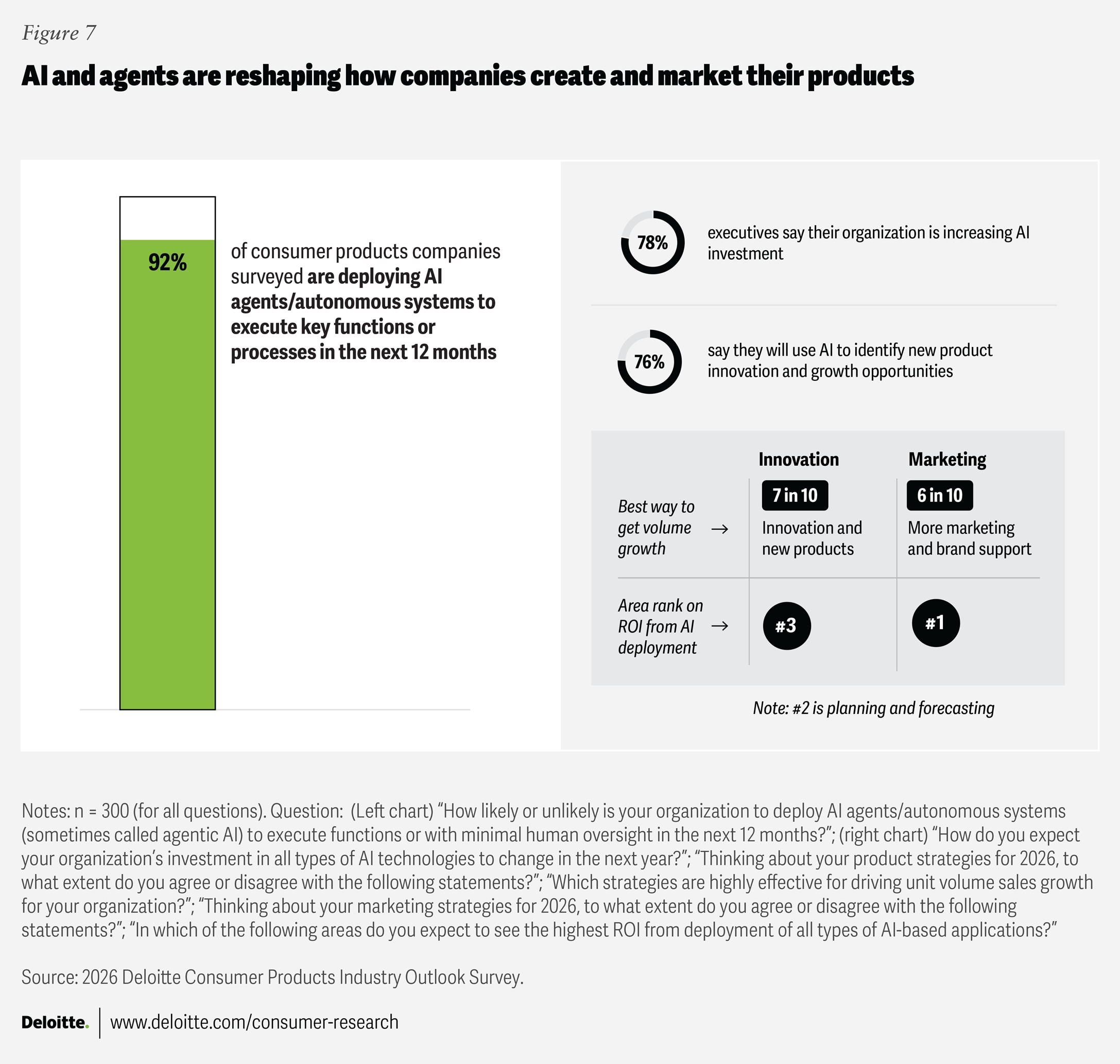
A recent Deloitte survey of 300 CPG executives found that over 90% planned to deploy AI agents in the next 12 months and 64% believe they are quicker to embrace agentic AI than the competition. But additional data tells a different story.
LLMs are becoming the new search bar, and consumers are being conditioned to use them to search for products. And yet, according to Deloitte, 31% say they're struggling to reach AI-using consumers. Another 46% don't even have an opinion yet about it.
Executives may believe they're ahead on AI implementation, but their systems and operating models tell a different story.
That gap between having AI and actually using it effectively is worth exploring deeper. Here's what needs to change for AI to deliver at scale.
What Deloitte Gets Right
The biggest takeaway from the report is that AI adoption is no longer experimental. Executives are excited about the promise AI provides and are willing to invest to make it happen. They also know that marketing is among the most important disciplines to be unlocked by AI. Finally, they understand that creative and marketing roles are under pressure to “do more, faster.”
Executives also have outsized expectations. They want the headcount to remain flat while output increases. For most of Corporate America’s history, you needed to hire to grow. The rise of digitalization led to a new army of software engineers. Call centers proliferated and more sophisticated marketing begat programmatic executives and social media. AI threatens to upend that by enhancing worker productivity to a level not seen before.
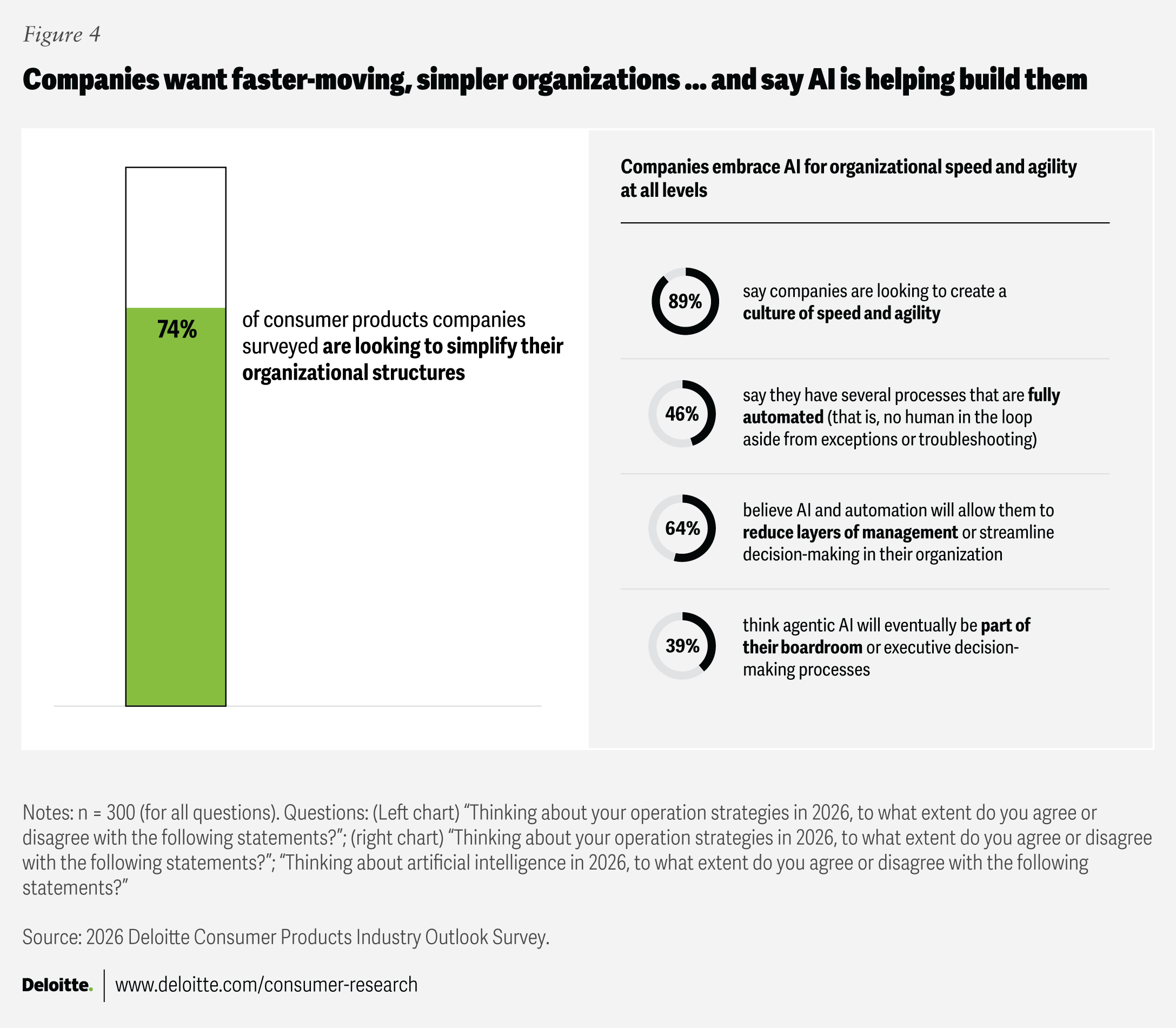
AI is supposed to free product managers from routine production tasks so they can focus on creativity and judgment again.
But it’s not so simple. Companies that deploy agents without the proper system may find themselves hiring expensive AI specialists six months later to manage the chaos they've created. Managing virtual production teams requires a completely different skill set and level of technical precision.
The Missing Layer: From AI Tools to AI Systems
Most companies now have AI tools in play. The question is: what are those tools actually doing together?
A newly created agent can become extremely powerful, but it is likely starting from zero context. Launching several agents without smart orchestration is like can become chaotic. They may get some things done, but likely not what you want to happen.
As such, we need to draw a distinction between AI as assistance and AI as infrastructure. AI as assistance means humans spend their time managing tools, selecting models, retrying prompts, and reviewing outputs. AI as infrastructure means the system handles those decisions, consistently and automatically.
Because merely adopting the technology is only the first step. Scaling it is the issue. This is especially true with marketing, with many professionals expecting AI to make exponential content generation possible. Marketers can now create digital twins of their products across a vast array of situations in different languages, different contexts, different colors, and many more permutations.
The companies that will win must treat content creation as infrastructure. It must exist as a system that produces, adapts, and scales without needing constant adjustments from employees. A company’s content operation has to be as nimble as the rest of the business.
The companies that succeed understand there's a fundamental distinction between AI implementation and AI orchestration. Implementation is buying the tools and turning them on. Orchestration is creating systems where those tools work together intelligently, with proper oversight and continuous optimization.
Content as infrastructure allows you to encode your brand rules, legal constraints, and visual standards into a production system once, ensuring future outputs follow those rules.
Where humans still play a role
If headcount is flat or shrinking and content volume needs to grow, where does that content come from? More tools for fewer people doesn't solve a scale problem. It just makes fewer people busier.
Most companies appreciate the productivity gains AI provides while still wanting humans in control during creative decision-making.That's exactly the right instinct. When a system handles those tasks reliably, the humans who remain can focus on the work that actually requires judgment and taste.
The Reality Check: Having AI vs. Using AI Effectively
The Deloitte data confirms what most marketing executives already feel: AI is no longer optional, and their bosses look to their departments for the greatest lift.
But the companies that pull ahead won't be the ones with the most AI tools or the biggest agent deployments. They'll be the ones that redesigned how content gets made. AI strategy without operating-model change will likely create more work with minimal results. The winners will be the most structurally prepared, not the most AI-enabled. You can read the entire Deloitte report here.
About Grip
As INDG’s software branch, Grip is a visual content configuration engine powered by NVIDIA Omniverse that makes it possible for large enterprises to use AI at scale. It breaks existing content down into configurable modules, allowing brands to swap out any element, including products, talent, accessories, and branding assets, with complete control and accuracy. Grip integrates with existing workflows to automate product swaps and generate endless, hero-quality content variation, without disrupting established content production processes.