AI product photography for enterprise brands


AI product photography is the use of artificial intelligence to create or edit product images without a traditional shoot for every image. It covers everything from replacing the background of an existing photo to generating a complete lifestyle scene around a product, and at enterprise scale it is often combined with 3D digital twins.
Product images carry more weight than most marketing images. Shoppers use them to judge size, colour and finish before they buy, and consumer-protection law treats a misleading product image as a misleading commercial practice, however it was made. Current image models make realistic scenes easy. They are less dependable about the product itself, such as the label, the colour and the exact shape of the pack. This guide compares the ways to create AI product images by where the product in the picture comes from, sets out the 2026 rules, and covers what enterprise brands need from an AI product image generator.
What is AI product photography?
AI product photography tools do five kinds of work, often in one interface:
- Background removal and replacement. The product is cut out of a photo and placed on a clean background or in a generated setting.
- Scene generation. A lifestyle setting, such as a kitchen counter, a beach or a bathroom shelf, is generated around the product.
- Relighting and shadows. Light, shadows and reflections are adjusted so the product sits naturally in its new setting.
- Clean-up and extension. Dust and small defects are removed, and images are upscaled or extended to fit new formats.
- Generation from reference photos. A model learns a product from a few photos and generates new images of it from other angles or in other settings.
Many of the tools that rank for “AI product photography” are built for individual sellers who need a few good images quickly. An enterprise brand needs thousands of images across a portfolio, markets and retailers, and each one has to show the current version of the product correctly. That requirement decides which methods are safe to use.
Why accuracy matters more in product images
A campaign image sells a mood. A product image is closer to evidence, because it shows the shopper what will arrive.
Shoppers use product images that way. In Baymard Institute’s e-commerce usability research, 42% of users tried to judge a product’s size from its images, and users looked at customer photos to check whether a site’s own images were representative. When the image and the product don’t match, returns follow. In a 2024 study by Coresight Research with Nfinite, a software company, 190 brands and retailers in the US and Europe linked inaccurate online images to 11% of their returns. In a 2023 survey commissioned by Cloudinary, 30% of 2,693 consumers in four countries said they had returned an item because it did not look as expected. Returns are costly in their own right. The US National Retail Federation expected 19.3% of online sales in 2025 to be returned.
Academic research points the same way. In a study using a large data set from a European apparel retailer, published in Marketing Science in 2023, Daria Dzyabura and colleagues found that product images available before launch helped predict each item’s return rate. Return rates across the retailer’s products ranged from 13% to 96%.
Plausible is not the same as accurate
An image model generates the most plausible picture for its input. When the input is a text prompt, the product in the picture is the model’s idea of the product, with a bottle of roughly the right shape and a label that looks like a label. That works for a mood board. On a product page the gap is hard to see, because shoppers often can’t tell a generated product from a photographed one. In a 2025 survey of 411 shoppers by the retail software company Stylitics with Aha Studio, 71% said a real photo and an AI-generated image of the same product looked the same or had only small differences, and their trust dropped when details such as buttons or fabric texture looked wrong.
Three details cause most of the trouble:
- Text on the pack. Labels, ingredients, claims and legal marks have to be exact. Image models have improved quickly here, but benchmarks keep finding gaps. In the 2023 TextDiffuser benchmark from Microsoft Research and partners, Stable Diffusion produced almost none of the requested words correctly. A 2025 benchmark, STRICT, found that current proprietary and open models still struggle to produce consistent, legible text, especially longer passages.
- Colour and finish. When Google researchers introduced DreamBooth in 2022, a method that teaches a model a specific subject from typically three to five photos, they listed its limitations. The subject’s appearance could change with the setting (their example is a backpack that changes colour), and the model could add features the subject does not have.
- Shape and detail across a range. A 2025 paper on product ad generation, RefAdGen, notes that existing methods either need fine-tuning for each product or lose fidelity across varied products. For a portfolio of thousands of SKUs, both are expensive.
For any AI product image, then, the first thing to check is where the product pixels came from. They can be captured by a camera, generated by a computer from the brand’s approved 3D data, or generated by a model. The scene around the product can come from anywhere.
Four ways to create AI product images
| Method | Where the product comes from | Main risk | Suited to |
|---|---|---|---|
| Prompt-only generation | Generated by a model from a text description | The product is invented | Concepts, mood boards, backgrounds |
| Model trained on a few product photos | Generated by a model that has learned the product | Colour shifts, invented details, garbled label text | Early concepts, low-risk social content |
| Real photo with an AI-generated scene | Captured by a camera | Edits that reach the product; the angle and pack version are fixed by the photo | Lifestyle and marketplace variants from existing shoots |
| Digital twin with an AI-generated scene | Generated from approved 3D, material and artwork data | Twin data that is out of date | Many angles, pack changes, markets and high volume |
Prompt-only generation
Text-to-image models create the whole picture, product included. They are fast and good at settings, props and light, which makes them useful for exploring a concept or generating a background. Asked for the product itself, they produce something that resembles it.
Models trained on a few product photos
Methods such as DreamBooth and LoRA fine-tuning teach a model a specific product from a handful of photos, so it can generate that product in new settings and from new angles. They get much closer than a prompt. They also inherit the limits the DreamBooth authors described: colour that shifts with the setting, details that appear or disappear, and label text the model reconstructs instead of copying.
Real photos with AI-generated scenes
Here the product stays as the camera captured it, and AI generates the background, the setting and the light around it. Many marketplace and lifestyle variants are made this way from existing shoots, and Amazon Ads’ image generator, launched as a beta in 2023, creates lifestyle scenes around an advertiser’s product image. Accuracy is high as long as the edits stay off the product. The photo sets the limits: one angle, one pack version and the light it was shot in. A pack change means a new photo. Inpainting and outpainting also count as generative AI edits for metadata purposes, which matters for the rules below.
Digital twins with AI-generated scenes
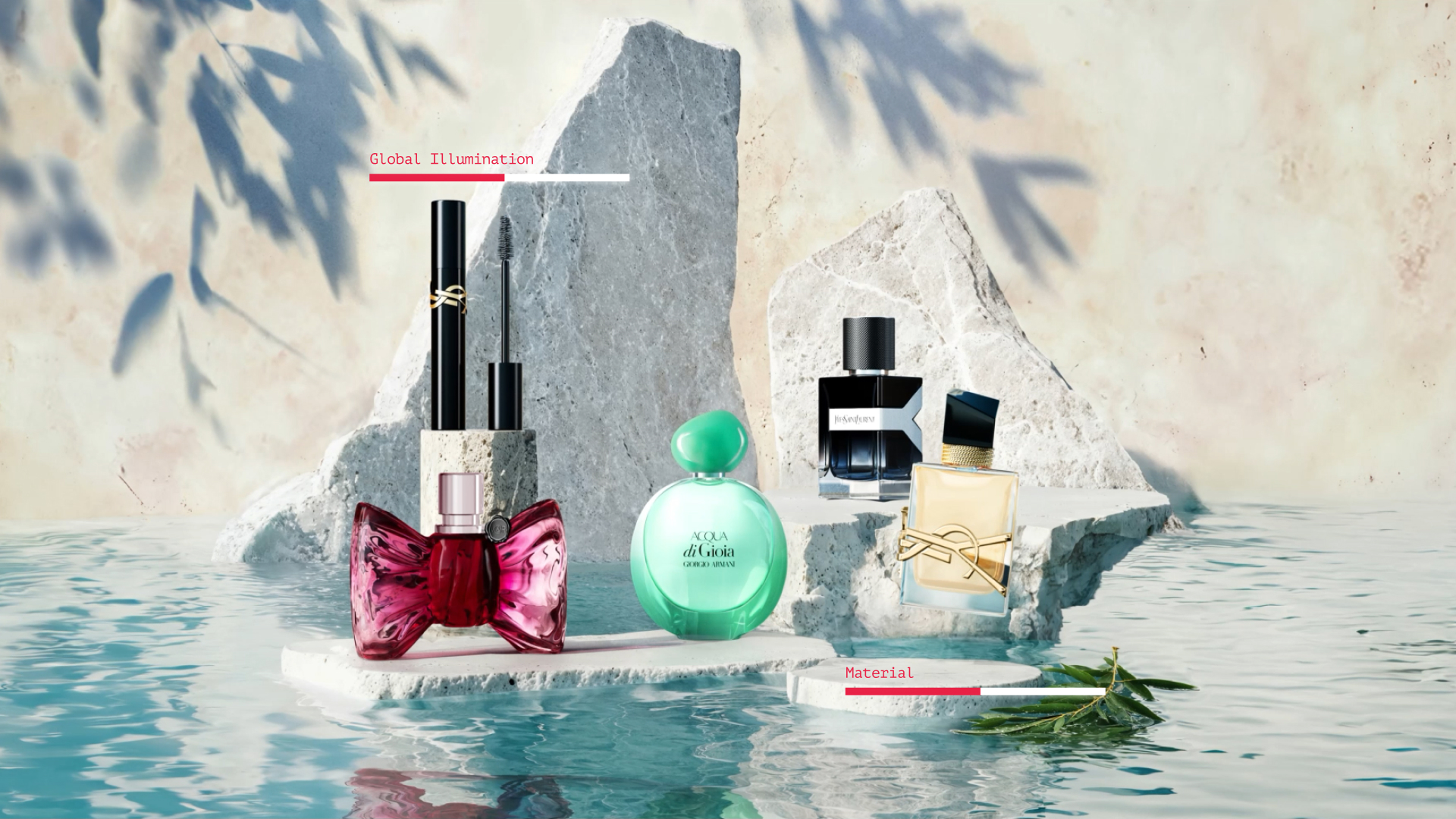
A digital twin is an accurate 3D model of the product, built from CAD, material and packaging artwork data. Images generated from the twin take the label, the colour and the proportions from the brand’s approved data, from any angle and in any light. AI then generates or extends the scene around the product, and compositing matches the light, shadows and reflections. The twin has to stay current, so when the artwork changes, the twin changes with it. In return, a new pack version, angle or market becomes a data change rather than a reshoot.
Large companies have worked this way for years. In 2018 IKEA’s Martin Enthed said that 6,000 or more IKEA products existed as complete 3D models and that 95% of its images were made by computer software. Nestlé reported in 2025 that it had built 3D “digital masters” of 4,000 products, with a target of 10,000 within two years, and said its new digital twin service was set to lower the time and cost of scaling its digital twins by more than 70%.
How to use AI to create product images
The process below works for a single product line or a whole portfolio.
- Choose the source of truth for each product. This is an approved photo or a digital twin, with the pack version and market recorded. Every later check depends on it.
- Keep the product fixed and generate the scene. Use AI for backgrounds, settings, props and light. Any edit that touches the product, such as correcting a label, goes through the same approval as artwork.
- Encode the rules once. Brand rules cover angles, light, props and what the brand never shows. Retailer rules cover requirements such as main images on white that show the exact item sold. Market rules cover claims, regulated categories and the language on pack. Applied when images are generated, they hold for every image in the batch.
- Generate in batches. Work across SKUs, scenes, formats and markets at once, so a new retailer format or a seasonal scene reaches the whole range together.
- Check against the source. Because the product comes from a known source, label text, colour and proportions can be compared with it. People review samples and every new template or scene type.
- Keep the metadata. Write the IPTC DigitalSourceType value and, where your pipeline supports it, C2PA Content Credentials, and make sure resizing and DAM exports don’t strip them.
- Watch returns and reviews. Customer photos and return reasons such as “not as pictured” show where images and products have drifted apart.
The rules for AI-generated product images in 2026
The rules come from three directions: the retailers, the EU AI Act and consumer-protection law. This is general information, not legal advice.
Retailers and marketplaces
Google Merchant Center accepts AI-generated product images with one condition: “All AI-generated images must contain the IPTC DigitalSourceType trainedAlgorithmicMedia tag.” The rule covers main, additional and lifestyle images, and Google’s image specifications separately require the main image to show the exact item being sold. In July 2026 Amazon told sellers to tag product images, videos and A+ content that show photorealistic AI-generated people, following New York’s law on synthetic performers in advertising.
The IPTC vocabulary that these rules rely on separates fully generated images (trainedAlgorithmicMedia) from real images edited with generative AI, for example by inpainting or outpainting (compositeWithTrainedAlgorithmicMedia), and from composites that include at least one generated element (compositeSynthetic). C2PA, the open standard behind Content Credentials, records how a file was made and edited and is backed by companies including Amazon, Google, Meta, Microsoft and OpenAI.
The EU AI Act
The AI Act defines a deepfake as AI-generated or manipulated image, audio or video content that resembles existing persons, objects, places, entities or events and would falsely appear authentic. The European Commission’s guidelines on Article 50, published in July 2026, confirm that objects include consumer goods. Their examples are useful for product teams:
- An AI-generated product image in an ad or on packaging that could mislead the audience about the product’s actual appearance is given as an example of a deepfake. Deployers have to disclose deepfakes.
- A real product shown in an ad against an AI-generated background is given as an example that is not a deepfake, as long as the ad does not mislead.
- Colour correction and background replacements for clearly aesthetic purposes in product ads or packaging are described as likely to have only a minor impact, depending on context.
Article 50’s transparency obligations have applied since 2 August 2026. Providers of generative AI systems that were already on the market before that date have until 2 December 2026 to mark their output as AI-generated in a machine-readable format. According to the Commission’s guidelines, that transition applies only to the marking duty, so the disclosure duty for deepfakes was not delayed.
Consumer-protection law
Consumer-protection rules apply however an image was made. Under the EU’s Unfair Commercial Practices Directive, a practice is misleading if it contains false information, or in any way, including its overall presentation, deceives or is likely to deceive the average consumer about matters such as the main characteristics of a product, and is likely to change their purchasing decision. The UK’s Digital Markets, Competition and Consumers Act 2024 uses similar wording, and since April 2025 the Competition and Markets Authority can enforce it directly, with fines of up to 10% of global turnover. In the US, Section 5 of the FTC Act prohibits deceptive practices in commerce.
Enforcement has started to reach AI imagery. In March 2026 the UK Advertising Standards Authority upheld complaints against a WiggyDog social media ad for a robotic puppy toy. Scenes of what appeared to be real and/or AI-generated puppies implied the toy looked and behaved like a real dog, and the ASA found that the ad exaggerated its performance and characteristics. The same month, the Guangzhou Intermediate People’s Court published a case in which a clothing seller’s undisclosed AI-generated images differed significantly from the goods, and the seller had falsely told the buyer they were real photos. The court found consumer fraud and ordered triple damages.
Product photography automation at enterprise scale
The volume is what moves enterprise brands toward automation. As an illustration, a portfolio of 1,000 SKUs with six product page images each, in pack versions for ten markets, needs 60,000 images before any seasonal, retailer-specific or campaign variant. A photo-based process repeats work for every pack change and every new angle. A twin-based process repeats data work once per product and then generates the images.
Retailers have moved fastest on editorial imagery. Reuters reported that about 70% of Zalando’s editorial campaign images in the fourth quarter of 2024 were AI-generated, and Zalando said production time had fallen from six to eight weeks to three or four days and costs by 90%. Those are company figures, and they apply to editorial images, where the scene carries more of the message than the product’s exact details. For product pages, Mondelez said in October 2025 that it would use its generative AI tool for Oreo product pages on Amazon and Walmart in the US, with people reviewing the output.
What to look for in an AI product image generator
For an enterprise portfolio, the questions to ask an AI product image generator are mostly about the product, not the scene:
- A defined product source. Every image traces to an approved photo or a digital twin, with its pack version.
- Exact label text. Text on pack comes from the artwork rather than being reconstructed by a model.
- Colour you can measure. Colour is managed and can be compared with the source or the physical pack.
- Rules applied at generation. Brand, retailer and market rules are encoded once and applied to every image.
- Batch scale and versions. The tool works across SKUs, markets and formats, and shows which images use which pack version when artwork changes.
- Provenance metadata. IPTC values and Content Credentials survive export to the DAM and retailer feeds.
- Rights. The generative models are trained on licensed data or covered by an IP indemnity.
- Integration. The tool connects to the DAM, PIM, artwork management system and retailer feeds.
- Approvals and audit. It records who approved each template, scene and pack version.
Which AI is best for realistic product images?
Realistic scenes are now easy to get from most leading models, so test the product instead. Pick ten SKUs, including a transparent bottle, a metallic or reflective pack and a pack with small print. Generate the same set in each tool, then compare the label text letter by letter, the colour against the physical pack under controlled light, and the proportions against the pack specification. Expect the differences to show in the small print and on the reflective pack.
What it looks like in practice
The Coca-Cola Company described its approach with Grip in a session at NVIDIA GTC in March 2025. According to the session, 95% of its online product imagery was by then powered by 3D digital twins, which had replaced traditional photography across campaigns, the digital shelf and e-commerce. Opella, the consumer health company, faced decentralized workflows and strict brand and compliance demands, and centralized its e-commerce content production with Grip while giving local teams room to move fast. In beauty, where curved glass, foil and embossing are notoriously hard to photograph, brands use digital twins to show premium packaging accurately in any setting.
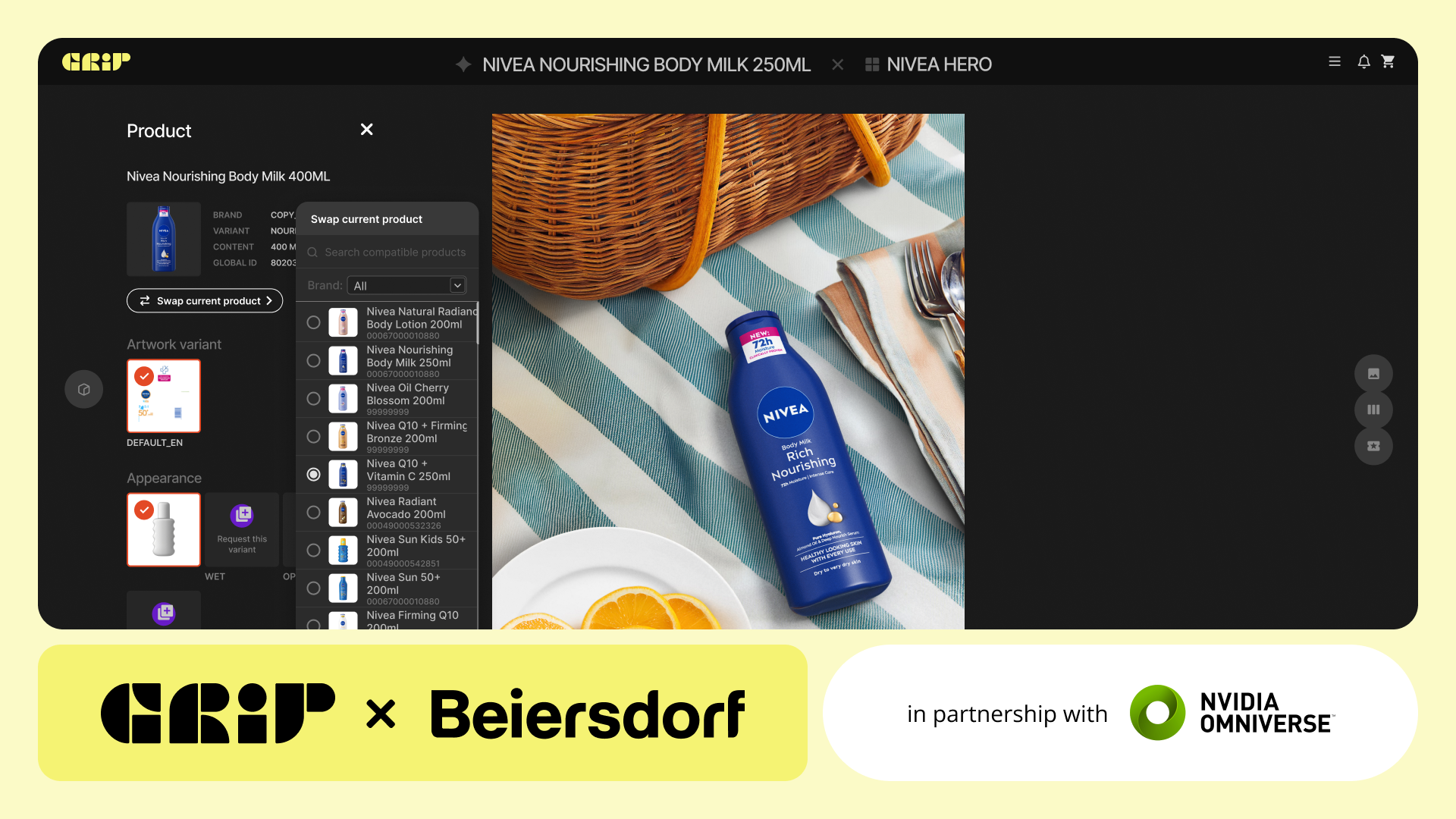
Grip is the enterprise automation platform for publishable marketing content at scale, built by INDG. For product imagery, it starts from the product rather than a prompt. Digital Shelf generates product page and e-commerce imagery from digital twins of the actual product, built on OpenUSD, so the label, materials and proportions match the real pack from every angle and in every market. Where a brand has approved photography, Adaptations turns those masters into compliant variations for each market and format. Originals generates new lifestyle content from a brief, grounded in the twin, with art direction and brand rules from the Brand Center applied at generation time, so it is on-brand by design. Where an image has to show the exact pack, it comes from Digital Shelf or from approved photography. Each twin stays with the brand, so the next launch or pack change starts from what is already built.
Where to start
Pick one product line and list every image it needs across retailers, markets and formats. For each image, note where the product in it comes from today: a photo, a 3D model, a fine-tuned model or a prompt. Start with the images where the product is generated, since those carry the accuracy risk, and the images that change most often, since those carry the cost. To see how product images fit into the wider pipeline, read content production at scale, or talk to the Grip team.
Frequently asked questions
How do you use AI to create product images?
Start from an accurate source of the product, either an approved photo or a 3D digital twin. Let AI generate the scene, background and light around it, apply the brand’s and retailers’ image rules, check label text, colour and proportions against the source, and keep the AI metadata in the file when you publish.
Are AI-generated product images allowed on Google Shopping and Amazon?
Google Merchant Center accepts AI-generated product images if they carry the IPTC DigitalSourceType trainedAlgorithmicMedia tag, and the main image must show the exact item being sold. Amazon requires sellers to label images that show photorealistic AI-generated people. Both expect the image to represent the actual product.
Do AI product images need to be disclosed in the EU?
Sometimes. The EU AI Act’s definition of a deepfake includes objects. The European Commission’s guidelines give an AI-generated product image that could mislead about the product’s actual appearance as an example of a deepfake, which has to be disclosed. A real product shown against an AI-generated background is given as an example that is not one, as long as the ad does not mislead. This is general information, not legal advice.
What is the best AI for realistic product images?
Most current image models can produce a realistic scene. The harder test is whether the product itself is accurate: the label text, colours, materials and proportions. The most reliable approaches keep the product from a real photo or a 3D digital twin and use AI for the scene around it.
Can AI replace product photography?
For many images, yes. IKEA said in 2018 that 95% of its images were made by computer software, and The Coca-Cola Company said in 2025 that 95% of its online product imagery was powered by 3D digital twins. AI can now generate the scenes around such products. A physical shoot still makes sense for new hero campaigns and for products that have no accurate photo or 3D source yet.
References
- Baymard Institute, “Product Page UX 2026: 10 Pitfalls and Best Practices,” updated 18 March 2026.
- Nfinite, “Nfinite and Coresight Research unveil the impact of enhanced product imagery on the $816 billion product returns challenge,” PR Newswire, 17 January 2024.
- Cloudinary, global e-commerce survey on visual media and returns, 17 May 2023.
- National Retail Federation, “Consumers Expected to Return Nearly $850 Billion in Merchandise in 2025,” 15 October 2025.
- Daria Dzyabura, Siham El Kihal, John R. Hauser and Marat Ibragimov, “Leveraging the Power of Images in Managing Product Return Rates,” Marketing Science 42(6), 2023.
- Stylitics, survey with Aha Studio on shopper trust in AI-generated product images, 3 October 2025.
- Jingye Chen et al., “TextDiffuser: Diffusion Models as Text Painters,” NeurIPS 2023.
- STRICT, a benchmark for text in generated images, EMNLP 2025.
- Nataniel Ruiz et al., “DreamBooth: Fine Tuning Text-to-Image Diffusion Models for Subject-Driven Generation,” CVPR 2023.
- RefAdGen, reference-based product advertising image generation, 2025.
- Amazon Ads, AI image generation for advertisers.
- Victoria and Albert Museum, collection record for BERTIL (IKEA, 2005), CD.17-2026.
- Packaging Europe, on Nestlé’s digital twin service, 18 June 2025.
- Google Merchant Center Help, requirements for AI-generated images.
- Google Merchant Center Help, image link specification.
- CNBC, on Amazon’s labels for AI-generated people in product images, 23 July 2026.
- IPTC, Digital Source Type vocabulary.
- C2PA, Coalition for Content Provenance and Authenticity.
- EU AI Act, Article 3 (definitions).
- EU AI Act, Article 50 (transparency obligations).
- European Commission, guidelines on the transparency obligations for providers and deployers of AI systems, July 2026.
- Hunton Andrews Kurth, on the EU Digital Omnibus on AI entering into force, 28 July 2026.
- Directive 2005/29/EC (Unfair Commercial Practices Directive), Article 6.
- Digital Markets, Competition and Consumers Act 2024, section 226.
- CMS, on the DMCC Act consumer protection provisions coming into force, 8 April 2025.
- 15 U.S.C. § 45 (FTC Act, Section 5).
- Advertising Standards Authority, ruling on UAB Commercecore (WiggyDog), 25 March 2026.
- Yangtse Evening News, on the Guangzhou ruling on AI-generated clothing images, 13 March 2026.
- Reuters via Global Banking & Finance Review, on Zalando’s use of AI for editorial imagery, 7 May 2025.
- Reuters via Yahoo News, “Oreo maker Mondelez to use new generative AI tool to slash marketing costs,” 25 October 2025.
About Grip
As INDG’s software branch, Grip is a visual content configuration engine powered by NVIDIA Omniverse that makes it possible for large enterprises to use AI at scale. It breaks existing content down into configurable modules, allowing brands to swap out any element, including products, talent, accessories, and branding assets, with complete control and accuracy. Grip integrates with existing workflows to automate product swaps and generate endless, hero-quality content variation, without disrupting established content production processes.