Content production at scale: from shoots to systems


Brands are being asked for more content while production takes a smaller share of the marketing budget. In the World Federation of Advertisers’ 2025 study of 50 global brands, production took an average of 19% of total marketing budgets, down from 24% before the pandemic. Claire Randall, whose consultancy ran the study with the WFA, pointed to the pressure on brands to produce and deliver the required volume of content at greater speed.
The usual response is to speed up the workflow around production: better briefs, faster approvals, more agencies on call. That helps until the next market or retailer is added. This guide explains what content production is, why shoot-based production gets relatively more expensive as demand grows, how other industries changed the way they produce, and what a content production workflow looks like when a system produces the variations.
What is content production?
Content production is the work of turning a brief into finished, publishable content: planning, shooting or generating, editing, adapting, reviewing and delivering images, video and copy for every channel and market. In marketing it covers both the hero content of a campaign and the many variations derived from it.
Three terms get used for overlapping things:
- Content creation is the creative act of making something new, such as a concept, a photograph or a piece of copy.
- Content production is the wider process that turns ideas into finished assets at the volume a brand needs, including adaptation, versioning, review and delivery.
- Creative production is the production side of creative work, usually run by an in-house studio, a production agency or a creative operations team. Creative asset production refers to the individual files it delivers: product images, banners, social formats and videos.
If you were looking for video production services, this guide is about production as a system inside a brand. For how the teams around it are organized, see the guide to content operations and creative operations.
Why shoots don’t get cheaper: the string quartet problem
In 1965 the economists William Baumol and William Bowen studied why orchestras and theaters kept running into money trouble. Their explanation became known as Baumol’s cost disease. A string quartet needs the same four musicians and the same playing time it needed in Schubert’s day, so the productivity of a live performance barely moves. Manufacturing productivity keeps rising, wages rise with it across the economy, and the performance becomes relatively more expensive every decade.
A photo or video shoot behaves like a live performance. It needs a crew, a location, talent, product samples and a fixed number of days, and it produces a roughly fixed number of finished images per day. Better cameras and faster retouching help at the margins, but the shoot day itself stays the unit of output.
Demand moved anyway. In Baymard Institute’s e-commerce usability research, 56% of users’ first action on a product page was to explore the product images, so each product needs a full image set on every retailer that sells it. Each market needs its own language, claims and sometimes its own packaging. Each channel needs its own formats. In a shoot-based model, every one of those additions turns into more shoot days or more hours of retouching, resizing and versioning, and both grow with headcount.
That is why the 19% budget share in the WFA data is hard to square with the volume brands are asked for. Making the workflow faster leaves the unit of production, and the cost behind it, unchanged.
How other industries changed the unit of production
Music escaped Baumol’s problem partly through recording. A performance that is recorded once can be played many times, so the cost of the performance is spread over a far larger audience, even though the concert itself takes as long as ever.
Furniture and film made a similar move with images:
- IKEA started producing product imagery from 3D models years ago. By 2014, three-quarters of its single product shots were computer-generated, according to a correction published by Slate. A new color or finish became a change to a model instead of a new photo session.
- Hollywood moved part of the shoot inside the system. Industrial Light & Magic reported that more than 50 percent of The Mandalorian season one was filmed on an LED stage driven by real-time game engine technology, which removed the need for location shoots for those scenes.
Where the hero shoot still belongs
Concerts survived recording, and hero shoots keep the same place in a system-based model. A campaign film, a new face for the brand or a photograph in a real place is still best made by people with cameras. What changes is the role of that shoot. It becomes the master that variations are derived from, and the product data or 3D digital twin becomes the source for the product imagery that has to exist in every format, market and retailer.
Scale or scope?
“Content production at scale” suggests the challenge is making more of the same thing. For most brands it is the variety. Economists separate economies of scale, where a larger volume of one product lowers unit cost, from economies of scope, where producing many related products together is cheaper than producing each separately because they share inputs. John Panzar and Robert Willig formalized the second idea in 1981.
A brand’s content problem is a scope problem. The number of assets is products multiplied by markets, languages, channels, retailers and formats, and most of those assets differ only slightly from each other. Shoots offer few shared inputs between variations, because each image is captured separately. A system that produces content from shared inputs, such as a digital twin of the product, an approved master asset and encoded brand and market rules, lets every new variation draw on work that has already been done. The same idea, applied to the whole operating model, is behind the case for a content supply chain that adds variety as late as possible.
The content production workflow, redrawn
A classic content production workflow runs from brief to shoot to retouching, resizing, review and delivery. Each step is repeated for each asset or batch. When production moves to a system, the steps look different:
| Shoot-centric workflow | System-centric workflow | |
|---|---|---|
| Unit of production | The shoot day and the individual asset | The product twin, the approved master and the rules |
| Inputs | Product samples, sets, talent, a shot list | Product data, artwork, brand and market rules, approved masters |
| Adding a market | New versions made by hand, sometimes a new shoot | New rules and claims, variations generated |
| A packaging change | Re-shoot or retouch every affected image | Update the twin or artwork once |
| Where quality is checked | At the end, asset by asset | In the rules the system applies, with people handling exceptions |
| What the team spends time on | Coordinating and correcting variations | Hero content, art direction and the rules themselves |
What changes for creative production teams
The creative production workflow keeps its creative core. Concepts, art direction and hero content still come from people, often with agencies. The difference is in what the team produces for the system. Instead of delivering 400 finished banners, a team delivers one approved master, the rules for how it may change and the list of formats it must cover. Instead of re-briefing a studio when a label changes, someone updates the artwork once. Work that used to be repeated for every asset moves into inputs that are made once and reused.
Where AI content production helps, and where it needs product truth
AI is already changing parts of content production. In a 2023 experiment published in Science, 453 college-educated professionals completed writing tasks, and those given access to ChatGPT finished 40% faster with output rated 18% higher in quality. A larger field experiment by Harang Ju and Sinan Aral, released as a preprint, had 2,234 participants produce more than 11,000 ads. Teams of people working with AI agents produced 50% more ads per worker and higher-quality text, while teams of people working together produced higher-quality images.
The pattern is useful for anyone trying to scale content production with AI. AI content production is strongest where the output is text, ideas or scenes that can vary freely. Product visuals have a narrower tolerance, because the label, the shade, the pack size and the claim must be right for the market. A model prompted without the brand’s product data has to guess those details, and the time saved in generation moves into review. AI marketing content production pays off for product visuals when the product comes from the brand’s own data or digital twin and the brand’s rules are encoded, so the product stays exact and what is generated around it is on-brand by design. The guide to creative automation explains the different kinds of tools, and the six levels of visual content automation show how far each workflow can go.
What to look for in content production management software
Content production management software covers a wide range, from project trackers to full production platforms. These questions separate tools that manage production from tools that change it:
- What is the unit of work? A tool that tracks assets and approvals manages the queue. A tool that produces variations from shared inputs reduces the queue.
- What does one more market cost? Ask for the steps and the hours needed to add a market with its own language, claims and retailer specifications.
- What happens when packaging changes? Count how many assets must be found, corrected and re-approved by hand.
- Where are brand rules applied? Rules that are checked after production create review work. Rules applied during production prevent it.
- Can it start from what you already have? Existing shoots, approved hero assets and product data should be usable as inputs, so the move to a system does not require starting over.
- Who owns the inputs? Digital twins, masters and encoded rules are long-term assets. They should belong to the brand and work with its DAM, PIM and artwork systems.
What it looks like in practice
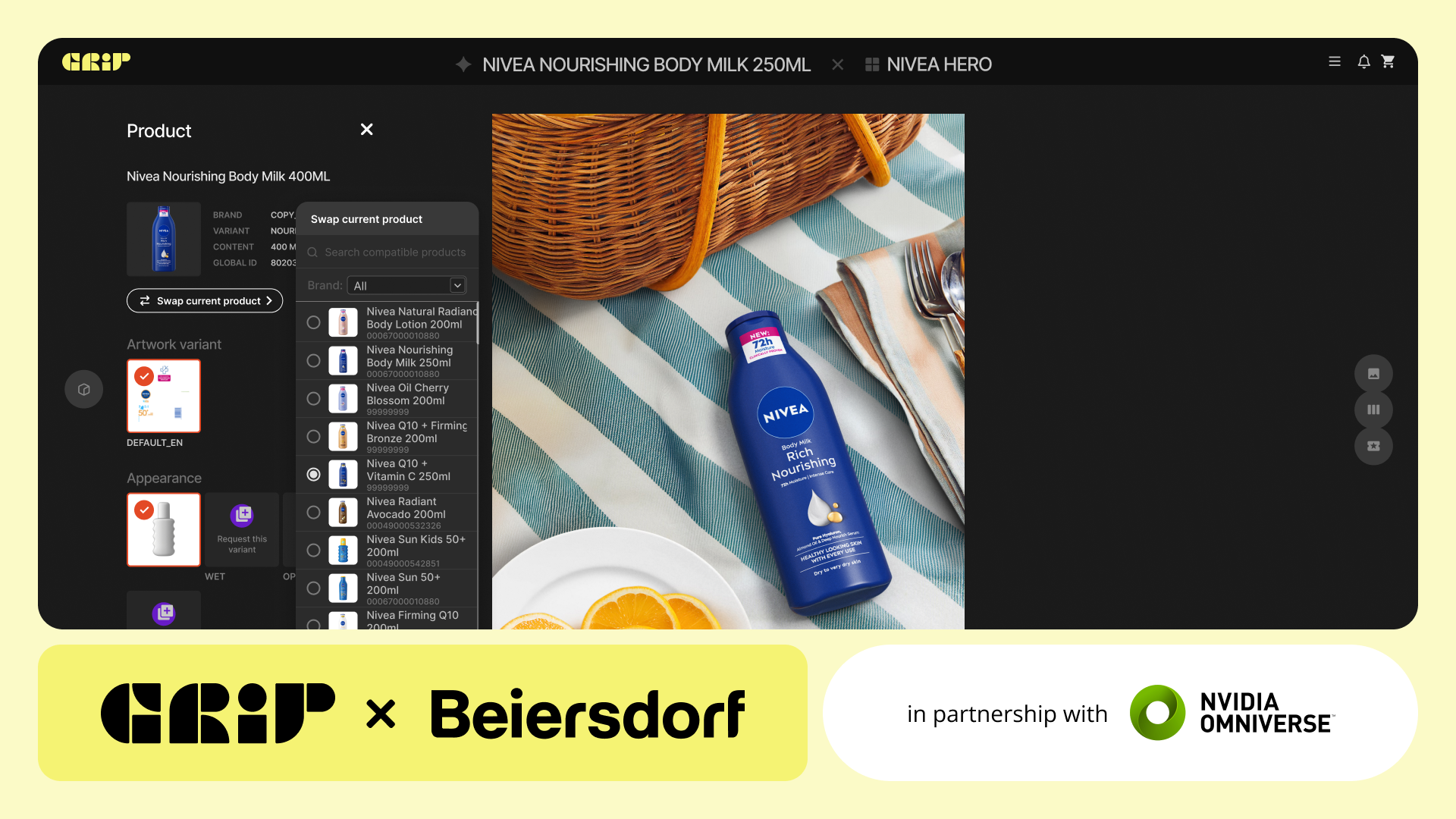
Beiersdorf, the company behind NIVEA and Eucerin, found that lengthy photoshoots and manual edits were becoming unsustainable for localized advertising, and combined digital twins of its portfolio with AI-enabled content configurators to localize advertising across formats and channels. Moët Hennessy, the wine and spirits division of LVMH, works across more than 25 maisons in over 70 markets. Its teams create, adapt and deploy visuals through Grip and have delivered over 3 million content variations globally, at twice the speed. LVMH maisons including Château Galoupet and Hublot are also testing original content generation for hero beauty visuals, pack shots and social variants. In each case the shoot or the twin is made once, and the variations come from the system.
Grip is the enterprise automation platform for publishable marketing content at scale, built by INDG. It changes the unit of production from the shoot day to inputs the brand owns: digital twins of the product portfolio, approved master assets, and art direction, brand and compliance rules encoded in its Brand Center. Three propositions produce content from those inputs. Digital Shelf generates product page and e-commerce imagery from digital twins of the actual product. Adaptations turns a master asset, from Originals, a new campaign or an existing shoot, into compliant variations across markets and formats. Originals creates new on-brand content from a brief without a physical shoot, with brand rules applied at generation time. Grip connects to existing DAMs, PIMs and artwork systems, and every twin and rule added stays available for the next campaign.
Where to start
Pick one product line and count its assets: how many exist per product, per market and per retailer, and how many of them were produced by hand from a shoot or a retouch. The derived assets, the ones that differ from a master only in size, language, claim or background, are the ones a system can produce. Starting there leaves the hero shoot where it is and moves the repetitive part of content production to a system the brand owns.
For the wider operating picture, read what is a content supply chain (and how to fix it), or talk to the Grip team about your own production.
Frequently asked questions
What is the difference between content creation and content production?
Content creation is the creative act of making something new, such as a concept, a photo or a piece of copy. Content production is the wider process that turns ideas into finished assets at the volume a brand needs, including adaptation, versioning, review and delivery.
What are the stages of a content production workflow?
Most workflows follow pre-production (brief, planning, assets and approvals), production (shooting, filming or generating) and post-production (editing, retouching, adapting, reviewing and delivering). In a system-based workflow, much of post-production is generated from approved inputs instead of done by hand for each asset.
What is creative asset production?
Creative asset production is the production of the individual visual and creative files a campaign or product launch needs, such as product images, banners, social formats and videos, usually in many sizes, languages and versions for different channels and retailers.
How do you scale content production without losing brand consistency?
By producing variations from shared, approved inputs instead of making each asset by hand. Product data or digital twins keep the product accurate, encoded brand and market rules keep variations on-brand, and people focus on the hero content and the exceptions.
How is AI used in marketing content production?
AI is used to draft and translate copy, generate backgrounds and scenes, adapt compositions to new formats and check assets against specifications. For product visuals it works best when the product comes from the brand’s own product data or digital twin and the rules are encoded, so review can focus on the exceptions.
What should content production management software do?
It should show where every request, asset and approval stands, connect to the DAM and product data, and, at enterprise scale, reduce the work itself by producing variations automatically rather than only managing the queue of work.
References
- World Federation of Advertisers, “WFA research reveals new trends showing how brands are responding to changes in content production” (Global Content Production 2025, 50 global brands), 25 March 2025.
- William J. Baumol and William G. Bowen, “On the Performing Arts: The Anatomy of Their Economic Problems,” American Economic Review 55 (1/2), 1965, pp. 495–502.
- Policy Options (IRPP), “Productivity and the performing arts,” February 2018.
- Baymard Institute, “Ensure Sufficient Image Resolution and Zoom,” 2 April 2020.
- Slate, “75 Percent of Ikea’s Catalog Images Are Computer-Generated” (corrected to single product shots), 5 September 2014.
- Industrial Light & Magic, “Groundbreaking LED Stage Production Technology Created for Hit Lucasfilm Series ‘The Mandalorian’,” 20 February 2020.
- John C. Panzar and Robert D. Willig, “Economies of Scope,” American Economic Review 71 (2), 1981, pp. 268–272.
- Shakked Noy and Whitney Zhang, “Experimental evidence on the productivity effects of generative artificial intelligence,” Science 381, 14 July 2023.
- Harang Ju and Sinan Aral, “Collaborating with AI Agents: Field Experiments on Teamwork, Productivity, and Performance,” arXiv preprint 2503.18238, version 4, 15 October 2026.
About Grip
As INDG’s software branch, Grip is a visual content configuration engine powered by NVIDIA Omniverse that makes it possible for large enterprises to use AI at scale. It breaks existing content down into configurable modules, allowing brands to swap out any element, including products, talent, accessories, and branding assets, with complete control and accuracy. Grip integrates with existing workflows to automate product swaps and generate endless, hero-quality content variation, without disrupting established content production processes.