Brand compliance at scale: automating on-brand content


Brand compliance is the practice of making sure every piece of content a company publishes follows two sets of rules: the brand’s own guidelines for its logo, colours, typography, imagery and tone, and the external rules that apply to marketing, such as claims law, mandatory statements and the codes for regulated categories. It covers ads, social posts, packaging, product pages and anything else that carries the brand.
Most guides treat these as one thing, but the two are set by different bodies and owned by different teams. Brand guidelines protect how the brand looks and sounds, and breaking them dilutes it slowly. Regulatory rules govern what marketing may claim and must disclose, and breaking them leads to rulings, fines and withdrawn content. At enterprise volume, checking every asset after it is made stops keeping up with either. This guide covers what brand compliance includes, the rules that apply, recent enforcement, what AI can and can’t check, and how to build compliance into content production.
What is brand compliance?
| Brand guidelines | Regulatory and legal rules | |
|---|---|---|
| Set by | The company | Laws, regulators and industry codes |
| Covers | Logo use, colours, typography, imagery, composition, tone of voice | Claims, substantiation, mandatory statements, age restrictions, disclosures |
| Owned by | Brand and creative teams | Legal, regulatory and compliance teams |
| Cost of failure | A weaker, less recognizable brand | Rulings, fines, withdrawn ads, delisted products |
| Varies by | Brand, sub-brand and channel | Market, product category and channel |
The two overlap in practice. A disclaimer is a legal requirement that has to sit somewhere in the layout without breaking the brand’s design, and a product claim has to be both lawful and in the brand’s voice. Compliance at scale needs the two sets of rules connected, with each one kept by the team that owns it.
Why brand compliance matters
Consistency is how a brand becomes recognizable. In Ipsos’s database of more than 12,000 brand assets from over 900 brands, only 15% reached Ipsos’s top “gold” rating. Brands with many strong assets, rated gold or silver, scored higher on consideration (69 against 53) and on usage (43 against 31) than brands with few. The finding is correlational, but Ipsos’s conclusion is that consistent use is what builds distinctiveness in the first place.
The regulatory side has more direct costs. Rulings are public, fines can follow, and a withdrawn campaign has to be replaced at short notice. The next two sections cover the rules and some recent cases.
The rules that apply to marketing content
Regulatory compliance depends on the category and the market. These are some of the main rules for consumer brands. This is general information, not legal advice.
- Cosmetics (EU). Regulation (EU) No 655/2013 sets six common criteria for cosmetic claims: legal compliance, truthfulness, evidential support, honesty, fairness and informed decision-making. A claim can’t, for example, present a legal minimum as a product benefit.
- Food (EU). Under Regulation (EC) No 1924/2006, health claims are prohibited unless they are authorised and listed, and they must carry mandatory statements, such as the importance of a varied and balanced diet and the quantity needed for the claimed effect. Great Britain now keeps its own register, which the ASA applies in its rulings.
- Alcohol. In the UK, the Portman Group’s code requires packaging to communicate the alcoholic nature of a drink with absolute clarity and rules out particular appeal to under-18s. In the EU, the Audiovisual Media Services Directive bans TV alcohol ads that target minors or link drinking to performance, driving or social success. In the US, the TTB’s rules on spirits ads ban untrue or misleading health-related statements and allow specific health claims only if they are adequately substantiated and properly qualified, and the industry’s DISCUS code limits ad placement to media where at least 73.8% of the audience is of legal drinking age.
- Health products (US). The FTC’s Health Products Compliance Guidance of December 2022 generally expects high-quality randomized controlled trials for health claims and makes clear that vague qualifiers and fine print don’t cure a deceptive claim.
- Prescription medicines (US). Promotional material has to be submitted to the FDA, on Form FDA-2253, when it is first used.
- Environmental claims (EU). Directive (EU) 2024/825 on empowering consumers for the green transition has applied since 27 September 2026. Member states had until 27 March 2026 to transpose it, and it has no transitional provision for claims or labels already on the market. It bans generic environmental claims such as “eco” or “green” unless the trader can show recognized excellent environmental performance, sustainability labels that aren’t based on a certification scheme or set up by public authorities, claims about a whole product or company when only one aspect qualifies, and claims, based on offsetting greenhouse gas emissions, that a product has a neutral, reduced or positive environmental impact in terms of those emissions. Several member states had not finished transposing it by the application date.
Recent enforcement
Enforcement shows where content most often goes wrong:
- Nike, December 2025. The UK Advertising Standards Authority upheld a complaint against a Google search ad that said “Sustainable Materials”, finding the environmental claim unsubstantiated.
- Whitworths, January 2026. The ASA ruled against an Instagram claim of “equivalent nutrition to 1 portion of your 5-a-day” as a non-permitted comparative nutrition claim.
- Kit & Kin, February 2026. The ASA upheld complaints about “eco”, “sustainable” and “biodegradable” claims on the brand’s website.
- GLP-1 Pro, May 2026. The ASA treated a product’s name, “GuLP-1”, as a specific health claim that was not authorised on the GB register.
- Shein, August 2025. Italy’s competition authority fined the retailer €1 million for vague, generic and misleading environmental claims.
- 21 European airlines, November 2025. Following action by the European Commission and national consumer authorities, the airlines committed to stop claiming that a flight’s CO2 emissions could be offset or neutralized through customer payments.
- “Made in USA”, April 2026. The FTC announced a sweep including three enforcement actions over origin claims on websites, marketing and labels.
In most of these cases the claim itself wasn’t supported or wasn’t permitted, however neatly it was laid out. A check on finished content can catch a missing disclaimer, but whether a claim may be used has to be decided before the content is made, by the legal and regulatory teams who approve which claims can be used, where and with what wording.
Why checking every asset doesn’t scale
The traditional model of brand compliance is review. Content is produced, then checked by brand, legal and regulatory teams, then corrected and checked again. Review cycles take time. In Veeva’s 2021 benchmark of more than 350 pharmaceutical companies, content took an average of 21 days from design to approval. In a 2023 survey by Saifr of 107 leaders at US financial institutions, marketers said content took ten working days on average, six to eight of them in compliance review. Both are vendor figures, and both describe regulated sectors where review is required by law.
The quality pioneer W. Edwards Deming made the underlying point decades ago. The third of his 14 points for management reads “Cease dependence on inspection to achieve quality”, and he went on to recommend building quality into the product in the first place. His target was dependence on mass inspection, which finds defects after they are made and does nothing to stop the next one. Applied to content, a review queue that checks every asset grows with each new market, format and variant. A rule applied where content is made is written once and covers the assets produced under it.
How AI helps with brand compliance checking
AI can take much of the routine checking off reviewers’ desks:
- Logos. Computer vision models detect logos and their position. Detecting a brand’s own logo usually needs a custom-trained model, which can be built from a few hundred images or fewer.
- Colour. Image analysis returns the dominant colours in an image and the share of pixels each covers, which can be compared with the brand palette.
- Text and disclaimers. OCR reads text with its position, so a check can confirm that a disclaimer is present, legible and in the right place.
- Claims and tone. Language models can flag risky wording and compare copy with tone-of-voice rules.
The limits are well documented. A 2026 study of 15 vision-language models found that they read text and recognize colours almost perfectly but recognize font styles poorly, and that larger models didn’t do better. On claims, researchers at Capital One fine-tuned two small open models on synthetic financial marketing content against 267 regulatory requirements. The best reached about 67% accuracy, and the authors recommend human supervision. In a 2025 study of influencer ads, models performed well on clear cases but lost more than ten points on ambiguous ones, and adding the regulatory text to the prompt didn’t consistently help.
AI checking is inspection done faster, which makes it useful as a first pass that sends people the assets most likely to need attention. It doesn’t replace the decisions about which claims are allowed, and it doesn’t stop the next asset from repeating the same error.
Building compliance in: brand compliance automation at scale
Building compliance into production means deciding the rules once and applying them every time content is made, with each set of rules staying with the team that owns it:
- Approve claims before content is made. Legal and regulatory teams decide which claims may be used per market and category, with the substantiation, approved wording, mandatory statements and expiry date for each. This usually sits in their own claims management or review system.
- Encode the brand guidelines as rules. Logo size and clear space, colour values, typography, composition, product placement and what the brand never shows, written as data rather than a PDF.
- Add the market rules. Formats, languages, pack versions and retailer image requirements for each market, and where approved legal copy sits in the layout and at what size.
- Apply the rules when content is produced. Templates and generation steps use the brand and market rules directly, so reviewers receive variants that already follow them.
- Check against the rules. Automated checks, including the AI checks described above, confirm that each asset matches the rules it was made under, rather than judging it from scratch.
- Keep legal sign-off with people. Regulated categories, new claims and new templates need sign-off from the people accountable for them, and new creative work needs human judgment. The review workflow keeps the record of who approved what, so a question from a regulator or retailer can be answered quickly.
Final review then confirms compliance, and most of the review effort goes into new rules, claims and templates, which are far fewer than the assets made from them.
Brand compliance software: three approaches compared
Guideline portals and asset libraries with usage rights support compliance, and brand governance compares them with the other governance tools. The software that decides whether a given asset complies falls into three approaches, which differ mainly in when a rule is applied and who makes the call.
| Regulated claims review | Visual rule checks | Generation with rules | |
|---|---|---|---|
| What it covers | Whether a claim is permitted and substantiated, and which statements it must carry | Logos, colours, text, and whether disclaimers are present and placed correctly in finished assets | Brand, visual and market rules such as logo placement, colour values, layouts and channel formats |
| When it applies | Before a claim is used, and again at sign-off | After the asset is made | While the asset is made |
| Who decides | Legal, regulatory and medical reviewers | The software flags, people decide | Rule owners decide once per rule, and reviewers approve the output |
| Typical tools | Claims management and medical, legal and regulatory review workflows, which keep a record of each approval | AI checkers and creative scoring | Locked templates and generation platforms with encoded brand rules |
| Where it stops | Built for review, not for production volume | Finds errors after they are made, with accuracy that varies by element | Covers the rules it is given, and leaves claims and legal sign-off to people |
The three answer different questions, so they work best connected. Claims and their mandatory statements are approved in the legal team’s review system before production starts, production applies the brand and market rules around them, and final review checks the finished asset against both.
What to look for in brand compliance software
- Both sets of rules. Brand guidelines and regulatory requirements per market and category, each managed by the team that owns it.
- Rules applied at creation. Brand, visual and market rules shape content as it is made, not only after.
- Checks you can trust. Automated checks with known accuracy, and people reviewing what they flag.
- Owners and versions. Every rule has an owner, and changes are versioned.
- A link to claims review. Approved claims and mandatory statements come from the system the legal team already uses, rather than being retyped in each tool.
- Integration. Connections to the DAM, PIM, artwork management and approval systems already in use.
What it looks like in practice
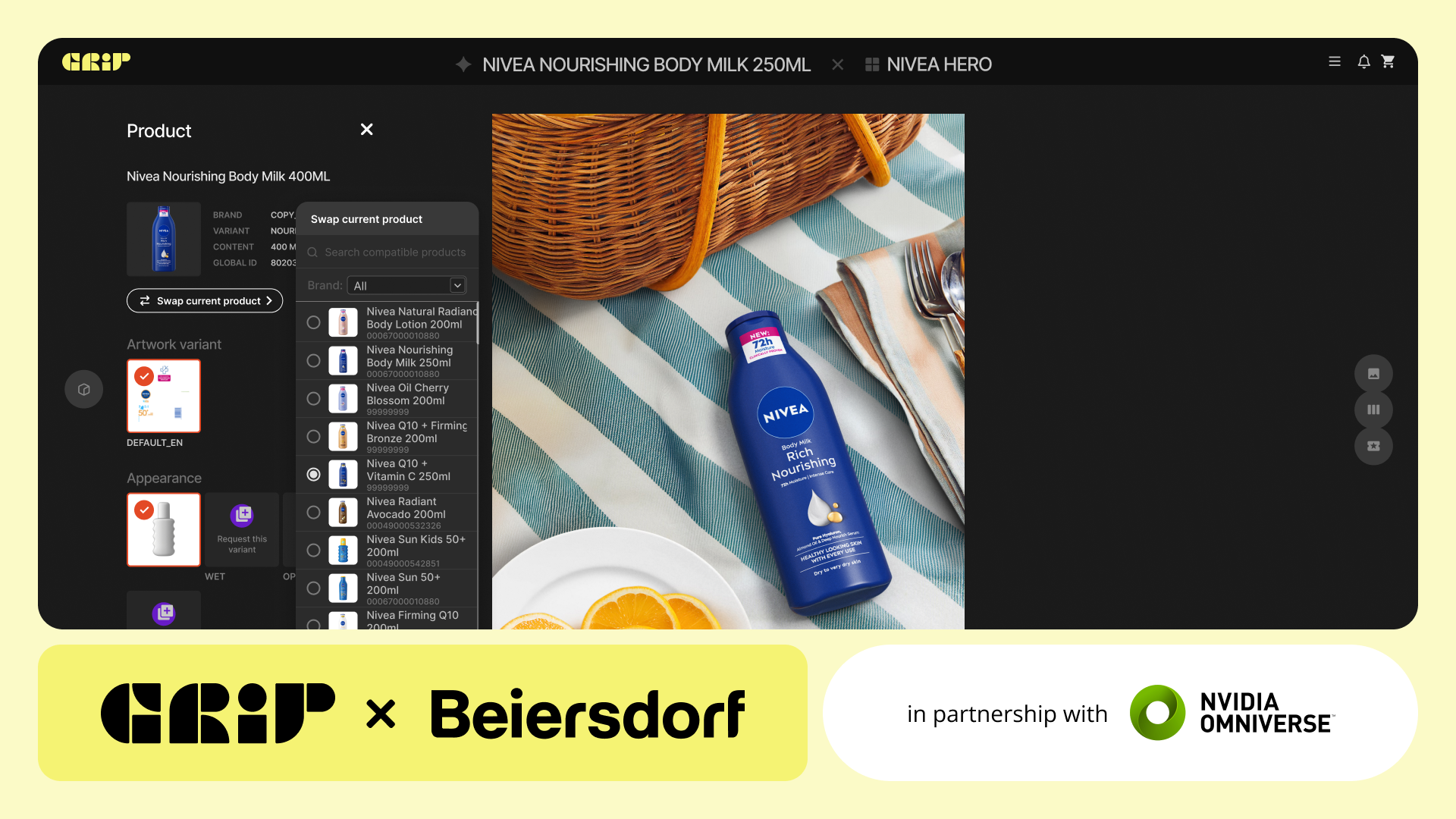
Opella faced strict brand and compliance demands alongside decentralized workflows and rising localization costs, and turned to Grip to centralize its e-commerce content production while giving local teams room to move fast. Beiersdorf, whose brands include NIVEA and Eucerin, has been using Grip’s rule-based AI control with digital twins to scale on-brand ad production.
In Grip, the enterprise automation platform for publishable marketing content at scale built by INDG, a brand’s rules are applied before content reaches review. Grip’s Brand Center holds the visual, brand and market rules, such as logo use, colour, typography, layout and each retailer’s image requirements, and assets are produced under them. Digital Shelf validates e-commerce images against GS1, Amazon and Walmart standards, with the product taken from its digital twin. Adaptations produces variations of a master asset, from Originals, a new campaign or an existing shoot, for each market and format under that market’s rules. Originals generates new content from a brief, grounded in the brand’s twins and rules, so it reaches reviewers on-brand by design. Which claims may be used, and the legal sign-off on each asset, stay with the brand’s legal and regulatory teams.
Where to start
Take last quarter’s rejected or corrected assets and sort the reasons into two lists: brand guideline issues and regulatory issues. For each reason, ask whether a rule applied at creation would have prevented it. The brand list shows which rules to encode first. The regulatory list shows which claims your legal team should approve in advance, with their wording and mandatory statements. For how the review step changes when rules come first, read content operations, or talk to the Grip team.
Frequently asked questions
What is the difference between brand compliance and regulatory compliance?
Brand guidelines are set by the company and protect how the brand looks and sounds; breaking them dilutes the brand. Regulatory rules are set by law and industry codes and govern what marketing may claim and must disclose; breaking them can lead to rulings, fines and withdrawn content. Brand compliance in practice has to cover both.
What is brand compliance software?
Brand compliance software helps teams create and publish content that follows brand and regulatory rules. The main categories are brand guideline portals, digital asset management with usage rights, locked templates, AI checkers that score finished content, regulated review workflows such as medical, legal and regulatory review, and content generation platforms that apply the rules while content is produced.
How can AI help with brand compliance checking?
AI can detect logos, measure colours, read text with OCR to check that disclaimers are present, and flag risky claims with language models. It is less reliable on typography and on ambiguous claims, and in one study of financial marketing review, the best fine-tuned model reached about 67% accuracy, so AI checks work best as a first pass with people reviewing what they flag.
How do you ensure brand compliance at scale?
Move the rules to where content is made. Legal and regulatory teams approve claims per market in advance, with their wording and mandatory statements. Brand and market rules are encoded as data and applied when content is produced, and automated checks confirm each asset against them. Final review then confirms compliance rather than catching errors, and legal sign-off stays with people.
What happens if marketing content is not compliant?
It depends on the rule and the market. Advertising regulators such as the UK’s ASA can rule against an ad and require it to be withdrawn, consumer authorities can fine companies, and retailers can remove or suppress listings. Off-brand content has a slower cost, because it weakens the distinctive assets that make a brand recognizable.
References
- Ipsos, “Recognisably You,” September 2026.
- Commission Regulation (EU) No 655/2013, common criteria for cosmetic claims, Annex.
- Regulation (EC) No 1924/2006 on nutrition and health claims, Article 10.
- European Commission, nutrition and health claims.
- Portman Group, codes of practice.
- Portman Group, Independent Complaints Panel decision on Beatbox Fruit Punch, citing Code rules 3.1 and 3.2(h).
- Directive 2010/13/EU (Audiovisual Media Services Directive), Article 22.
- 27 CFR § 5.235, prohibited practices in distilled spirits advertising.
- Frankfurt Kurnit Klein & Selz, on DISCUS raising its adult demographic placement standard to 73.8%, 2 June 2023.
- Federal Trade Commission, Health Products Compliance Guidance, December 2022.
- 21 CFR § 314.81, other postmarketing reports.
- European Commission, sustainable consumption and the Directive on empowering consumers for the green transition.
- CMS, on the publication of Directive (EU) 2024/825, 19 March 2024.
- Mayer Brown, on Directive (EU) 2024/825 two years on, 27 October 2026.
- Advertising Standards Authority, ruling on Nike Retail BV, 3 December 2025.
- Advertising Standards Authority, ruling on Whitworths Ltd, 28 January 2026.
- Advertising Standards Authority, ruling on Kit & Kin Ltd, 4 February 2026.
- Advertising Standards Authority, ruling on GLP-1 Pro Ltd, 6 May 2026.
- Euronews, “Italy hands fast-fashion retailer Shein €1mn greenwashing fine,” 4 August 2025.
- Neytendastofa (Icelandic Consumer Agency), on 21 European airlines modifying environmental claims, 19 November 2025.
- Federal Trade Commission, “Made in USA” sweep, 14 April 2026.
- Veeva, on content benchmarks in life sciences, 29 April 2021.
- Saifr, on workflow gaps between marketing and compliance.
- University of Cambridge, Institute for Manufacturing, “Deming’s 14 points.”
- Google Cloud, detecting logos.
- AWS, Amazon Rekognition Custom Labels.
- Google Cloud, detecting image properties.
- Google Cloud, detecting text (OCR).
- Study of typography recognition in vision-language models, March 2026.
- Capital One researchers, on large language models for financial marketing compliance review, December 2025.
- Study of language models detecting non-compliant influencer advertising, October 2025.
About Grip
As INDG’s software branch, Grip is a visual content configuration engine powered by NVIDIA Omniverse that makes it possible for large enterprises to use AI at scale. It breaks existing content down into configurable modules, allowing brands to swap out any element, including products, talent, accessories, and branding assets, with complete control and accuracy. Grip integrates with existing workflows to automate product swaps and generate endless, hero-quality content variation, without disrupting established content production processes.