The digital shelf: winning with compliant product content


The digital shelf is the online environment where a product is found, compared and bought: retailer sites, marketplaces, quick-commerce apps, brand stores, search engines and, increasingly, AI assistants. NIQ describes it as the online counterpart of the store shelf. It is made up of search results, category pages, product pages, sponsored placements, ratings and reviews.
A store shelf is negotiated once and stays put until the next reset. The digital shelf is assembled again for every search, on every retailer, and sometimes for every store location. A brand can rent a place on it through retail media, one query and one auction at a time. It can’t own one. What a brand does fully control is the product content it supplies, and that content now feeds the search results, the ads and the AI answers. This guide covers how the digital shelf works, the levers and metrics that decide visibility, a digital shelf strategy for consumer goods brands, and how AI assistants are changing it.
What is the digital shelf?
The digital shelf includes every place a shopper meets a product online:
- Search results and category pages on retailer sites and marketplaces, where most shopping journeys start.
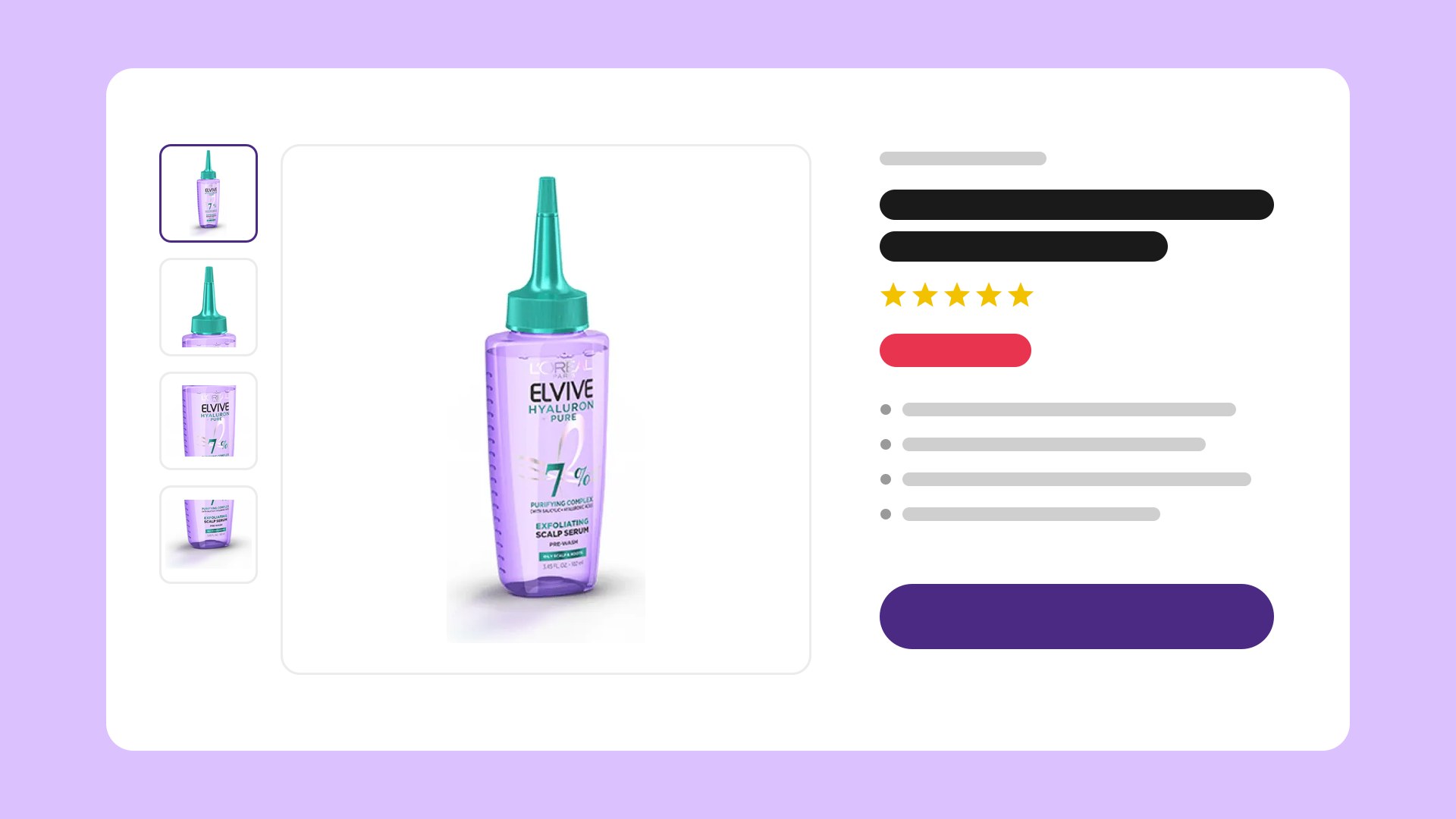
- Product detail pages, where the decision is made. Product detail page content covers what they need.
- Sponsored placements, bought through retail media, that sit among and above the organic results.
- Ratings and reviews, which affect both ranking and conversion.
- Search engines and shopping feeds, such as Google Shopping.
- AI assistants, which increasingly answer shopping questions directly.
As Salsify puts it, the digital shelf is the place, and e-commerce is the buying and selling that happens there. A brand’s job on the digital shelf is to be found, chosen and in stock wherever its shoppers look.
How the digital shelf differs from a store shelf
| Store shelf | Digital shelf | |
|---|---|---|
| Placement | Fixed by the planogram until the next reset | Recalculated for every search, retailer and often location |
| How space is secured | Negotiated facings and fixtures | Earned through ranking factors, or rented per query through retail media |
| Speed of change | Weeks or months | Hours |
| What the shopper sees | The physical pack | Images, titles, attributes and reviews, displayed to each retailer’s specification |
| Competition | The products next to yours | Every product the search returns, including sponsored ones |
Sponsored placements now take much of the most valuable space. In a 2024 study of 4,800 searches on Amazon in the US, India, Germany and France, Dash and colleagues found that about 30% of results were sponsored, and that in the US a sponsored result appeared above the top organic result in 77% to 91.5% of queries. A Modern Retail review of about two dozen Walmart searches, published in October 2025, found that for “batteries”, the first organic listing from a non-advertiser sat in ninth position.
Position matters because shoppers consider what they see first. In a field experiment that randomized hotel rankings on Expedia, published in Marketing Science in 2018, Raluca Ursu found that rank changed which options consumers looked at, although once they had looked, rank didn’t change what they chose.
Why the digital shelf matters for CPG brands
Online sales are now a large and fast-growing part of consumer goods. NIQ measured US online sales of fast-moving consumer goods at $432 billion in 2025, with Amazon and Walmart together accounting for more than half. NIQ puts Amazon’s own share of US online FMCG at about 38%. Circana found that e-commerce delivered more than 73% of US CPG omnichannel dollar growth in 2025 to date, in an analysis published in November 2025. Europe is earlier on the curve. Europanel data for 2024, excluding fresh food, put online at 7.2% of FMCG sales in Western Europe and 10.1% across 42 countries worldwide.
The shelf also starts beyond the retailer. In Forrester’s October 2025 survey of US online adults, 69% had used Google and 58% Amazon for product discovery searches, and 19% had used ChatGPT to search for products in the past month, a share Forrester found had barely moved during 2025.
The five levers of digital shelf visibility
Five things decide whether a product is seen and chosen on the digital shelf. A brand controls some fully and others only partly.
- Availability. A product that is out of stock can’t be bought, and it quickly loses its place in search. In one vendor analysis by DataWeave of a consumer goods brand on Amazon, products ranked in the top ten lost more than 28% of their rank after a single day out of stock and 83% after three days or more. A Profitero study found that search placement on Amazon.co.uk and Tesco.com took an average of nine to ten days to recover after two or more days out of stock.
- Price and promotion. Price competitiveness, promotions and pricing rules such as minimum advertised price.
- Ratings and reviews. Average rating and number of reviews affect ranking, click-through and conversion.
- Retail media. Sponsored placements on retailer sites. WPP Media estimated that commerce media, led by retail media networks, reached $178.2 billion globally in 2025, or 15.6% of global ad spend, overtaking linear and connected TV combined.
- Content. Titles, images, attributes, descriptions, A+ Content and video. The brand owns this content at the source, while each retailer’s specification decides how it is displayed.
Content is the lever that connects the others. Retailers score and display products using it, retail media ads are built from it, and AI assistants answer from it. Vendor case studies point to the size of the effect: Profitero reported that new video, images and copy lifted one Bayer product page’s conversion by 17%. It is also the hardest lever to keep complete, because it has to be right for every SKU, every retailer and every market at once.
Digital shelf metrics for brands
| Metric | What it measures | Why it matters |
|---|---|---|
| Availability (in-stock rate) | Share of time and locations where a product can be bought | Out-of-stock products lose sales, rank and wasted media |
| Share of search | How often a brand’s products appear in the top results for important searches, organic and sponsored | Visibility relative to competitors |
| Content compliance | Whether titles, images and attributes meet each retailer’s requirements | Non-compliant listings rank lower or are suppressed |
| Ratings and reviews | Average rating and number of reviews | Ranking, trust and conversion |
| Price and promotion compliance | Whether prices and promotions are correct and competitive | Conversion, margin and channel conflict |
| Share of assortment | How much of the range is listed and live on each retailer | Missed listings are missed sales |
| Conversion and sales | Results by product and retailer | Shows which levers are working |
Some consumer goods companies now manage these metrics like store execution. At the CAGNY conference in February 2025, Colgate-Palmolive’s CEO Noel Wallace said the company was 90% compliant with its “best shelf” standard online and had improved by 32% since 2022 against four digital shelf KPIs, a score he said moves week to week with retailers’ algorithms.
Digital shelf optimization: a strategy in five steps
- Define the best shelf for each retailer. For each important retailer and category, decide what a winning presence looks like: the searches to rank for, the content standard, the minimum rating, the in-stock target.
- Measure weekly. Track the metrics above by product and retailer, and look at the shelf the way shoppers see it, including by location where results differ.
- Fix at the source. Correct content in the PIM and DAM rather than editing listings one retailer at a time, so the fix reaches every destination.
- Coordinate availability and media. Pause sponsored placements on products that are out of stock, and plan content refreshes around promotions and pack changes.
- Make content machine-readable. Complete attributes, structured product data and accurate images help both retailer search and AI assistants understand the product.
The digital shelf and AI assistants
AI assistants are adding another layer to the shelf. In January 2026 Google announced the Universal Commerce Protocol, with checkout inside AI Mode in Search and the Gemini app, dozens of new Merchant Center attributes for conversational answers such as product questions and substitutes, and Direct Offers, a Google Ads pilot that lets advertisers show exclusive discounts in AI Mode. In March 2026 Amazon made sponsored prompts generally available in the US: AI-generated additions to Sponsored Products and Sponsored Brands ads that appear in shopping results and on product pages, drawing on detail page content, Brand Store content and campaign data. OpenAI began testing labelled ads in ChatGPT in February 2026, placed below its answers.
In each case the assistant or the ad works from the product data the brand has supplied. Products with incomplete or inconsistent data are less likely to be recommended or advertised well, which makes content quality a visibility factor on AI surfaces as well as on retailer sites.
Producing compliant content for every SKU, retailer and market
The difficulty with digital shelf content is the matrix. Every SKU needs images, titles and attributes for every retailer, each with its own specification, in every market’s language and pack version, and all of it has to change when the pack, the promotion or the retailer’s rules change. Amazon product image requirements shows how much one retailer’s rules alone involve, and packshots at scale covers why pack versions are hard to keep current. The work becomes manageable when it is treated as a production problem rather than a listing problem, with one accurate source per product and pack version, each retailer’s rules applied when the content is produced, and validation before anything is sent.
What it looks like in practice
Grip automates digital shelf visual content for more than 100,000 SKUs. The brands its Digital Twin Factory lists among its customers include Kellanova, Heinz and Campbell in food and Coca-Cola, Diageo and Pernod Ricard in beverages. The Coca-Cola Company has described how digital twins replaced traditional photography across its campaigns, digital shelf and e-commerce imagery.
Grip is the enterprise automation platform for publishable marketing content at scale, built by INDG. For the digital shelf, it keeps the content side of the shelf complete and compliant across retailers. Grip’s Digital Shelf capability generates hero shots, alternate views and promo variants from digital twins of the actual product, and automates packaging updates and multipacks at SKU level, so promotions and refreshes reach every retailer on time. Every asset is validated against GS1, Amazon and Walmart standards by default, and against Carrefour and other retailers’ requirements, to keep product pages from being suppressed or delisted. Art direction and retailer standards are encoded in its Brand Center, and Grip connects to the artwork management, PIM, DAM and syndication systems that feed retailers.
Where to start
Pick your top 50 SKUs and your three most important retailers, and score each product on the five levers: availability, price, ratings, media and content. For content, check images and attributes against each retailer’s requirements and against the current pack. The products that score well on everything except content are the quickest wins, because the demand and the stock are already there. For what each product page needs, read product detail page content, or talk to the Grip team.
Frequently asked questions
What is digital shelf optimization?
Digital shelf optimization is the ongoing work of improving how a brand’s products appear and perform online. It covers keeping products in stock, managing price and promotions, building ratings and reviews, buying retail media, and making product content complete, accurate and compliant with each retailer’s requirements, measured retailer by retailer.
What are the most important digital shelf metrics?
The core digital shelf metrics are availability or in-stock rate, share of search (organic and sponsored), content compliance against each retailer’s requirements, ratings and reviews, and price and promotion compliance. Many brands also track share of assortment, image compliance and conversion.
What is a digital shelf strategy?
A digital shelf strategy sets what a winning product page and search presence look like for each retailer, how the brand will measure it, and how it will fix gaps at the source. It coordinates availability, pricing, retail media and content so that, for example, media isn’t spent on products that are out of stock.
Why does the digital shelf matter for CPG brands?
Online sales are a growing share of consumer goods, and they drive a large share of growth. NIQ measured US online sales of fast-moving consumer goods at $432 billion in 2025, and Circana found that e-commerce delivered more than 73% of US CPG omnichannel dollar growth in 2025 to date, as of November 2025.
How do AI assistants change the digital shelf?
AI shopping assistants answer from product data rather than showing a page of results, so complete, structured and accurate product content decides whether a product is recommended at all. Google and Amazon have both added AI shopping features and ad formats in 2026 that draw directly on merchants’ product content.
References
- NIQ, “What is the digital shelf?” 16 September 2024.
- NIQ, “What are digital shelf analytics?” 16 September 2024.
- Salsify, “The digital shelf explained,” 25 March 2021.
- Abhisek Dash et al., “Sponsored is the New Organic,” July 2024.
- Modern Retail, on sponsored results in Walmart search, 13 October 2025.
- Raluca M. Ursu, “The Power of Rankings: Quantifying the Effect of Rankings on Online Consumer Search and Purchase Decisions,” Marketing Science 37(4), 2018.
- NIQ, “The Commerce Revolution,” 27 April 2026.
- Circana, on e-commerce and CPG growth, 7 November 2025.
- Europanel, “E-Commerce Lite Report 2025,” June 2025.
- Forrester, “US Consumers’ Adoption Of Answer Engines For Product Discovery Remains Flat,” 2 December 2025.
- DataWeave, on the impact of stock-outs on Amazon search rank, 30 June 2022.
- The Grocer, Profitero whitepaper on the implications of going out of stock, 16 November 2020.
- WPP Media, This Year Next Year, December 2025.
- Digiday, on WPP Media’s estimates of commerce media spending, 8 December 2025.
- Profitero, Bayer case study.
- diginomica, on Colgate-Palmolive at CAGNY 2025, 24 February 2025.
- Google, on agentic commerce tools and the Universal Commerce Protocol, 11 January 2026.
- Amazon Ads, Sponsored Products and Sponsored Brands prompts, 10 March 2026.
- Engadget, “OpenAI starts testing ads in ChatGPT,” 9 February 2026.
About Grip
As INDG’s software branch, Grip is a visual content configuration engine powered by NVIDIA Omniverse that makes it possible for large enterprises to use AI at scale. It breaks existing content down into configurable modules, allowing brands to swap out any element, including products, talent, accessories, and branding assets, with complete control and accuracy. Grip integrates with existing workflows to automate product swaps and generate endless, hero-quality content variation, without disrupting established content production processes.