Dynamic creative optimization (DCO) with on-brand variations


Dynamic creative optimization (DCO) is advertising technology that assembles ads from interchangeable elements, such as images, headlines, offers and calls to action, decides in real time which combination to show each person, and learns from results which combinations work best.
Creative is worth optimizing. In NCSolutions’ analysis of sales-effect studies for consumer packaged goods brands, the creative drove 49% of the incremental sales from advertising, more than brand, reach, targeting or recency. When Advertiser Perceptions surveyed marketers and agencies for Westwood One in 2024, they estimated creative’s share at 19%.
Most pages about DCO sell it on the number of combinations it can produce. This guide explains what DCO in advertising is and how it works, why the traffic a campaign has limits how many variants it can learn from, what DCO actually optimizes for, and what the production side has to deliver for the system to work.
What is DCO?
DCO stands for dynamic creative optimization. (The same letters are used in other fields, from the military to electronics. This guide is about DCO in advertising.) Instead of producing a fixed set of finished ads, a brand supplies the parts and the rules, and the system builds and selects ads as impressions are served.
Dynamic creative vs dynamic creative optimization
The two terms are often used interchangeably, but they describe different steps. Dynamic creative fills a template with content according to rules. Google’s documentation for its Studio tool describes three parts: the creative, a feed holding “all the potential content variations”, and a profile, “a set of rules and a map between creative elements and the content.” A retailer showing the product a person just viewed is using dynamic creative.
Dynamic creative optimization adds learning. The system tries different combinations, measures how each performs and shifts impressions toward the better ones.
DCO, A/B testing and platform automation
A/B testing compares a few versions with an even split of traffic until one wins. DCO tests many combinations at the same time and adjusts as it goes. The large ad platforms have built similar mechanics into their own products. Google’s Performance Max accepts up to 15 headlines, 5 long headlines, 5 descriptions, 20 images and 15 videos per asset group and combines them automatically, and Meta’s Advantage+ tools do the same within its apps.
How dynamic creative optimization works
Every DCO setup has four parts:
- Feeds hold the variable content: products, prices, offers, locations, headlines and images.
- Templates define the layout and which elements may change, for each format the campaign runs in.
- Decisioning chooses a combination for each impression, using rules (this audience sees this offer) and signals such as context, location or past behavior.
- Testing and learning measure results and shift future impressions toward what works.
The fourth step is where DCO differs from simple automation, and it is also where its limits sit.
A short history of dynamic creative
The idea is older than most current platforms. In 2009 Google bought Teracent, whose technology, as The Register reported, could “pick and choose from literally thousands of creative elements of a display ad in real-time.” In 2017 Facebook launched dynamic creative with up to 30 assets per ad, so that, as Marketing Land calculated, “a single ad could spawn up to 6,250 unique combinations.” The same report noted that Facebook would “only serve a fraction of those combinations.” By late 2024, Meta reported that more than a million advertisers had used its generative AI tools to create more than 15 million ads in a month.
The number of possible variants has grown by orders of magnitude. The amount of traffic available to learn from has not.
The traffic ceiling: why more variants don’t mean more learning
Choosing between options while learning which is best is an old problem in statistics. In 1933 William Thompson framed it as a choice between two treatments, and in 1952 Herbert Robbins formalized it as what became known as the multi-armed bandit, after a gambler choosing between slot machines. Every impression spent on exploring a weak variant is an impression not spent on the best one known so far. DCO engines use versions of the same methods.
Learning has a price in traffic. Ron Kohavi and colleagues, who built Microsoft’s experimentation platform, give a rule of thumb for the sample each variant needs: for a 5% conversion rate, detecting a 5% relative change takes up to about 122,000 users per variant. Display advertising usually has far lower response rates. As an illustration with the same formula, at a 1% response rate and a 10% relative lift, each variant needs roughly 158,000 impressions. Five variants need about 800,000. The 6,250 combinations of a single 2017 Facebook ad would need close to a billion.
In practice the numbers are often worse. Randall Lewis and Justin Rao studied 25 large field experiments with major US retailers and brokerages and concluded that informative advertising experiments “can easily require more than 10 million person-weeks.”
The consequence for DCO is simple. A campaign can only learn from as many variants as its traffic supports. Thousands of small permutations split that traffic so finely that most of them never get enough impressions to be judged, and the system ends up guessing. A few variants that differ in something meaningful, such as the concept, the scene, the offer or the message, give the engine differences large enough to detect. Elements that should change for a known reason, like the product a person viewed, the language or the format, can follow rules without being tested at all.
What DCO optimizes for
An optimizer maximizes the number it is given. The anthropologist Marilyn Strathern summarized the problem, which she credited to the economist Charles Goodhart: “When a measure becomes a target, it ceases to be a good measure.”
Clicks are the classic example. A 2009 comScore and Starcom study found that 8% of US internet users accounted for 85% of display ad clicks. An engine that optimizes for clicks learns what that small group responds to. In a field test on more than 750 million display impressions for a large retail bank, Eric Schwartz, Eric Bradlow and Peter Fader found that an adaptive policy optimizing for customer acquisitions raised the acquisition rate by 8%, and that optimizing for click-through instead would have reduced acquisitions by about 10%.
Platform scores raise the same question. Google says advertisers who improve the Ad Strength of their responsive search ads from “Poor” to “Excellent” see on average 15% more conversions. An analysis of more than a million responsive search, expanded text and Demand Gen ads by the PPC tool vendor Optmyzr found “no clear correlation between ad performance and Ad Strength.” Whatever the truth for a given account, the safest target for creative optimization is the business outcome the campaign exists for, measured as directly as possible.
Where DCO falls short
DCO is a strong tool with known limits:
- More specific isn’t always better. In a field experiment with an online travel company, Anja Lambrecht and Catherine Tucker found that “dynamic retargeted ads are, on average, less effective than their generic equivalents”, except when consumers had already narrowed down what they wanted. Alexander Bleier and Maik Eisenbeiss found that highly personalized banners lose effectiveness quickly after a store visit. The guide to personalized advertising covers this in more depth.
- Combinations aren’t approved as a whole. When ads are assembled at the moment of serving, nobody reviews the exact combination a person sees. A headline, an image and a claim that are each approved can still produce an ad that is wrong for a market. In 2026 the OECD’s AI incident monitor recorded a case in which an AI tool on Meta altered an REI ad so the bike shown had two sets of handlebars, and REI opted out of the feature.
- Reporting is often opaque. Platforms report performance by asset or combination in different ways, which makes it hard to know which creative decision caused a result.
What a DCO engine needs from production
DCO can only serve what has been produced. The guide to creative automation makes the same point from the production side. For DCO to work at enterprise scale, the production side has to deliver four things:
- Accurate product imagery for every item in the feed. If the feed holds 2,000 products, each needs current, correct images in every format, with the right pack and claims for each market.
- Compliant variants for every market and format, made from approved masters, so every combination the engine assembles is one the brand would approve.
- A few clearly different concepts for the engine to learn from, instead of minor permutations of one idea.
- Brand rules applied when the content is made, so legal lines, logo placement and product depiction are correct before anything reaches the feed.
This is the same shift described in content production at scale: the variations come from shared, approved inputs instead of being built one by one.
DCO platforms and tools: what to evaluate
The market for dynamic creative platforms has three layers. The built-in tools of Meta, Google and other platforms assemble and optimize within their own inventory. Independent ad servers and creative management platforms run DCO across many publishers and channels. Production platforms create the assets and variants that both of them serve. When you compare DCO platforms or dynamic creative optimization tools, ask:
- What does the engine optimize for, and can it optimize for your business outcome rather than clicks?
- How many variants can your traffic actually evaluate, and does the tool show when a variant hasn’t had enough impressions to be judged?
- Can every possible combination be checked against brand and market rules before it is served?
- Where do the product images and variants come from, and what happens to them when a pack or claim changes?
- Can you see which creative decisions drove the results?
What it looks like in practice
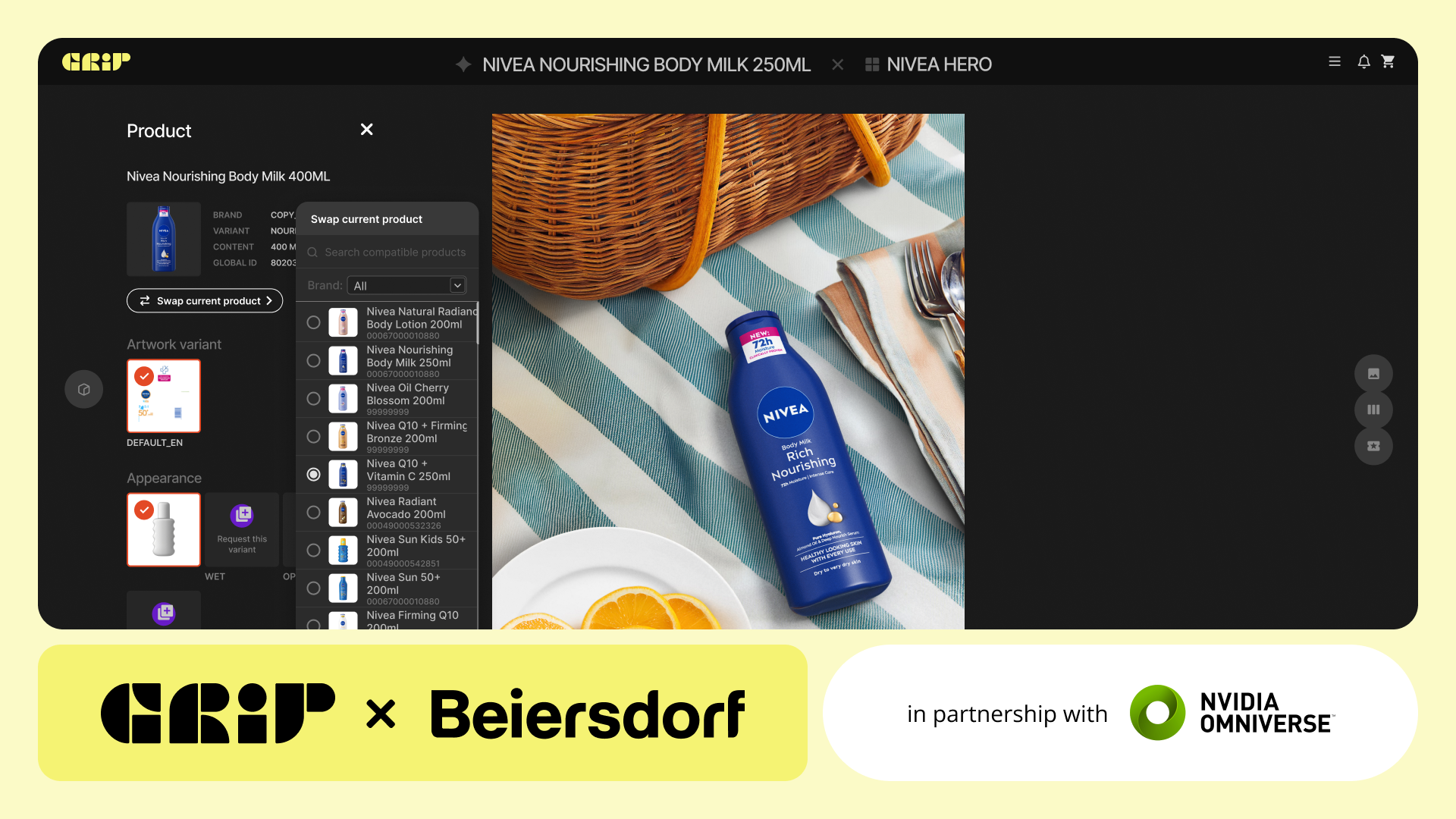
Beiersdorf set out to deliver personalized, channel-specific marketing for NIVEA and Eucerin worldwide and works with Grip’s rule-based AI and digital twins to scale its ad production. Moët Hennessy uses templates across several of its brands to produce localized ad variations for its markets. Grip has also announced partnerships that connect production with measurement: with Realeyes in 2024, for attention-based content recommendations, and with Claritas in 2026, for a closed loop between performance data and the next round of creative.
Grip is the enterprise automation platform for publishable marketing content at scale, built by INDG. In a DCO setup, it is the production side that feeds the engine. Digital Shelf generates product imagery for every item in the feed from digital twins of the actual product. Adaptations produces compliant variations of a master asset, from Originals, a new campaign or an existing shoot, for every market and format. Originals creates new on-brand concepts from a brief without a physical shoot, giving the engine meaningfully different options to learn from. Art direction, brand and compliance rules are encoded in its Brand Center and applied when the content is generated, so the variants are approvable before they are served.
Where to start
Take one DCO campaign and compare the number of live variants with the impressions each has received. Using the rule of thumb above, mark which variants have had enough traffic to be judged. If most haven’t, cut the permutations, keep a few clearly different concepts, and let rules handle the details that should change for a known reason. For a wider look at how ad production is changing, read about AI in advertising, or talk to the Grip team.
Frequently asked questions
What is the difference between dynamic creative and DCO?
Dynamic creative fills a template with content from a feed according to fixed rules, for example showing the product a person viewed. Dynamic creative optimization adds a learning step: it tests combinations and shifts impressions toward the ones that perform best.
How is DCO different from A/B testing?
A/B testing splits traffic evenly between a few versions until there is a clear winner. DCO tests many combinations at once and shifts traffic toward better performers while the campaign runs, which balances learning with results but needs enough traffic for each variant.
How many creative variants does DCO need?
As many as your traffic can evaluate, and no more. Each variant needs enough impressions to show a reliable difference, so a campaign with modest reach learns more from a few clearly different variants than from thousands of small permutations.
Is DCO the same as personalized advertising?
No. Personalized advertising is the goal of showing people more relevant ads. DCO is one way of doing it, by assembling and selecting ad variations automatically. Personalization can also come from targeting, context or separately produced creative.
What are DCO platforms?
DCO platforms are the tools that assemble, serve and optimize dynamic ads. They include the built-in features of Meta and Google, independent ad servers and creative management platforms, and production platforms that create the variations those tools serve.
References
- NCSolutions, Five Keys to Advertising Effectiveness, August 2023.
- Westwood One, “Marketers vastly understate the sales effect of creative and significantly overestimate the impact of targeting,” 22 April 2024.
- Google, “About dynamic creatives” (Studio Help).
- Google Ads Help, “Performance Max campaigns specs and format requirements.”
- The Register, report on Google’s acquisition of Teracent, 24 November 2009.
- Marketing Land, “Facebook’s dynamic creative option can automatically produce 6,250 versions of an ad,” 30 October 2017.
- Meta Engineering, engineering blog post on Meta Andromeda and Advantage+ automation, 2 December 2024.
- William R. Thompson, “On the likelihood that one unknown probability exceeds another in view of the evidence of two samples,” Biometrika 25 (3–4), 1933.
- Herbert Robbins, “Some aspects of the sequential design of experiments,” Bulletin of the American Mathematical Society 58 (5), 1952.
- Ron Kohavi, Roger Longbotham, Dan Sommerfield and Randal M. Henne, “Controlled experiments on the web: survey and practical guide,” Data Mining and Knowledge Discovery 18 (1), 2009.
- Randall A. Lewis and Justin M. Rao, “The Unfavorable Economics of Measuring the Returns to Advertising,” Quarterly Journal of Economics 130 (4), 2015.
- Marilyn Strathern, “‘Improving ratings’: audit in the British University system,” European Review 5 (3), 1997.
- comScore, “comScore and Starcom USA Release Updated ‘Natural Born Clickers’ Study,” 1 October 2009.
- Eric M. Schwartz, Eric T. Bradlow and Peter S. Fader, “Customer Acquisition via Display Advertising Using Multi-Armed Bandit Experiments,” Marketing Science 36 (4), 2017.
- Google Ads Help, “About Ad Strength for responsive search ads.”
- Optmyzr, “Google Ad Strength study,” 9 September 2024.
- Anja Lambrecht and Catherine Tucker, “When Does Retargeting Work? Information Specificity in Online Advertising,” Journal of Marketing Research 50 (5), 2013.
- Alexander Bleier and Maik Eisenbeiss, “Personalized Online Advertising Effectiveness: The Interplay of What, When, and Where,” Marketing Science 34 (5), 2015.
- OECD.AI, AI incident record on an altered REI ad, 26 June 2026.
About Grip
As INDG’s software branch, Grip is a visual content configuration engine powered by NVIDIA Omniverse that makes it possible for large enterprises to use AI at scale. It breaks existing content down into configurable modules, allowing brands to swap out any element, including products, talent, accessories, and branding assets, with complete control and accuracy. Grip integrates with existing workflows to automate product swaps and generate endless, hero-quality content variation, without disrupting established content production processes.