AI in advertising: what enterprise brands can automate today


AI in advertising is the use of artificial intelligence to plan, buy, target, create, test and check ads. By late 2026 it runs much of media buying, and it is changing creative production faster than any other part of the business. It also produces some of advertising’s most visible failures.
The pattern makes sense once you look at the research. In a 2023 field experiment with 758 consultants at Boston Consulting Group, researchers from Harvard Business School and other universities found that AI improved performance sharply on tasks within its capabilities and made it worse on a task just outside them. They called the boundary a “jagged frontier.” This guide maps that frontier across advertising: where AI is used today, which tasks are mature and which are risky, the rules that apply, and what enterprise brands can safely automate now.
What AI in advertising means in 2026
AI advertising covers two kinds of systems that are often discussed as one:
- Platform AI is run by the ad platforms: Google’s Performance Max, Meta’s Advantage+ and similar campaign types decide bids, placements, audiences and which ad variant to show. The advertiser supplies a goal, a budget and creative assets, and the platform decides much of the rest.
- Brand AI is run by the advertiser and its partners: tools that analyze audiences, draft copy, produce and adapt creative, and check ads before they go out.
Platform AI has grown quickly. The research firm Madison and Wall estimated, as reported by Digiday in September 2026, that automated or AI campaign types would handle about 12% of US ad spend in 2026, up from 2% in 2023, and forecast 27% by 2030. Brand-side adoption is broader but shallower. In the 2026 edition of The CMO Survey, fielded in January 2026 and sponsored by Duke University’s Fuqua School of Business, Deloitte and the American Marketing Association, marketing leaders said AI was used in 24.2% of their marketing activities, up from 13.1% in 2024. Business-to-consumer product companies reported the lowest use of generative AI of the survey’s four economic sectors.
The jagged frontier: why AI helps on some ad tasks and hurts on others
In the study by Fabrizio Dell’Acqua and colleagues, consultants using GPT-4 on tasks inside the frontier completed 12.2% more tasks, finished 25.1% faster and produced work rated more than 40% higher in quality. On a task designed to sit just outside it, consultants using AI were 19 percentage points less likely to reach a correct answer than those working without it. The tasks looked similar. What differed was whether each one fell within what the AI could do reliably.
The study used a 2023 model, and the frontier has moved since. The lesson hasn’t changed: whether AI helps depends on the task and on what the system knows, so the useful question for each advertising task is which side of the frontier it sits on today.
Where AI sits across the advertising value chain
The table below is a practical reading of the frontier in late 2026, based on the evidence and cases in this guide rather than on a formal study.
| Task | Maturity | Who controls it | Main risk |
|---|---|---|---|
| Audience analysis and planning | Useful, needs judgment | Brand and agency | Confident answers from incomplete data |
| Media buying and bidding | Mature, largely automated | Platform | Optimizing for the wrong metric |
| Targeting and personalization | Mature, constrained by privacy rules | Platform and brand | Using signals people find intrusive |
| Copy drafting and translation | Mature for drafts | Brand | Off-brand tone, wrong claims |
| Adapting approved creative | Mature when governed by product data and rules | Brand | Product and claim errors without them |
| New hero creative | On the edge | Brand and agency | Public backlash, sameness |
| Testing and measurement | Useful, improving | Platform and brand | Opaque reporting |
| Compliance checking | Useful as an aid | Brand | Missed errors at volume |
Planning and insight
AI tools summarize research, cluster audiences and draft plans quickly. They work best as a fast first pass that people check, because a plausible plan built on incomplete data is hard to spot.
Media buying and bidding
This is the most automated part of advertising, and most of the AI is inside the platforms. Meta reported that its Advantage+ campaigns were on track for a $75 billion annual run-rate in 2026. The brand’s main levers are the goal it sets, the data it shares and the creative it supplies. The guide to advertising automation explains why faster media has made creative the bottleneck.
Targeting and personalization
AI predicts who is likely to respond and which variant to show. It is effective, and it is increasingly shaped by privacy law and platform policy. The guide to personalized advertising covers what works and what is allowed.
Creative production: generative AI advertising
Generative AI advertising spans a wide range. At one end is adapting approved assets: resizing, versioning, localizing and generating backgrounds or scenes around a correct product. At the other is generating entire campaign films with synthetic people.
Brands have used algorithms in creative for years. In 2017 Nutella’s Unica campaign in Italy printed 7 million unique jar labels designed by an algorithm. In 2021 Cadbury’s “Not just a Cadbury ad” in India let local stores appear in personalized versions of an ad featuring the actor Shah Rukh Khan. More recently, Reuters reported in October 2025 that Mondelez had invested more than $40 million in a generative AI tool built with Publicis and Accenture, used for social content for brands such as Chips Ahoy and Milka and for Oreo product pages, with guardrails that exclude human likenesses and require people to check the output.
What these cases share is governed variation: approved brand assets, clear rules and the product itself kept accurate. The guide to creative automation compares the different ways tools produce variations.
Testing and measurement
AI helps predict attention before launch and allocate impressions while campaigns run. The DCO guide explains why the amount of traffic limits how much any system can learn from many variants.
Compliance and review
AI can check assets against specifications and flag likely issues. It works best as an aid to people, or when the rules are applied as the content is made, rather than as a final gate expected to catch everything.
Outside the frontier: what the backlash cases have in common
The best-known problems with AI in advertising have followed a similar pattern. Coca-Cola’s AI-generated holiday ads in 2024, produced by three studios, were called “soulless” by critics online, although the company described them as a collaboration between human storytellers and generative AI. Toys“R”Us released a brand film in 2024 that was almost entirely created with OpenAI’s Sora and drew strong criticism. In December 2025 McDonald’s Netherlands withdrew an AI-generated Christmas ad within days of its release after a backlash.
The reaction online doesn’t always match the reaction of viewers. When the testing firm System1 measured Coca-Cola’s 2025 AI holiday ad, it scored the maximum on System1’s emotional response scale, and the firm concluded that using AI didn’t hurt ordinary viewers’ enjoyment of the ad. But the industry’s own sense of the audience is off. In IAB research published in January 2026, 82% of advertising executives believed Gen Z and Millennial consumers feel positive about AI-generated ads, while only 45% of those consumers said they did.
The backlash cases were hero films that used synthetic people and scenes to stand in for the brand’s own world. The governed cases above adapted real, approved brand assets at scale. That is the clearest line on the frontier today.
The rules in late 2026
Several rules now apply directly to AI-generated advertising. This is general information, not legal advice.
- EU AI Act, Article 50. Transparency obligations have applied since 2 August 2026. Deepfakes must be disclosed, and providers of generative AI systems must mark their output in a machine-readable way, with a grace period until 2 December 2026 for systems already on the market before August. Evidently artistic or creative works need disclosure only in an appropriate manner.
- New York’s synthetic performer law. Since 9 June 2026, ads in New York that use a synthetic performer must disclose it conspicuously.
- US Federal Trade Commission. In its 2024 enforcement sweep on deceptive AI claims, the FTC said “there is no AI exemption from the laws on the books.” Its 2024 rule on fake reviews explicitly covers AI-generated reviews.
- UK advertising rules. The ASA and CAP have said their rules apply “regardless of how the ad was created,” and that AI-generated images can mislead if they don’t accurately reflect the product.
The last point matters most for product brands. An ad that shows the wrong pack, shade or claim is misleading whether a person or a model made it.
What enterprise brands can safely automate now
Running AI marketing campaigns with control starts with sorting tasks by how costly an error is and how easy it is to spot.
Automate:
- Bidding, budget allocation and placement within the platforms, with business-outcome goals
- Resizing and formatting approved creative for every channel
- Versioning approved assets for markets, languages and audiences under encoded rules
- Drafts of copy, translations and briefs for people to refine
Automate with review:
- New scenes and backgrounds around an accurate product
- Personalized variants for segments and contexts
- Compliance pre-checks and specification checks
Keep human-led:
- Creative strategy, brand ideas and hero concepts
- Final claims and legal lines
- Synthetic people in hero campaigns
- Product depiction without the brand’s own product data
The middle column is where most of the value is moving. Each item in it becomes safer to automate when the system works from the brand’s own product data and rules.
Moving creative inside the frontier
The jagged frontier is not fixed. A task moves inside it when the system has what it needs to do the task correctly. For product advertising, that means two things: accurate product data, so the AI doesn’t have to guess what the product looks like, and the brand’s rules, applied while the content is generated rather than checked afterwards. A model prompted without either has to invent the product and the brand. Given a 3D digital twin of the product and brand rules locked into templates, a system can produce product variations that are correct by construction within that domain. Scenes generated around the product are on-brand by design, and people still review them.
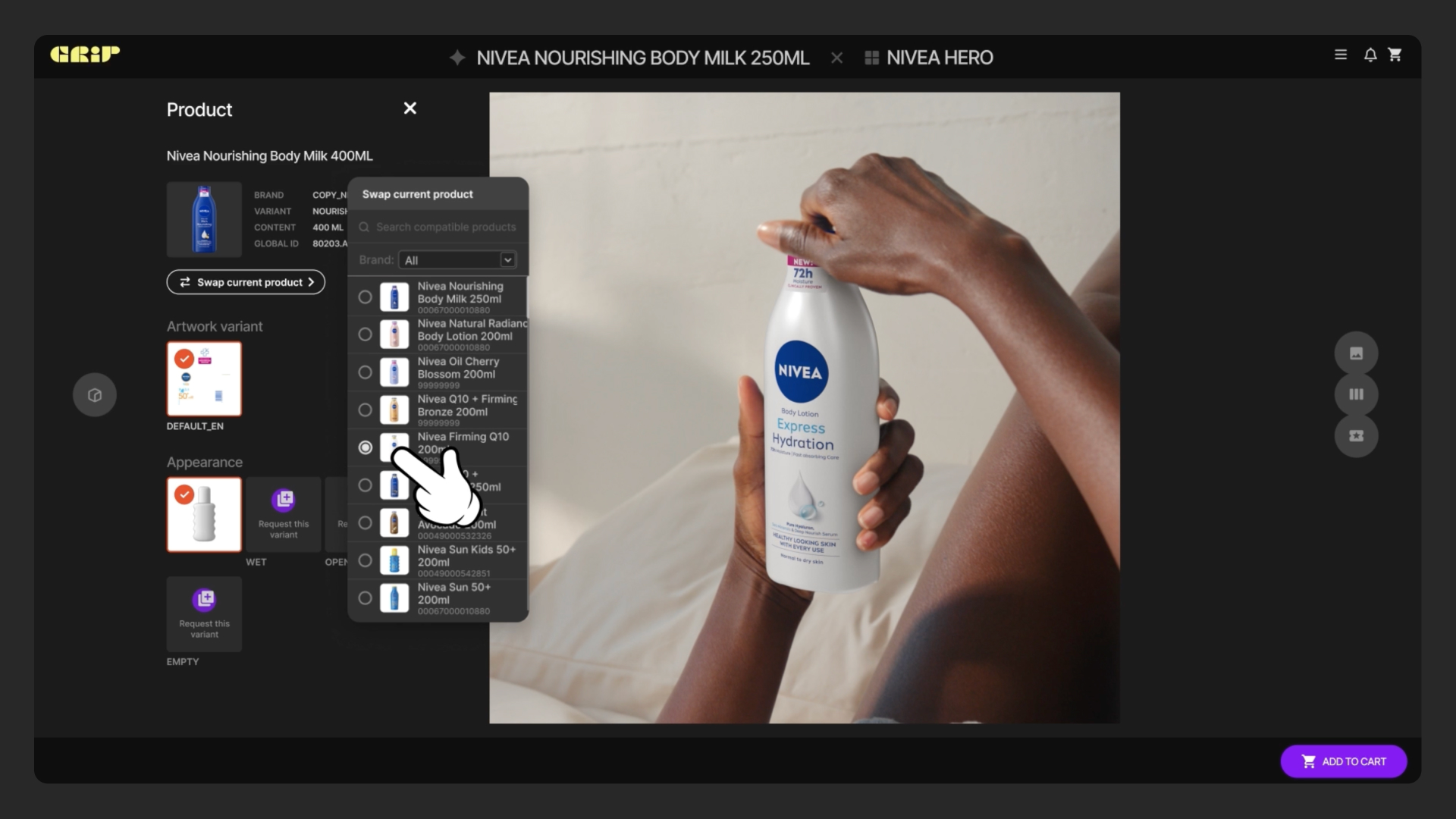
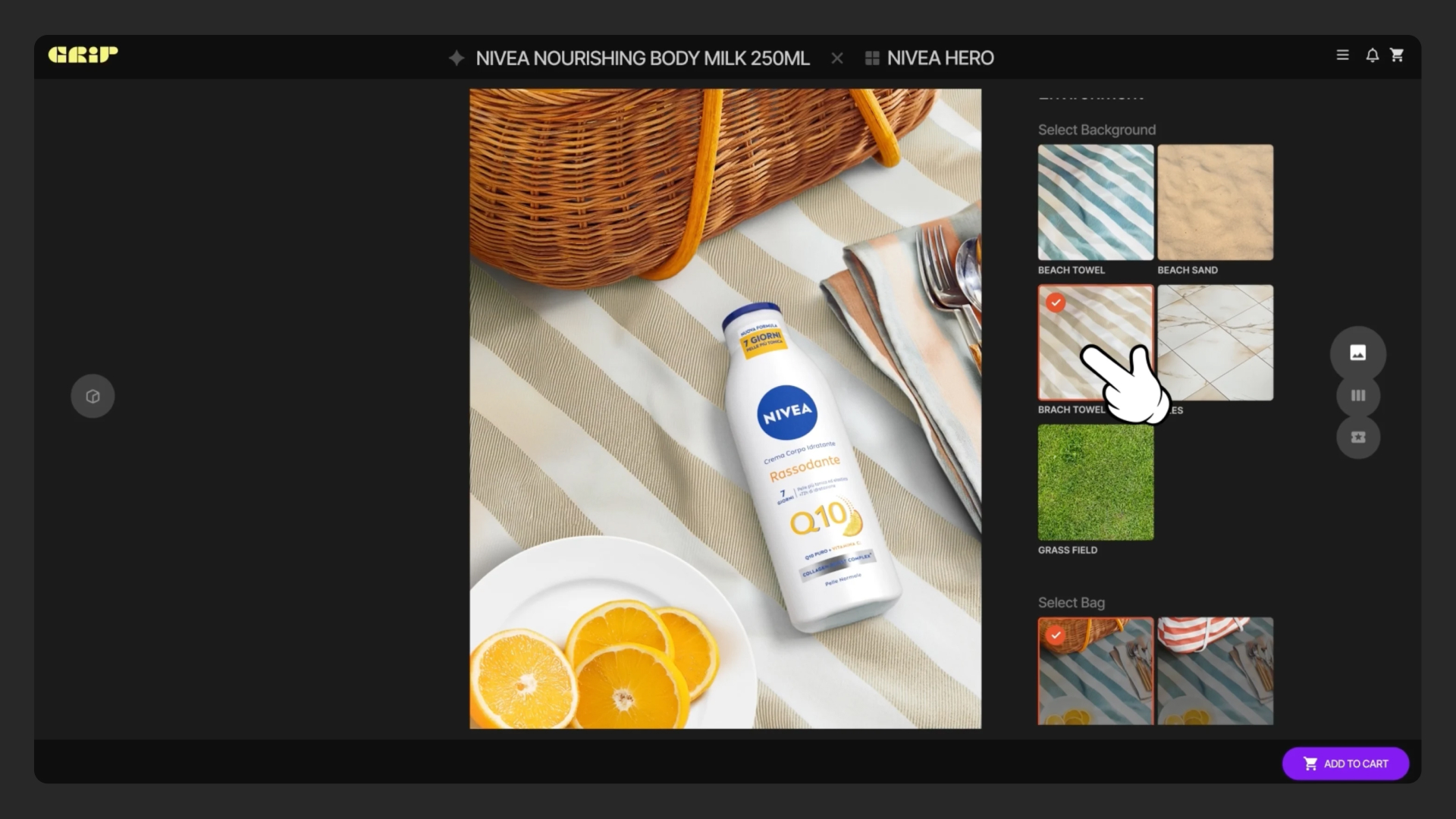
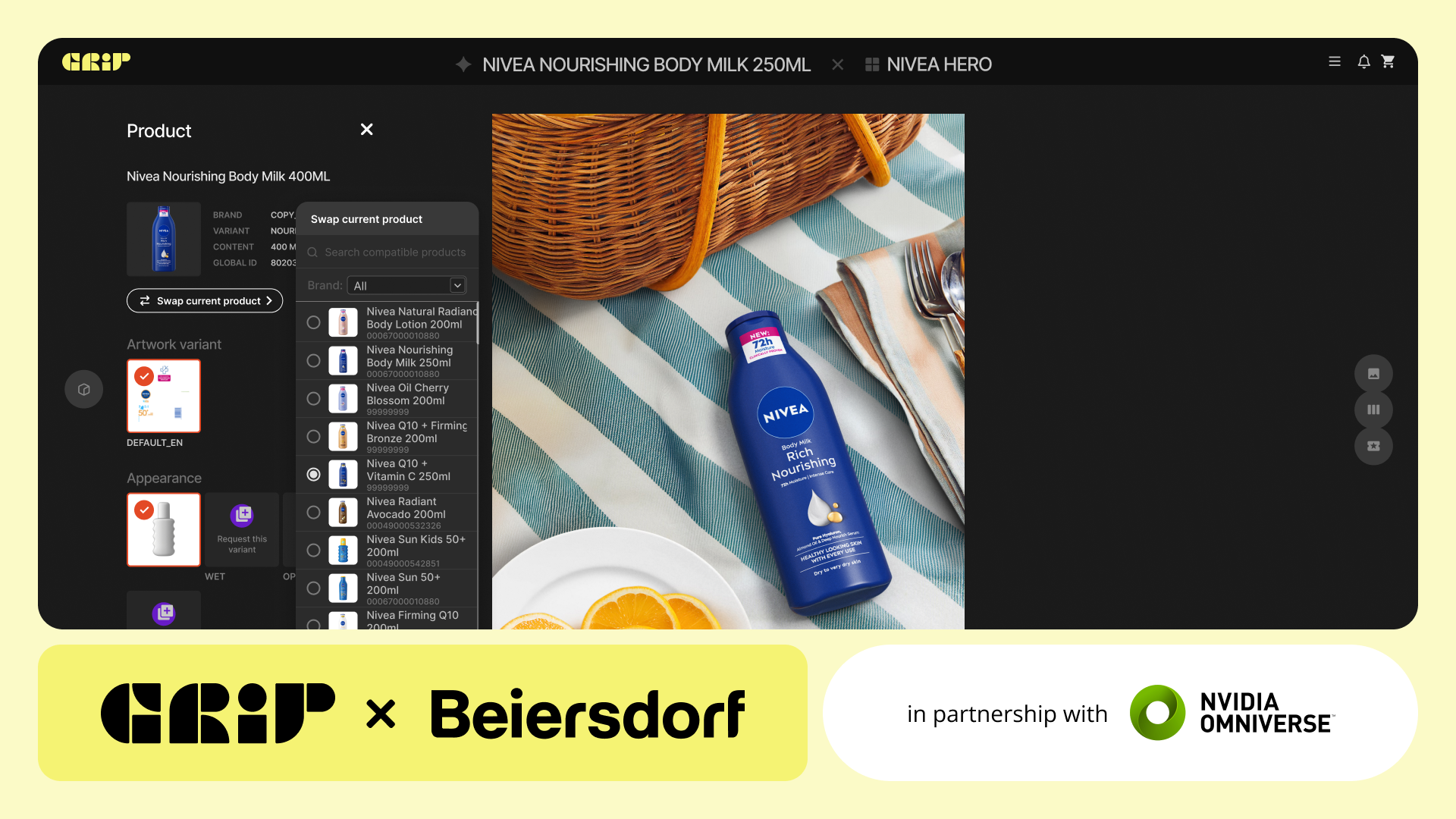
Grip is the enterprise automation platform for publishable marketing content at scale, built by INDG. It is built to move creative production inside the frontier. Digital Shelf generates product imagery from digital twins of the actual product. Adaptations produces compliant variations of a master asset, from Originals, a new campaign or an existing shoot, across markets and formats. Originals creates new on-brand content from a brief without a physical shoot, with art direction, brand and compliance rules from its Brand Center applied at generation time. Brands such as Beiersdorf use it to scale ad production for NIVEA and Eucerin, and LVMH maisons including Hublot and Château Galoupet are testing original content generation for hero beauty visuals, pack shots and social variants.
Where to start
List the advertising tasks your team does each month and place each one in the three columns above. For every task in the middle column, write down what the AI would need to know to get it right: the product data, the brand rules, the market claims. That list is the work that moves the task inside the frontier. For how production changes when that information is in place, read content production at scale, or talk to the Grip team.
Frequently asked questions
What is generative AI advertising?
Generative AI advertising uses AI models to create ad content such as copy, images, video and voice. It ranges from drafting headlines and adapting approved assets for new formats and markets, to generating new scenes and entire campaign films.
What are real examples of AI in advertising?
Examples include Nutella’s 2017 Unica jars, with millions of algorithm-generated label designs; Cadbury’s 2021 campaign that let local stores in India appear in personalized ads featuring Shah Rukh Khan; and Coca-Cola’s AI-generated holiday ads in 2024 and 2025.
Do you have to disclose AI-generated ads?
It depends on the market and the content. In the EU, the AI Act’s transparency rules have applied since 2 August 2026 and require deepfakes to be disclosed. New York requires ads that use synthetic performers to disclose it conspicuously. Advertising rules on misleading claims apply regardless of how an ad was made. This is general information, not legal advice.
Do consumers trust AI-generated ads?
Less than advertisers think. In IAB research published in January 2026, 82% of ad executives believed Gen Z and Millennial consumers feel positive about AI-generated ads, while only 45% of those consumers said they did.
How much ad spend is AI-powered?
Estimates vary by definition. Madison and Wall estimated that AI campaign types such as Google Performance Max and Meta Advantage+ would handle about 12% of US ad spend in 2026, up from 2% in 2023, and forecast 27% by 2030.
What should brands not automate with AI yet?
Tasks where errors are costly and hard to spot: final product depiction without the brand’s product data, claims and legal copy without review, synthetic people in hero campaigns, and creative strategy. These are better handled by people, or by AI working from approved data under the brand’s rules.
References
- Fabrizio Dell’Acqua et al., “Navigating the Jagged Technological Frontier: Field Experimental Evidence of the Effects of AI on Knowledge Worker Productivity and Quality,” Harvard Business School Working Paper 24-013, September 2023.
- Digiday, “Ad spend forecasts revised upward as more ad dollars are handled by AI tools,” 10 September 2026.
- The CMO Survey, Highlights and Insights Report, 2026.
- Dezeen, “Algorithm designs seven million different jars of Nutella,” 1 June 2017.
- WPP, “Not just a Cadbury ad” case study.
- ESM Magazine (Reuters), “Oreo maker Mondelez to use new generative AI tool to slash marketing costs,” 27 October 2025.
- NBC News, on Coca-Cola’s AI-generated holiday ads, 18 November 2024.
- Decrypt, on the Toys“R”Us Sora film, 25 June 2024.
- NBC News, on McDonald’s Netherlands’ AI-generated Christmas ad, 11 December 2025.
- System1, “AI or no AI, Coke gets the Christmas love,” 20 November 2025.
- IAB, “The AI Ad Gap Widens,” 15 January 2026.
- European Commission, “Quick facts: transparency rules for AI systems.”
- European Commission, “Transparency obligations under Article 50 of the AI Act” (FAQ).
- Hunton Andrews Kurth, “New York enacts law regulating the use of AI-generated synthetic performers in advertising.”
- Federal Trade Commission, “FTC Announces Crackdown on Deceptive AI Claims and Schemes,” 25 September 2024.
- Federal Trade Commission, “Federal Trade Commission Announces Final Rule Banning Fake Reviews and Testimonials,” 14 August 2024.
- ASA / CAP, “Generative AI & advertising: decoding AI regulation,” 31 August 2023.
About Grip
As INDG’s software branch, Grip is a visual content configuration engine powered by NVIDIA Omniverse that makes it possible for large enterprises to use AI at scale. It breaks existing content down into configurable modules, allowing brands to swap out any element, including products, talent, accessories, and branding assets, with complete control and accuracy. Grip integrates with existing workflows to automate product swaps and generate endless, hero-quality content variation, without disrupting established content production processes.