Advertising automation: automating ad creative production


Advertising automation is the use of software to run parts of advertising without manual work: buying media, setting bids, targeting audiences, assembling ads and producing creative variations. Over the past fifteen years it has transformed media buying. Real-time bidding systems make decisions in milliseconds, and Google reported in 2021 that more than 80% of its advertisers were already using automated bidding.
The creative side has moved much more slowly. In a Mediaocean survey of nearly 700 marketing and advertising professionals at the end of 2024, 86% said their creative and media processes were not synchronized. This guide explains why faster media automation has made ad creative production the bottleneck, what automating ad creative involves, and what to look for in an automated advertising platform for creative.
What is advertising automation?
The term covers two different halves of advertising:
- Media automation decides where, when and to whom ads run, and at what price: programmatic buying, automated bidding, audience targeting and budget allocation.
- Creative automation produces the ads themselves: the images, videos and copy, in every format, market and version a campaign needs. The guide to creative automation covers the different kinds of tools.
“Ad automation” is also used on the publisher side, for the systems websites use to place and sell ads. This guide is about advertisers.
The media side is already automated
Most of the decisions involved in buying media are now made by software:
- Real-time bidding happens in the time it takes a page to load. Google’s documentation for its ad exchange sets a latency requirement of 80 to 1,000 milliseconds for each bid response.
- Automated bidding sets prices for search and display. More than 80% of Google advertisers were using it by 2021, according to Google’s own data.
- AI campaign types run whole campaigns. Google’s Performance Max became available to all advertisers in November 2021. In January 2025, Meta told investors that its Advantage+ shopping campaigns had passed a $20 billion annual revenue run-rate and that all campaigns optimizing for sales, app or lead objectives would have Advantage+ turned on from the beginning.
In these systems, the advertiser supplies a goal, a budget and the creative, and the platform decides much of the rest.
Why creative is now the bottleneck
In 1967 the computer architect Gene Amdahl pointed out a limit that became known as Amdahl’s law. Speeding up one part of a process only helps as much as the remaining part allows. If a task is half serial and half parallel, making the parallel half infinitely fast still leaves the serial half, so the whole task can at most run twice as fast.
Advertising follows the same arithmetic. Take a hypothetical campaign in which media setup takes a day and creative production, versioning, approvals and trafficking take three weeks. Making media buying instant saves one day out of twenty-two. The campaign can only move as fast as its slowest serial step, and for most brands that step is producing and approving the ads.
Automated media also asks for more creative, not less. Performance Max takes up to 15 headlines, 5 long headlines, 5 descriptions, 20 images and 15 videos per asset group, in several aspect ratios. Meta’s own advice, as a spokesperson put it in 2026, is to “diversify your creative, test, and let the system optimize.” Every asset group, market and audience multiplies the work on the side of the process that is still largely manual.
What automating ad creative production involves
Ad creative production has four parts that can be automated, each with its own requirements.
Specs and formats
Every platform and placement has its own sizes, aspect ratios, durations and file limits. Performance Max alone asks for images in 1.91:1, 1:1 and 4:5 and video in 16:9, 1:1 and 9:16. The IAB’s New Ad Portfolio moved display toward aspect-ratio-based flexible sizes in 2017. Automating this step means producing every required format from one master, with the composition adapted to each ratio rather than cropped.
Versions for markets, audiences and products
A campaign that runs in 20 markets with 3 audience variants and 50 products is a matrix of thousands of ads before formats are counted. The guides to content localization and personalized advertising cover how to decide which versions are needed. Automating this step means generating them from approved inputs instead of building each one by hand.
Trafficking and creative IDs
Once made, ads have to be named, uploaded, tagged and tracked across platforms. The IAB Tech Lab’s Ad Creative ID Framework proposes a standardized ad creative ID for “consistent tracking, frequency management, and reporting across platforms.” Automating this step means every ad carries consistent metadata from the moment it is produced.
Compliance before launch
Categories such as alcohol, health and beauty have their own advertising rules on top of platform policies. The US spirits industry’s DISCUS code, for example, says that models and actors in spirits ads should be at least 25 years old, and that digital ads should only be placed where at least 73.8% of the audience can reasonably be expected to be of legal purchase age. Rules like these are easy to check once and hard to check a thousand times by hand, which is why they belong in the production system. (This is an illustration, not compliance advice.)
If you don’t supply the creative, the platform will
As media automation spreads, the platforms are also starting to fill gaps in creative. Google’s help pages state that if an advertiser doesn’t add a video to a Performance Max asset group, “one or more videos may be auto-generated from the assets in your asset group.” Meta’s standard enhancements can automatically adjust aspect ratios, apply templates and touch up images, and since version 22 of its Marketing API these settings are controlled feature by feature rather than with one switch.
This is a version of what the psychologist Lisanne Bainbridge called the irony of automation, discussed in the guide to content automation: the more a system automates, the more the remaining human decisions matter. For brands, the decision that matters is what goes into the system. A brand that supplies complete, compliant, on-brand assets in every format keeps control of how it appears, and any gaps in those assets are where the platform starts to improvise.
What to look for in an automated advertising platform for creative
Whether you are an enterprise brand or a DTC brand looking for an ad creative production workflow tool, the same questions separate tools that scale from tools that only speed up one step:
- Brand rules applied during production. Logo placement, typography, color and art direction should be enforced as the ad is made, not checked afterwards.
- Product accuracy. The product, pack and claims must be correct for each market in every version.
- Spec awareness. The platform should know each channel’s formats and produce them from a master without manual resizing.
- Versions from a master asset, so one approved campaign becomes every market, audience and format version.
- Compliance gates for category, market and platform rules before anything is published.
- Metadata and IDs that follow each ad into the ad platforms and reporting.
- Hand-off to media, so finished assets reach Google, Meta and other platforms without manual uploads.
Agencies, creative services or a platform?
The search for the best ad creative services for enterprise brands usually turns up three options. Creative agencies are strongest at concepts, campaigns and hero content. Production studios and creative services add capacity for volume work, usually priced per asset or per month. A production platform handles the rule-based work of versioning, resizing and localizing at a scale where hand-made assets become too slow. Most enterprise brands combine them, with agencies creating the idea and a platform producing the variations.
What it looks like in practice
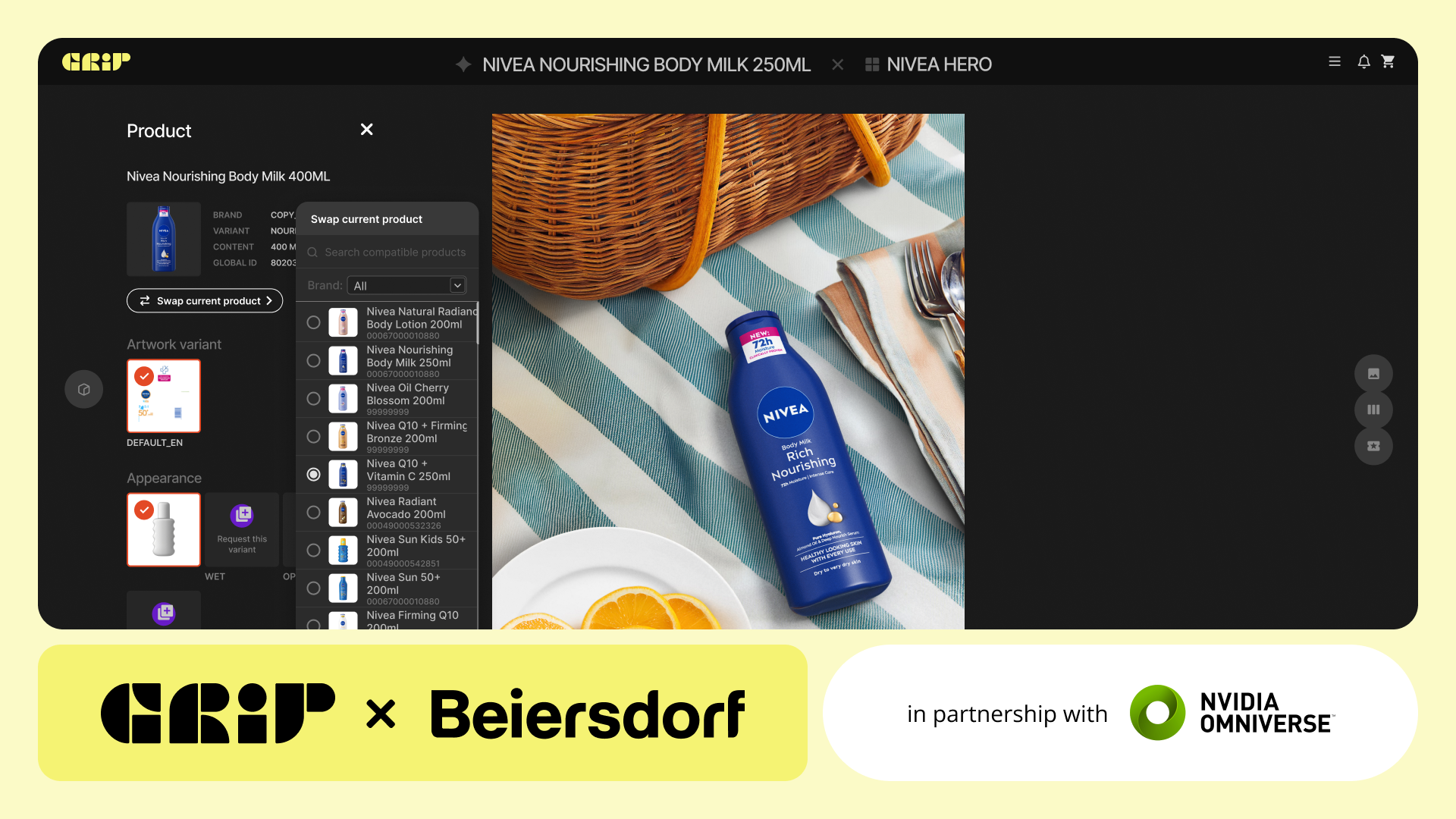
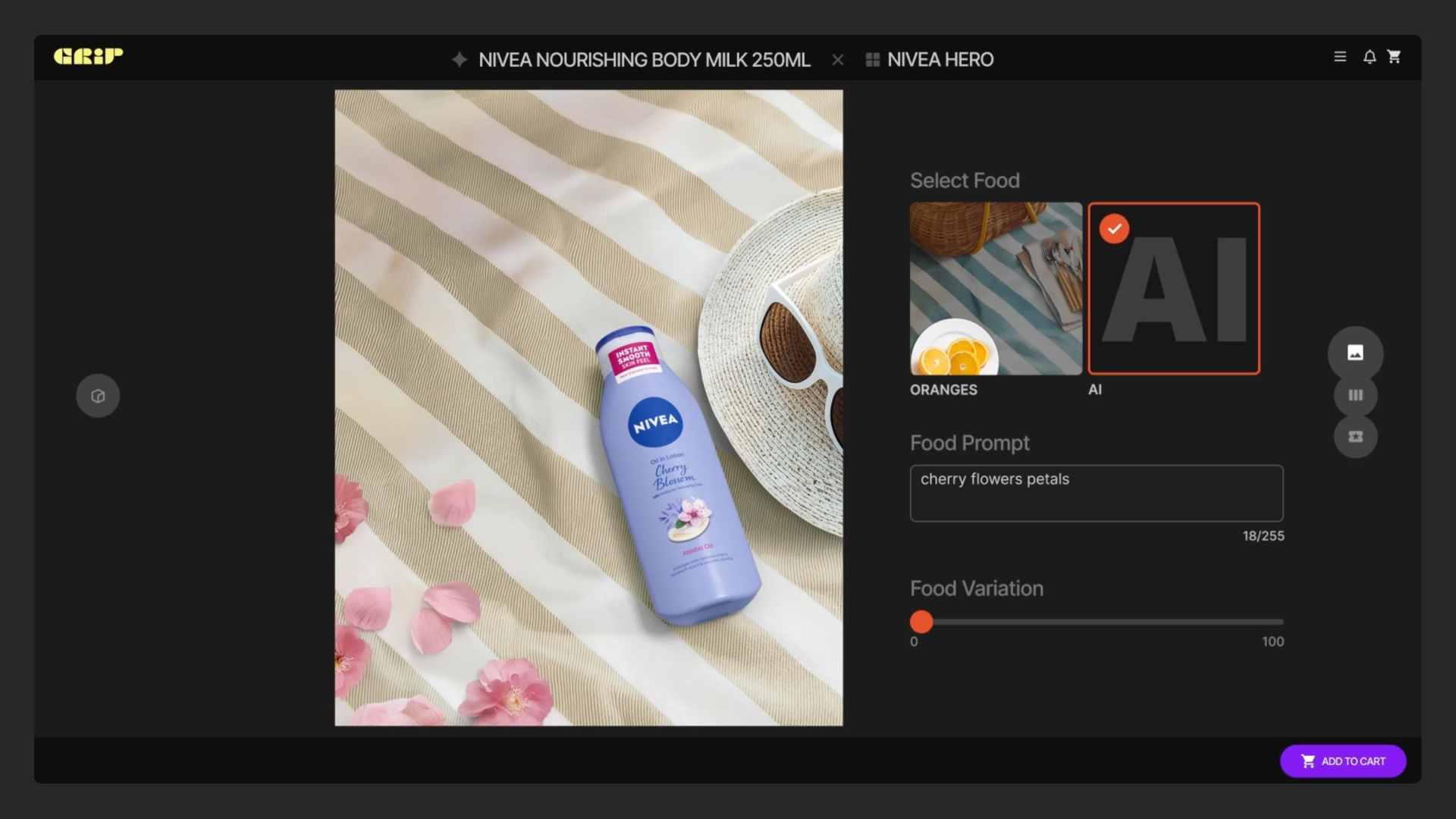
Beiersdorf, whose brands include NIVEA and Eucerin, found that lengthy photoshoots and manual edits were becoming unsustainable for its advertising. It works with Grip’s digital twins and rule-based AI to scale ad production and localize advertising across formats and channels. Moët Hennessy produces localized ad variations from shared templates across its brands and has delivered over 3 million content variations globally, at twice the speed.
Grip is the enterprise automation platform for publishable marketing content at scale, built by INDG. On the creative side of advertising automation, it produces on-brand ad creative and its variations. Art direction, brand and compliance rules are encoded in its Brand Center and applied when ads are generated. Adaptations turns a master asset, from Originals, a new campaign or an existing shoot, into compliant variations for every market and format. Digital Shelf generates product imagery from digital twins of the actual product for retail and e-commerce placements, and Originals creates new on-brand content from a brief without a physical shoot. Grip connects to existing DAMs, PIMs and artwork systems, so finished assets fit into the workflows that already feed the ad platforms.
Where to start
Take one recent campaign and time each step from approved brief to live ads in every market: media setup, creative production, resizing, versioning, approvals and trafficking. The longest serial step is your Amdahl bottleneck, and automating anything else will barely change the total. For the bigger picture of where AI fits, read about AI in advertising, or talk to the Grip team.
Frequently asked questions
Is ad automation the same as creative automation?
Not quite. Ad automation usually refers to automating media buying, bidding and campaign management. Creative automation refers to producing the ads themselves, such as images, videos and their variations for every format and market. Both are needed for a fully automated advertising process.
Can AI ad creative be on-brand and compliant?
Yes, when the AI generates from approved inputs and the brand’s rules are applied as the creative is made. AI ad creative generated from a prompt alone has to be checked and corrected afterwards, which limits how far it can scale.
What does an automated advertising platform do?
On the media side, it automates buying, bidding, targeting and budget allocation across channels. On the creative side, it produces ads in every required format, versions them for markets and audiences, checks them against brand and legal rules and hands them to the ad platforms.
Will Google or Meta create my ads if I don’t supply them?
Increasingly, yes. Google Performance Max can auto-generate videos from your other assets if you don’t add one, and Meta can automatically adjust and enhance creative. Brands that want control need to supply the assets and set the rules themselves.
Should enterprise brands use ad creative services or a platform?
Usually both, for different work. Agencies and creative services are strongest at concepts and hero content. A production platform is better at the high-volume, rule-based work of versioning, resizing and localizing ads for every format, market and audience.
References
- Google Ads Help, “Google Ads automated bidding.”
- Marketing Dive, on Mediaocean’s 2025 H1 Advertising Outlook report, 13 January 2025.
- Google Authorized Buyers, real-time bidding test guide.
- Google, announcement of Performance Max availability for all advertisers, November 2021.
- Meta Platforms, fourth quarter 2024 earnings call transcript, 29 January 2025.
- Gene M. Amdahl, “Validity of the single processor approach to achieving large scale computing capabilities,” AFIPS Spring Joint Computer Conference, 1967.
- Google Ads Help, “Performance Max campaigns specs and format requirements.”
- Marketing Brew, on Meta’s creative diversification guidance, 28 September 2026.
- IAB, “New Ad Portfolio,” 20 July 2017.
- IAB Tech Lab, “Ad Creative ID Framework (ACIF).”
- Distilled Spirits Council of the United States, Code of Responsible Practices for Beverage Alcohol Advertising and Marketing, 2025 edition.
- Meta for Developers, “Standard enhancements” (Advantage+ catalog ads).
- Lisanne Bainbridge, “Ironies of Automation,” Automatica 19 (6), 1983.
About Grip
As INDG’s software branch, Grip is a visual content configuration engine powered by NVIDIA Omniverse that makes it possible for large enterprises to use AI at scale. It breaks existing content down into configurable modules, allowing brands to swap out any element, including products, talent, accessories, and branding assets, with complete control and accuracy. Grip integrates with existing workflows to automate product swaps and generate endless, hero-quality content variation, without disrupting established content production processes.