Visual content localization for global brands


In CSA Research’s 2020 survey of 8,709 consumers in 29 countries, 76% said they prefer to buy products with information in their own language, and 40% said they will not buy from websites in other languages. It is no surprise that most writing about content localization is about words. The language services industry, by Nimdzi’s count, reached USD 71.7 billion in 2024.
For a brand that sells physical products, a large part of what a shopper sees first is visual: the pack shot, the claim on the label, the person using the product, the setting around it. Those elements need localizing too, and they rarely appear in translation workflows. This guide covers what content localization means once the content is visual, a content localization strategy borrowed from software engineering, and how to choose content localization tools for it.
What is content localization?
Content localization is the adaptation of content for a specific market, language and culture so it works there as if it had been made locally. For global brands it covers copy, images, video, packaging, product claims, legal marks and retailer specifications.
The definition used by software engineers was visual from the start. The W3C’s guide to localization lists “symbols, icons and colors”, graphics that may be misread or seen as insensitive in a given culture, and varying legal requirements alongside language. Marketing content localization applies the same idea to campaigns, product pages and retail content.
Localization as a whole adapts content for a market, from its language and imagery to its formats, cultural references and regulation. Translation changes the language only and is one part of that. Transcreation is the creative-copy end of localization, used when a literal translation would lose the meaning or effect of a headline or campaign idea, so the copy and the idea are recreated for the market. Which elements a campaign localizes, and whether the global or the local team decides, is the subject of marketing localization. This guide is about the assets themselves, and how their visuals and copy are adapted for many markets at production scale.
What changes in visual content from market to market
The elements below vary by market for most consumer brands. The examples are illustrations, not compliance advice.
| Element | Why it varies | Example |
|---|---|---|
| Text inside the image | Translations are longer or shorter than the source, and some scripts read right to left | IBM’s guidelines, cited by the W3C, expect English strings of up to ten characters to grow by 200 to 300% in translation |
| Pack and on-pack claims | Labeling language and permitted claims are set by each market | EU food law requires mandatory food information in a language easily understood by consumers where the food is sold |
| Product claims in the visual | The same product is described differently by different regulators | US sunscreen rules allow “Broad Spectrum SPF” only after a test, and ban “waterproof” and “sunblock” |
| Legal warnings | Some markets require their own wording, placement and format | US alcohol labels must carry a “GOVERNMENT WARNING” in capitals and bold |
| Models, settings, food and props | People respond to imagery they recognize, and what looks ordinary, aspirational or unacceptable differs, as do the seasons and holidays a scene can show | Netflix found that the best-performing artwork for some titles varied between countries and cultures |
| Symbols, maps and gestures | Borders, colors and hand signs carry different meanings | Microsoft had to withdraw a Windows 95 time-zone map in India because of how it showed Kashmir |
| Retailer image specifications | Each retailer sets its own sizes, angles, backgrounds and image counts | Product image standards such as GS1’s specify how products are photographed and named |
Imagery also shapes what people look at in the first place. In a 2016 study of how members browse, Netflix reported that artwork accounted for more than 82% of their focus. That figure comes from one company’s own research on browsing a streaming service, but the regional differences it found apply to any brand that shows the same image in many countries.
Why visual localization breaks at scale
In most organizations, visual content reaches markets as finished files. A global team delivers a campaign image with the headline, the claim and the legal line already set into the picture. Each market then opens the file, rebuilds the text in its own language, swaps what it can and sends the result for approval. When something can’t be swapped, such as a pack with the wrong language on it, the market books its own shoot or retouch.
That approach produces three familiar problems. The work is repeated in every market, so the cost grows with the number of markets. The quality depends on each local team, so the brand drifts. And the edits are made by hand on finished images, so errors are easy to make and hard to find. In 2012, IKEA’s Saudi Arabian catalog showed the same rooms as other editions with the women and girls removed, a local edit to a global asset that became international news.
The underlying issue is that the master was never designed to be localized. Every change has to be cut out of a finished picture.
A content localization strategy borrowed from software
Software teams faced the same problem decades ago and split the work in two. Internationalization (i18n) designs a product so it can be localized without being rebuilt. Localization (l10n) then adapts it for each market. In the W3C’s description, internationalization includes “separating localizable elements from source code or content, such that localized alternatives can be loaded or selected.” The same split makes a practical content localization strategy for visual content.
1. Separate what varies from what stays
Treat a master asset as layers rather than a flat image. The product, the scene, the headline, the claim, the legal line and the logo lockup each become a separate element, with clear rules for which of them may change. When the product itself is a 3D digital twin, the pack can show the right language and claims for each market without a new shoot. When the master comes from a traditional shoot, the same principle applies to the elements around the product.
2. Test the master before the first market
Software teams use pseudo-localization to check that a product is localizable “without actually localizing into a real language”, as Microsoft’s guidance puts it, by lengthening text and mirroring layouts early in development. A visual master can be tested the same way before rollout. Fill it with the longest expected headline, the longest claim and a right-to-left script, and see whether the layout still holds. Problems found at this stage are fixed once, in the master, instead of in every market.
3. Global, regional, local: store only the differences
The Unicode Common Locale Data Repository, which supplies locale data to many operating systems and browsers, organizes markets in a hierarchy. Shared data sits at the language level, and country locales “only need to supply differences”. Regional content localization works the same way. A Spanish-language version for Latin America carries the shared language and claims once, and each country adds only what is specific to it. Every regional decision is made once instead of in every country.
4. Treat market rules as data
Claims, warnings, label languages, retailer specifications and approved imagery differ by market, and they change. Kept in documents and in people’s heads, they have to be checked asset by asset. Kept as structured data that the production system applies, they are enforced every time a version is made, and a change to a rule reaches every future asset. This is where legal and regulatory teams contribute most, because they maintain the rules once instead of reviewing each file.
Content localization tools and software: what each one localizes
“Content localization tools” covers several categories that localize different parts of the content. Most enterprises need more than one:
- Translation management systems, CAT tools and machine translation handle words: copy, product descriptions, subtitles and UI text.
- Website localization tools serve translated versions of web pages.
- DAMs and content hubs store and distribute localized versions, but don’t create them.
- Template tools swap text and images inside fixed layouts, which works well for simple formats.
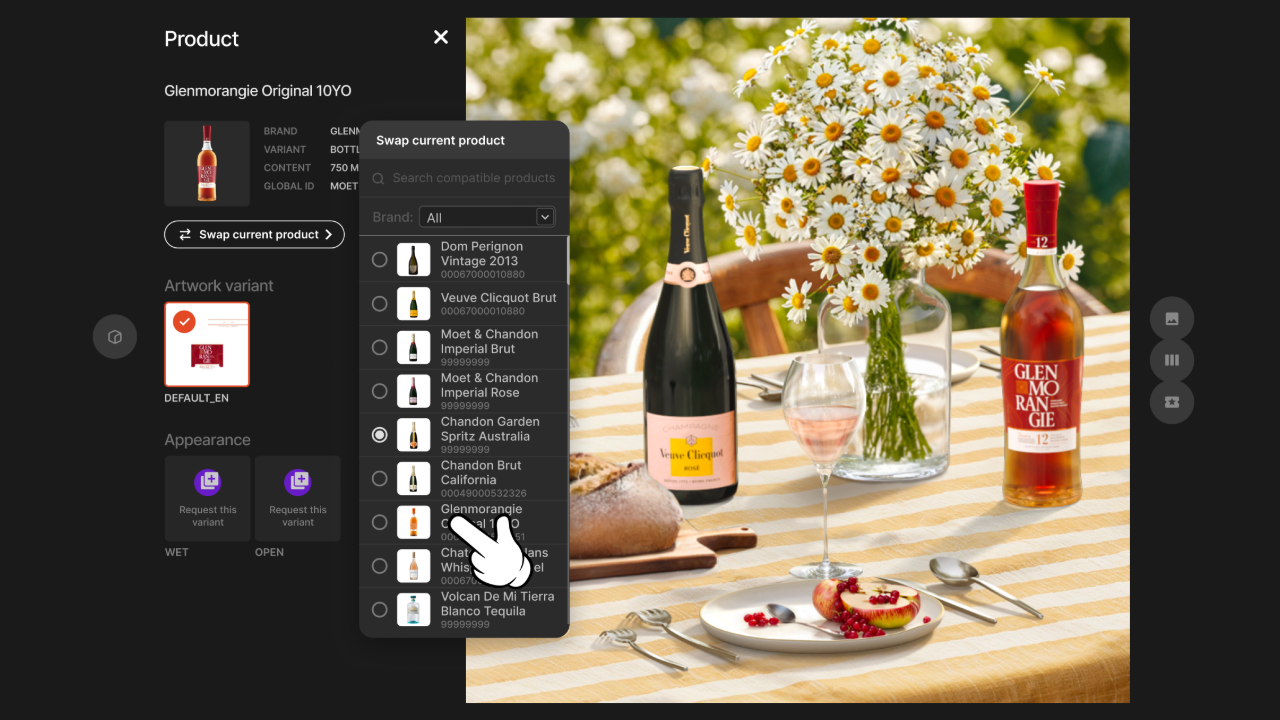
- Visual production platforms generate localized images and video from a product twin or master asset and the market’s rules, which covers packs, claims, settings and formats.
When you compare content localization software or global content localization solutions, ask:
- Which elements of a visual can it change per market, and which still need a designer?
- Where are market rules kept, and who maintains them?
- What happens to every localized version when a pack or claim changes?
- Can it handle regional and local levels without duplicating work?
- Does it connect to your translation management system, DAM and product data?
What it looks like in practice
Moët Hennessy uses Grip to produce visuals across more than 25 maisons and over 70 markets, giving local teams controlled flexibility to adapt for cultural relevance while keeping brand consistency. Its teams have delivered over 3 million content variations globally, at twice the speed. Beiersdorf set out to create hyper-localized content for all its formats and channels and combined digital twins of its portfolio with AI-enabled content configurators to localize advertising for NIVEA and Eucerin. Opella, facing decentralized workflows and rising localization costs, centralized its e-commerce content production while keeping local teams free to move fast.
Grip is the enterprise automation platform for publishable marketing content at scale, built by INDG. It applies the software split described above to visual production. Each market’s art direction, brand and compliance rules are kept as data in its Brand Center, and Adaptations turns a master asset, from Originals, a new campaign or an existing shoot, into a layered template. The product sits on a locked layer while the headline, claim, legal line and format change for each market and channel. Digital Shelf produces localized product page and e-commerce imagery from digital twins of the product, used as they are. Where a market needs a scene the master doesn’t have, Originals generates one from a brief, grounded in the twin and the Brand Center rules, and the result is on-brand by design. Grip connects to existing DAMs, PIMs and artwork systems, and because the twins and rules belong to the brand, each market added makes the next one easier to set up.
Where to start
Take one hero asset and its last five market versions. List every element that changed, who changed it and how long it took. The list shows which layers your masters need to separate, which rules belong in data and where a regional level would remove duplicate work. For the operating model behind it, read what is a content supply chain (and how to fix it), or talk to the Grip team about localizing your own content.
Frequently asked questions
How is content localization different from translation?
Translation converts text from one language to another. Content localization adapts the whole piece of content for a market, including images, colors, symbols, units, legal requirements and cultural references. Translation is one part of localization.
What are examples of visual content localization?
Common examples are changing the language and claims on a pack shot, replacing models, settings or props so they fit the market, adding a required legal warning, adjusting maps, symbols and reading direction, and resizing images to each retailer’s specifications.
What should a content localization strategy include?
A clear split between what stays global and what can vary, master assets designed so the variable parts can be changed easily, a test of the master against the hardest markets before rollout, market rules kept as data, and a model for which differences are set globally, regionally and locally.
What should you look for in content localization software?
Check which part of the content each tool localizes. Translation management systems handle words, website tools handle pages, DAMs store versions, and production platforms generate localized visuals. For visual content, look for tools that apply market rules automatically and keep the product accurate in every version.
What is regional content localization?
Regional content localization adapts content once for a group of markets that share a language, regulation or culture, such as Latin America or the GCC, before any country-specific changes are made. It reduces duplicated work, because each local version only needs to add its own differences.
References
- CSA Research, “Consumers Prefer their Own Language” (Can’t Read, Won’t Buy – B2C, 8,709 consumers in 29 countries), 7 July 2020.
- Nimdzi, “The Nimdzi 100” (2025 edition).
- W3C, “Localization vs. Internationalization.”
- W3C, “Text size in translation.”
- Microsoft Learn, “Pseudolocalization.”
- Unicode, “Unicode Locale Data Markup Language (LDML),” UTS #35.
- Regulation (EU) No 1169/2011, Article 15 (language requirements).
- U.S. Food and Drug Administration, “Questions and Answers: FDA announces new requirements for over-the-counter (OTC) sunscreen products marketed in the U.S.”
- Alcohol and Tobacco Tax and Trade Bureau, “Distilled Spirits Health Warning Statement.”
- Netflix, “The Power of a Picture,” 3 May 2016.
- UPI, “Microsoft settles India controversy,” 9 September 1995.
- Al Jazeera, “Swedish firm erases women in Saudi catalogue,” 1 October 2012.
About Grip
As INDG’s software branch, Grip is a visual content configuration engine powered by NVIDIA Omniverse that makes it possible for large enterprises to use AI at scale. It breaks existing content down into configurable modules, allowing brands to swap out any element, including products, talent, accessories, and branding assets, with complete control and accuracy. Grip integrates with existing workflows to automate product swaps and generate endless, hero-quality content variation, without disrupting established content production processes.