Transcreation: recreating copy and ideas for every culture


Transcreation is the adaptation of a marketing message for another language and culture so it has the same effect there, even when the words, the references and sometimes the images have to change. It is the creative-copy end of localization, closest to copywriting, and it is used where a literal translation would lose the humor, emotion or persuasion of the original.
Most guides to transcreation stop at the copy. Microsoft’s localization guidance is broader, describing transcreation as something that “adapts not just text, but also video, audio, and images.” This guide explains what transcreation means, how it differs from translation and localization, which famous examples are real and which are myths, and what changes when the image needs transcreating as well as the headline.
What is transcreation?
Transcreation recreates a message for a new audience, using the original as a brief rather than a script. A transcreator, usually a copywriter who is native to the target market, starts from what the message is meant to do and writes whatever achieves that in the new culture.
There is no single agreed definition. A 2021 systematic review of academic research on transcreation found that the literature “does not offer a homogenous definition.” In practice, the term covers anything from a freely rewritten tagline to a fully re-imagined campaign for one market.
Where the word comes from
The term is usually traced to literature rather than advertising. The Indian poet and translator P. Lal used it in the 1960s for his English versions of Sanskrit plays, and the Brazilian poet Haroldo de Campos wrote in the same period about translation as creation. Earlier still, in 1959, the linguist Roman Jakobson described “intersemiotic translation”, the interpretation of verbal signs by means of nonverbal sign systems. That idea, carrying a message from words into images or the other way round, is the theoretical ancestor of visual transcreation.
Transcreation vs translation vs localization
Localization is the widest of the three terms. It adapts content for a market, covering its language, imagery, formats, cultural references and regulation. Translation changes the language only and is one part of localization. Transcreation sits at the creative-copy end of localization, where the idea and the copy are recreated because a literal translation would lose their meaning or effect. The table sets the three side by side.
| Translation | Localization | Transcreation | |
|---|---|---|---|
| How it relates | One part of localization | The whole adaptation for a market | The creative-copy end of localization |
| Goal | Carry the meaning faithfully | Make content fit a market | Recreate the idea and its effect |
| What changes | Language only | Language, imagery, formats, cultural references, regulation | The creative idea and the copy, plus any image that carries the idea |
| Who does it | Translators | Localization teams and vendors | Native copywriters and creative teams |
| Typical content | Manuals, contracts, product specifications | Websites, product pages, packaging, apps | Slogans, headlines, campaigns, brand names |
| How it is priced | Usually per word | Per word and per asset | Usually by time or per project |
When translation is enough
When the content is informational and the facts matter more than the tone: specifications, instructions, legal text and most product descriptions.
When localizing the details is enough
When the message works in the new market as it stands and only the details around it need to change, such as language, formats, claims, imagery or retailer requirements. That is localization without transcreation. The guide to content localization covers how the assets themselves are adapted, and the guide to marketing localization covers how a campaign decides what to change and who makes the call.
When you need transcreation
When the message depends on wordplay, rhyme, cultural references, humor or emotion that won’t survive translation, or when the idea itself means something different in the new market.
The idea behind it: equivalent effect
In 1964 the linguist Eugene Nida, who worked on Bible translation, distinguished between formal equivalence, which follows the form of the source text, and dynamic equivalence, which aims for “the closest natural equivalent to the source-language message” and for the same response in the new reader. One of his examples is about a gesture. The translator J.B. Phillips rendered the instruction to greet one another with “a holy kiss” as “a hearty handshake all around”, because a kiss would not carry the intended meaning for his English readers.
Transcreation applies Nida’s principle to marketing. A later school of translation theory, known as skopos theory, adds that the purpose of a text in its new situation decides how it should be translated. For a campaign, that purpose is in the brief.
Phillips changed a gesture, which is a visual element. The French theorist Roland Barthes argued in 1964 that the text next to an image “anchors” which of its possible meanings the viewer takes. In an ad, the headline and the picture work together, so transcreating one without the other can leave them saying different things.
Transcreation examples
Haribo
Haribo’s German slogan “Haribo macht Kinder froh” dates from 1930, and “und Erwachsene ebenso” (and adults too) was added in the 1960s, according to the company’s history. The English version, “Kids and grown-ups love it so, the happy world of Haribo”, keeps the rhyme and the warmth rather than the literal meaning.
McDonald’s “i’m lovin’ it”
When McDonald’s launched “i’m lovin’ it” in 2003 as a global brand campaign, created with the Munich agency Heye & Partner, the company said local creative teams would execute the style, musical approach and theme-line in their own markets. The global idea was fixed, and its expression was transcreated per market.
Coca-Cola’s Chinese name
Coca-Cola is sold in China as 可口可乐 (kěkǒu kělè), which roughly means “let the mouth rejoice” and sounds close to the original name. It is a classic example of transcreating a brand name for both sound and meaning.
White Friday
When the online retailer Souq brought Black Friday to the Middle East in 2014, it named the event “White Friday”. Gulf News explained the name as a mark of respect for Friday as the day of worship and of gathering with friends and family in the Arab world.
Famous examples that are myths
Several stories that appear on many transcreation pages don’t hold up:
- Coca-Cola as “bite the wax tadpole”. Sinologist Victor Mair calls this an urban legend. The company never used that name, although some shopkeepers may have written improvised phonetic versions of the name.
- The Chevy Nova “doesn’t go” in Spanish. Snopes rates the claim that the Nova failed in Spanish-speaking markets because “no va” means “doesn’t go” as false.
- Pepsi “brings your ancestors back from the grave” in China. The story has never been substantiated.
They survive because they illustrate cultural risk well, which is a good reason to check a story before repeating it.
Visual transcreation: when the image carries the idea
Microsoft’s own guidance for transcreating a car brochure says people in the photos “might be recast to be more representative of the target market”, and that images might show landmarks and scenery from the market, down to street and road signs. Film studios do the same. For the Japanese release of Inside Out, Pixar replaced the broccoli a child refuses with green peppers, because, as director Pete Docter explained, broccoli isn’t considered gross in Japan. The studio also changed on-screen signs and other details for international releases. In Zootopia, the news anchor is a moose in the US and Canadian versions, a koala in Australia and a jaguar in Brazil, each voiced by a well-known local news anchor.
In the broccoli scene the picture carried the joke, so recreating the joke meant changing the picture. Other changes, such as the on-screen signs or the recasting and local streets in Microsoft’s example, are often needed even when the copy is only translated, and they belong to content localization. The guide to content localization lists those visual elements one by one, from casting and props to symbols, on-pack text and retailer specifications. Visual transcreation is the narrower case, where an image is recreated together with the copy because the image carries the idea.
What should not change
Visual transcreation has limits. The product must be shown as it actually is in that market, with the right pack, label, shade and approved claims. Brand codes such as the logo, color and typography stay recognizable. And the brand’s values hold everywhere. A transcreated scene changes the people, the place and the props around the product.
The transcreation process
Marketing transcreation works best as a structured creative process rather than a translation job:
- Brief. State the purpose of the message, the audience, the tone, what must not change, the legal limits, and the images and formats the copy will appear with. The Institute of Translation and Interpreting recommends including any images in the brief.
- Creative options. The transcreator writes several versions, each with a back-translation into the source language and a short rationale.
- Local review. Market teams choose and refine, checking cultural fit and claims.
- Visual adaptation. Images are checked against the chosen copy and adapted where the picture and the words no longer match.
- Approval and launch, with the final copy and visuals reviewed together.
Cost and timelines
Transcreation is priced differently from translation. As the ITI puts it, “the cost of transcreation is the cost of the time it takes to come up with the final copy.” Microsoft notes that it “takes more time and is more costly than other forms of localization.” The copy is rarely the expensive part, though. Rewriting a headline takes a copywriter hours. Re-shooting a scene with new casting, food or a new setting for one market can take weeks and a production budget, which is why images are often left unchanged even when they should be adapted.
Content transcreation at scale
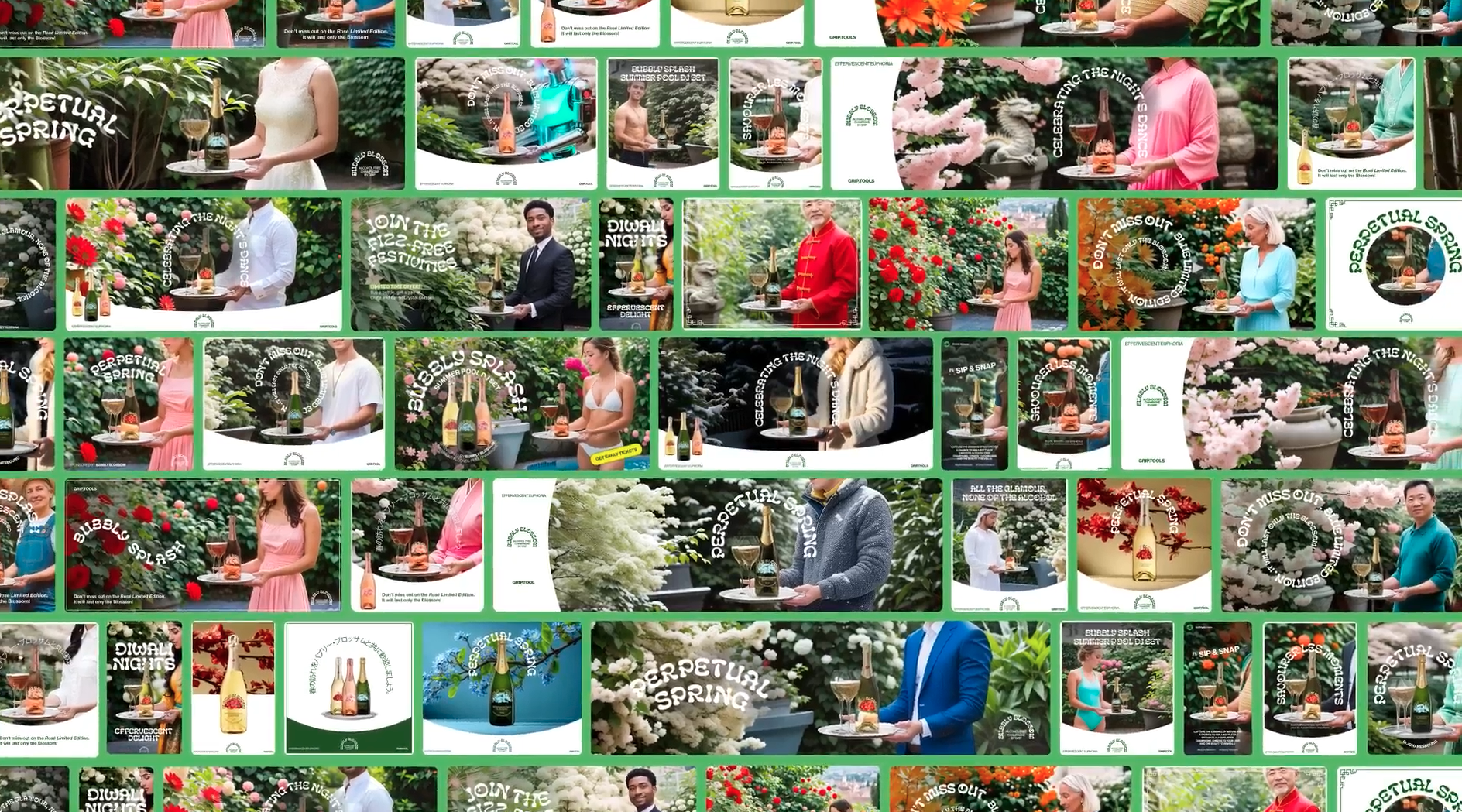
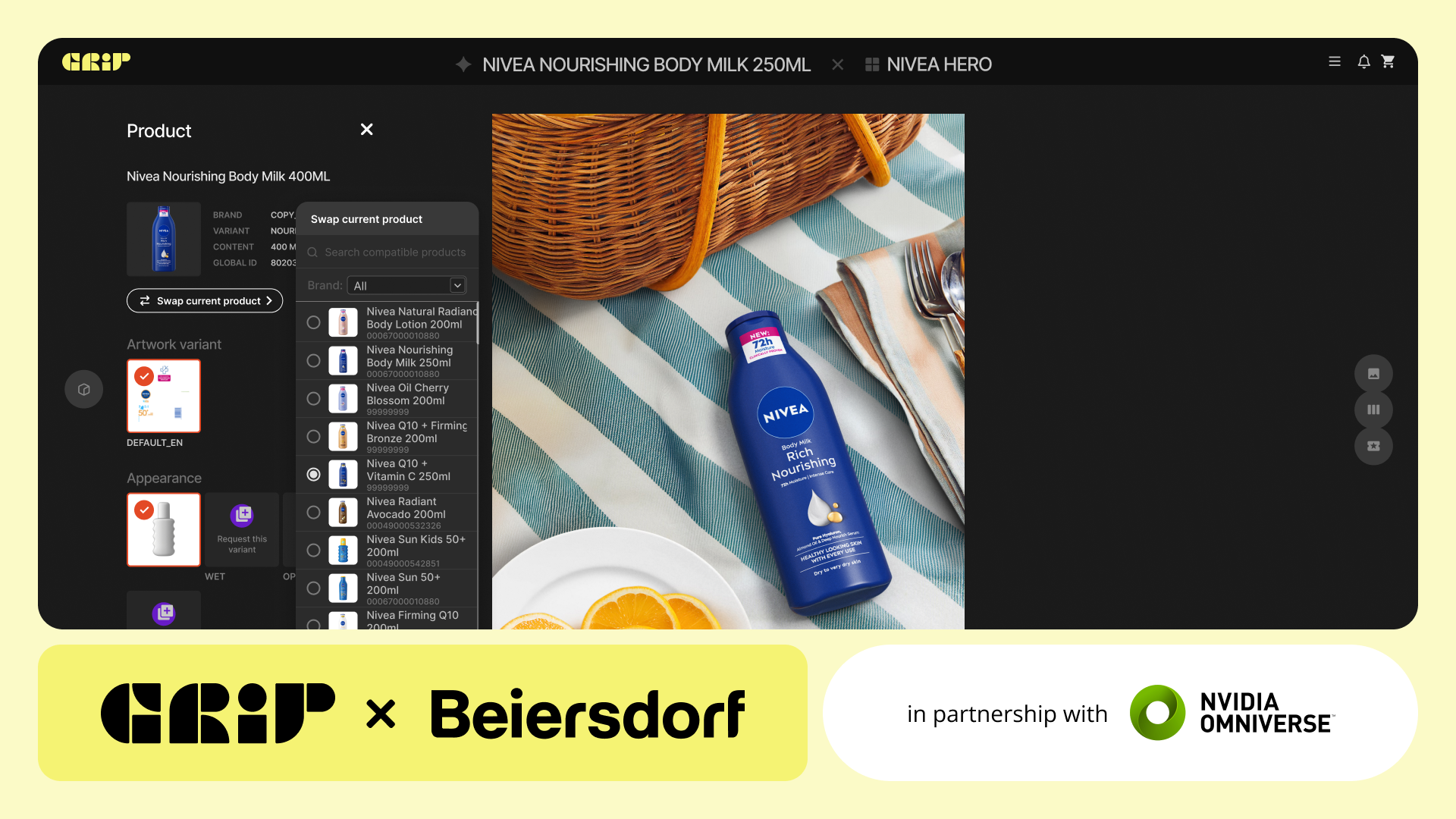
For a global brand, the challenge is doing this for dozens of markets and hundreds of formats. Content transcreation at that scale depends on how the visuals are produced. A finished photograph with the casting, setting and props fixed into it can only be transcreated by shooting again. A master built from separate elements, with the product as a 3D digital twin and the scene, people and props as variable parts, can be adapted per market while the product stays exact. And where a market’s recreated idea needs a scene that doesn’t exist yet, new imagery can be generated from a brief, grounded in the product data and the brand’s own rules rather than a prompt alone. The guide to creative automation explains the different ways tools produce these variations.
What it looks like in practice
The global-to-local demo shows one campaign adapted into many market versions around the same product. Moët Hennessy uses Grip to produce localized ad variations across its maisons and has delivered over 3 million content variations globally, at twice the speed. Beiersdorf uses digital twins of NIVEA and Eucerin products to create localized advertising for its markets and channels.
Grip is the enterprise automation platform for publishable marketing content at scale, built by INDG. On a transcreated campaign, its part is the imagery that has to follow the new line in each market. Art direction, brand and compliance rules are encoded in its Brand Center. Adaptations works from a master asset, from Originals, a new campaign or an existing shoot, and holds the product on a locked layer of the template, so it stays as approved while the elements around it change for each market and format. When a market’s new idea calls for a scene the master doesn’t contain, Originals generates it from a brief without a physical shoot, grounded in the product’s digital twin and the Brand Center rules, so the scene is on-brand by design. Digital Shelf covers the product pages a campaign leads to, with e-commerce imagery produced from the twins as they are.
Where to start
Take a recent campaign that was transcreated for several markets and look at each market’s final ad with the image and the headline together. Note where the copy was adapted but the picture wasn’t, and what would have had to change in the image to match. That list is your visual transcreation brief for the next campaign. For the campaign-level decisions behind it, read the guide to marketing localization, or talk to the Grip team.
Frequently asked questions
What is the difference between transcreation and translation?
Translation aims to carry the meaning of the original text into another language as faithfully as possible. Transcreation aims to carry the effect, such as the emotion, humor or persuasion, and is free to change the words, structure and references to achieve it.
Is transcreation the same as localization?
No. Localization adapts content for a market, including its language, imagery, formats, cultural references and regulation, and usually keeps the original message. Transcreation is the creative-copy end of localization. It recreates the idea and the copy for a market when a literal translation would lose their meaning or effect.
What is an example of transcreation?
Haribo’s German slogan “Haribo macht Kinder froh, und Erwachsene ebenso” became “Kids and grown-ups love it so, the happy world of Haribo” in English. The English line keeps the rhyme and the feeling rather than the literal meaning.
Does transcreation include images and visuals?
It should, when the image carries part of the idea. A transcreated headline can be undermined by a picture that no longer matches it, such as food, a gesture or a setting that means something different in the market. Visual transcreation recreates those parts of the image along with the copy, while the product, brand codes and brand values stay the same.
How much does transcreation cost?
Transcreation is usually priced by time or per project rather than per word, because the work is closer to copywriting than to translation. Visual transcreation adds production cost for every image that has to change, unless the images are produced from adaptable masters.
What goes into a transcreation brief?
The purpose of the message, the target audience and market, the tone and brand voice, what must not change, the images and formats it will appear with, any legal or claim restrictions, and the original creative rationale.
References
- Microsoft Learn, “Transcreation.”
- Pilar Díaz-Millón and María Dolores Olvera-Lobo, “Towards a definition of transcreation: a systematic literature review,” Perspectives, 2021.
- Roman Jakobson, “On Linguistic Aspects of Translation,” in R. Brower (ed.), On Translation, Harvard University Press, 1959.
- Eugene A. Nida, Toward a Science of Translating (1964), excerpt in “Dynamic Equivalence Defined,” Bible Research.
- Roland Barthes, “Rhetoric of the Image” (1964), in Image, Music, Text, Fontana, 1977.
- HARIBO, “100 years of HARIBO.”
- McDonald’s Corporation, “McDonald’s Unveils New Brand Creative Direction at Worldwide Marketing Conference in Chicago,” 11 June 2003.
- Victor Mair, “But, will think,” Language Log, 14 March 2019.
- Amazon Ads, “A guide to advertising on White Friday in the Middle East.”
- Gulf News, “Black Friday is new White Friday for Souq.”
- Snopes, “Did the Chevrolet Nova Fail to Sell in Spanish-Speaking Countries?”
- Snopes, “Pepsi Brings Back Ancestors.”
- SoraNews24, “Pixar alters Inside Out’s visuals for Japanese release, removes broccoli,” 24 July 2015.
- /Film, “Why Inside Out Changed So Many Scenes For Its Overseas Release,” 7 January 2022.
- Mental Floss, “Zootopia Has Different News Anchors for Different Countries,” 8 March 2016.
- Institute of Translation and Interpreting, “Transcreation explained,” 29 November 2023.
About Grip
As INDG’s software branch, Grip is a visual content configuration engine powered by NVIDIA Omniverse that makes it possible for large enterprises to use AI at scale. It breaks existing content down into configurable modules, allowing brands to swap out any element, including products, talent, accessories, and branding assets, with complete control and accuracy. Grip integrates with existing workflows to automate product swaps and generate endless, hero-quality content variation, without disrupting established content production processes.