Marketing localization: adapting campaigns for every market


In 1983 Theodore Levitt argued in Harvard Business Review that “a powerful force drives the world toward a converging commonality, and that force is technology.” Global brands would sell the same products in the same way everywhere. More than forty years later, the same brands still run many local versions of their campaigns, and the question Levitt raised is still open in most marketing departments: what should a global campaign keep, and what should each market change?
Most guides to marketing localization answer with a list of steps. This one starts with the decision underneath the steps. It covers what marketing localization is, what research says about standardizing versus adapting, a model borrowed from military command for splitting decisions between global and local teams, and how to turn that into a localization strategy your markets can work with.
What is marketing localization?
Marketing localization is the adaptation of marketing campaigns, messages and assets for each market so they fit its language, culture, regulations and buying habits, while the brand stays recognizable everywhere. It works at the level of the campaign, deciding which idea travels, which elements change and whether the global or the local team makes each call.
Localization in general adapts content for a market, which covers its language, imagery, formats, cultural references and regulation. Translation changes only the language, so it is one part of that work. Transcreation is the creative-copy end of localization, where the idea and the copy are recreated for a market because a literal translation would lose their meaning or effect. Content localization is the adaptation of the assets themselves, visuals and copy, at production scale. Marketing localization decides how much of each a campaign needs, market by market.
The phrase “localized advertising” is also used for something different, namely ads targeted to a city or neighborhood, as franchise and retail chains run them. This guide is about adapting a brand’s campaigns across countries and regions.
Why localize marketing at all
People notice when a message wasn’t made for them. In a 2011 Flash Eurobarometer survey for the European Commission, 90% of EU internet users said they prefer to visit websites in their own language, and 42% said they never buy products online in another language. Language is only the first layer. Kantar has reported that only around 43% of the ads it tested that were strong in one country were also strong in another.
Localization also has a cost, and that cost is why the question matters. Every adapted element adds production work, review work and a chance for the brand to drift. Marketing localization is a trade-off between local relevance and global consistency, made element by element.
Standardize or adapt? A 40-year argument
Levitt and his critics
Levitt’s article set off one of the longest debates in international marketing. His critics argued that markets had not converged as far as he claimed. In 1986 John Quelch and Edward Hoff answered in the same journal with “Customizing Global Marketing”, arguing that companies should decide the degree of standardization separately for each part of the business and each element of the marketing mix, and noting that “powerful local managers will not stand for centralized decision making.”
What the research found
Researchers have tested the question many times since. A 2011 meta-analysis by Vinicius Brei and colleagues combined 23 studies published between 1992 and 2010 and found a “positive impact of both marketing mix adaptation and standardization on performance.” Adaptation showed a slightly larger average effect, which the authors say should be read with caution. A 2021 systematic review in the Journal of Business Research described the evidence on performance as mixed and inconclusive.
The research does not settle which approach is better overall, because each one helps in some places. That supports Quelch and Hoff’s position. A global brand gets better results by deciding which elements to standardize and which to adapt than by picking one policy for the whole campaign.
Culture as an input
Frameworks such as Geert Hofstede’s cultural dimensions, which Marieke de Mooij and Hofstede applied to global branding and advertising in 2010, help explain why the same appeal works differently across markets, for example in how much an ad emphasizes individual achievement or group belonging. They are useful as a starting hypothesis for local teams. They describe averages across countries, so they work best alongside the judgment of people in the market.
Commander’s intent: how a global campaign becomes local
Armies faced the same problem long before marketers did. A plan written at headquarters meets local conditions it could not foresee, and units that wait for new orders lose time. The answer, developed in Prussian and later Western military doctrine, is mission command. The U.S. Army’s 2012 doctrine, ADRP 6-0, defined it as the use of “mission orders to enable disciplined initiative within the commander’s intent.” The commander’s intent is “a clear and concise expression of the purpose of the operation and the desired end state.” Headquarters states what must be achieved and why, plus any constraints, and leaves the method to the people on the ground.
In The Art of Action (2011), Stephen Bungay applies this to business. He describes three gaps: between a plan and the knowledge available, between a plan and what people actually do, and between what actions are expected to achieve and what they achieve. Adding more detail to the plan tends to make those gaps wider, because detailed instructions break as soon as conditions change. Clear intent and clear limits hold up better.
Marketing campaign localization has the same structure. The global brief carries the intent and the non-negotiables. Each market chooses the execution within them.
What stays fixed
- The purpose of the campaign: the brand idea, the role of the campaign and the effect it should have on people.
- Brand codes: logo, colors, typography, sonic and visual signatures, and the way the product is shown.
- Approved claims and legal lines, as cleared for each market.
- Values: what the brand will not do or show anywhere.
What flexes
This is the space for creative localization:
- Casting, settings, props and seasons
- Language, idiom and humor, including transcreated headlines
- Offers, prices, pack sizes and product range
- Channels, formats and retailer requirements
- Timing around local holidays, events and buying moments
When the line is drawn in the wrong place
A brand promise can also claim more local presence than the business has. HSBC used “the world’s local bank” from 2002 until 2011, when it moved on after leaving a number of smaller markets. Its global head of marketing later said that after those exits, “we probably weren’t really ‘the world’s local bank’.” Whatever stays fixed in the brief has to be true in every market where it runs.
Marketing campaign localization examples
- Coca-Cola, Share a Coke. The campaign started in Australia in 2011 with the 150 most popular first names printed on bottles and cans, and later ran in more than 70 countries. The idea and the pack design stayed the same. The names changed per market, and in China the campaign used nicknames instead of first names.
- KitKat in Japan. The brand name sounds like “kitto katsu”, roughly “you will surely win”, and giving a KitKat became customary for students sitting exams. Nestlé, as NPR reported, picked up a meaning that had started with consumers and built its local marketing around it, while the product and brand codes stayed the same.
- McDonald’s in India. Restaurants in India sell no beef or pork, and kitchens are split into vegetarian and non-vegetarian sections. The Maharaja Mac is a Big Mac made with chicken patties. The brand, the format and the arches stayed global. The menu flexed.
In each example, the global team kept the parts that make the brand recognizable and let the market change the parts that make it relevant.
Global, regional, local: choosing an operating model
Who makes which decision depends on the operating model. Global marketing organizations tend to work with some mix of three levels:
| Decision | Global | Regional | Local |
|---|---|---|---|
| Campaign purpose and brand idea | Owns | Consulted | Consulted |
| Brand codes and product depiction | Owns | Applies | Applies |
| Claims and legal lines | Sets the framework | Owns for shared regulations | Owns for local rules |
| Casting, settings, language, humor | Sets limits | Shared assets for the region | Owns |
| Offers, pricing, range | Informed | Coordinates | Owns |
| Channels and formats | Sets standards | Shared media plans | Owns |
A regional level is useful where markets share a language, a regulator or a culture, so that common work is done once. The content localization guide explains how to store only the differences at each level.
How to build a marketing localization strategy
A localized marketing strategy works when every market knows what it may change and can produce its versions quickly. A practical sequence:
- Prioritize markets by revenue, growth and how different they are from the source market.
- Break the campaign into elements: idea, visuals, copy, claims, offers, formats and channels.
- Write the intent brief: one paragraph of purpose and desired effect, a list of what is fixed and a list of what may flex, with limits.
- Turn the fixed elements into rules that production applies automatically, instead of guidelines that reviewers check afterwards.
- Produce the local versions from approved masters and product data, so localized content marketing doesn’t depend on rebuilding every asset by hand.
- Review exceptions, not every asset, and feed what you learn back into the rules.
- Measure per market, against the intent, so the next brief gets better.
Where marketing localization tools fit
A marketing localization tool can mean very different software. Translation management systems handle copy. Work management tools route briefs and approvals between global and local teams. Visual production platforms make the localized images and videos. The intent brief only works if the fixed elements are enforced in production, so the most important question for any tool is where the brand’s rules are applied. Rules checked after production create review work in every market. Rules applied during production let markets move quickly without breaking them.
What it looks like in practice
Moët Hennessy’s markets needed to be fast and culturally relevant without weakening the desirability of its brands. Using Grip across more than 25 maisons and over 70 markets, its teams have delivered over 3 million content variations globally, at twice the speed. As one of its creative leads put it, “We’re preserving the high desirability of our brands online, while finally giving our markets the freedom to be fast, agile, and relevant.” Beiersdorf set out to deliver personalized, channel-specific marketing for NIVEA and Eucerin worldwide, and uses digital twins and AI-enabled content configurators to localize its global advertising.
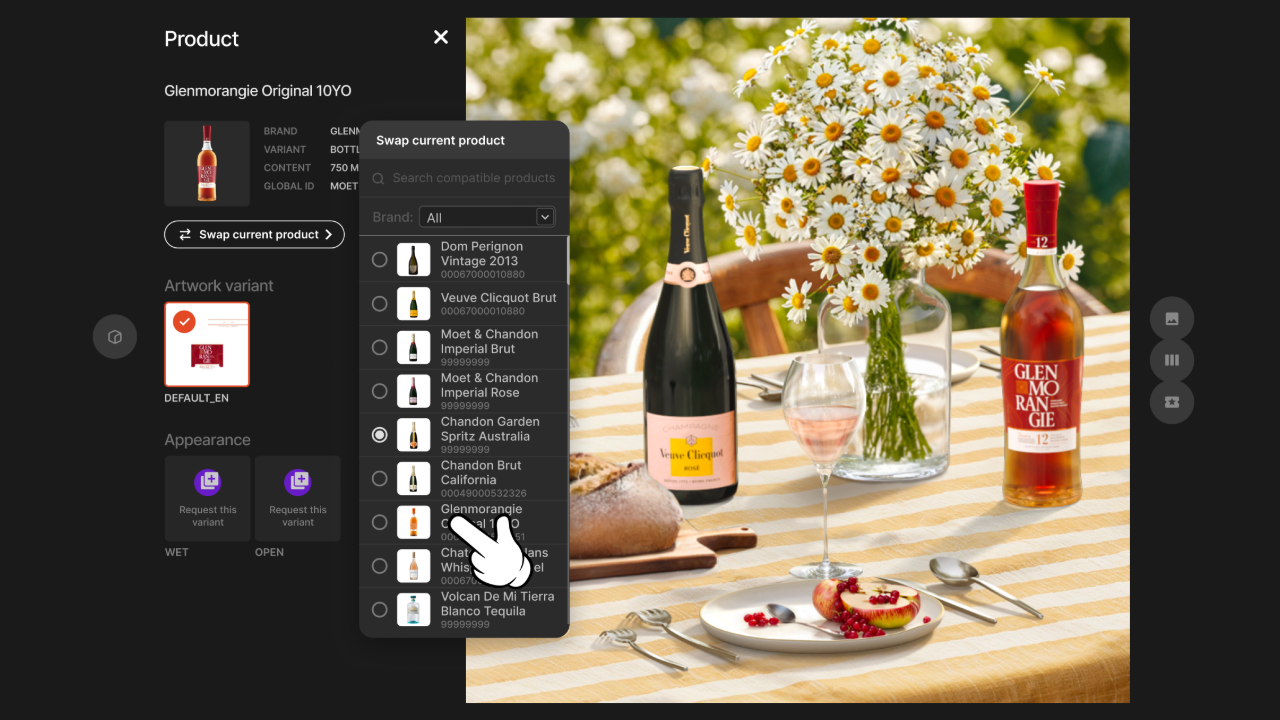
Grip is the enterprise automation platform for publishable marketing content at scale, built by INDG. It is where the split between global and local teams is applied in production. The elements the global brief fixes, such as brand codes, approved claims and art direction, are encoded as rules in its Brand Center, so markets work inside them without reopening each decision. Adaptations produces each market’s versions of a master asset, from Originals, a new campaign or an existing shoot, with the product on a locked layer of the template and the flexible elements changed within the limits the brief set. When a market needs a scene the global campaign doesn’t include, Originals generates it from a brief, grounded in the product’s digital twin and the Brand Center rules, so the new scene is on-brand by design. Digital Shelf supplies product page and e-commerce imagery produced from the twins as they are. The rules and the twins belong to the brand, so every campaign adds to a base the next one can use.
Where to start
Take your next global campaign and write its intent page before the creative is finished: one paragraph of purpose, a list of fixed elements and a list of flexible ones with their limits. Test it with two markets that differ a lot from each other, and note every question they ask. Each question shows a rule that is missing. For how the teams behind this are organized, read the guide to content operations, or talk to the Grip team about your campaigns.
Frequently asked questions
What is an example of localization in marketing?
Coca-Cola’s Share a Coke campaign kept the same idea and pack design worldwide but printed names chosen for each country, and used nicknames in China. McDonald’s in India kept its brand but sells no beef or pork and created the chicken-based Maharaja Mac.
How do you build a localization strategy for marketing campaigns?
Prioritize markets, break the campaign into its elements, write a global brief that states the intent and what is fixed, turn the fixed elements into rules, let markets adapt the rest, review exceptions rather than every asset, and measure results per market.
Should global brands standardize or adapt their marketing?
Research suggests both can improve performance, so the useful question is which elements to standardize and which to adapt. Many brands keep the brand idea, brand codes and approved claims global, and adapt casting, settings, language, offers and formats locally. This mix is often called glocalization.
Who should decide what gets localized, global or local teams?
Global teams should decide the intent and the fixed elements, such as the brand idea, brand codes, product depiction and approved claims. Local teams should decide how to execute within those limits, because they know the culture, the retailers and the customers.
References
- Theodore Levitt, “The Globalization of Markets,” Harvard Business Review, May 1983.
- John A. Quelch and Edward J. Hoff, “Customizing Global Marketing,” Harvard Business Review, May 1986.
- Vinicius A. Brei, Luciana D’Avila, Lucas F. Camargo and Jaap Engels, “The influence of adaptation and standardization of the marketing mix on performance: a meta-analysis,” Brazilian Administration Review 8 (3), 2011.
- Timo Mandler, Burcu Sezen, Jieke Chen and Ayşegül Özsomer, “Performance consequences of marketing standardization/adaptation: a systematic literature review and future research agenda,” Journal of Business Research 125, 2021.
- Marieke de Mooij and Geert Hofstede, “The Hofstede model: Applications to global branding and advertising strategy and research,” International Journal of Advertising 29 (1), 2010.
- European Commission, press release IP/11/556 on Flash Eurobarometer 313, “User language preferences online,” 11 May 2011.
- Shanine Chaudhry (Kantar), “Creating ads that travel #LikeABosch: Global campaign, made in Germany?”, 13 December 2023.
- U.S. Army, ADRP 6-0, Mission Command, Headquarters, Department of the Army, May 2012.
- U.S. Army, commander’s intent definition.
- Stephen Bungay, The Art of Action: How Leaders Close the Gaps between Plans, Actions and Results, Nicholas Brealey, 2011.
- CNBC, “Why HSBC chose to move on from being ‘the world’s local bank’,” 17 August 2016.
- The Coca-Cola Company, “How a Groundbreaking Campaign Got Its Start ‘Down Under’,” 25 September 2014.
- Nestlé, “KitKat.”
- NPR, transcript on KitKat in Japan.
- CNBC (AP), “McDonald’s goes meatless in India,” 4 September 2012.
About Grip
As INDG’s software branch, Grip is a visual content configuration engine powered by NVIDIA Omniverse that makes it possible for large enterprises to use AI at scale. It breaks existing content down into configurable modules, allowing brands to swap out any element, including products, talent, accessories, and branding assets, with complete control and accuracy. Grip integrates with existing workflows to automate product swaps and generate endless, hero-quality content variation, without disrupting established content production processes.