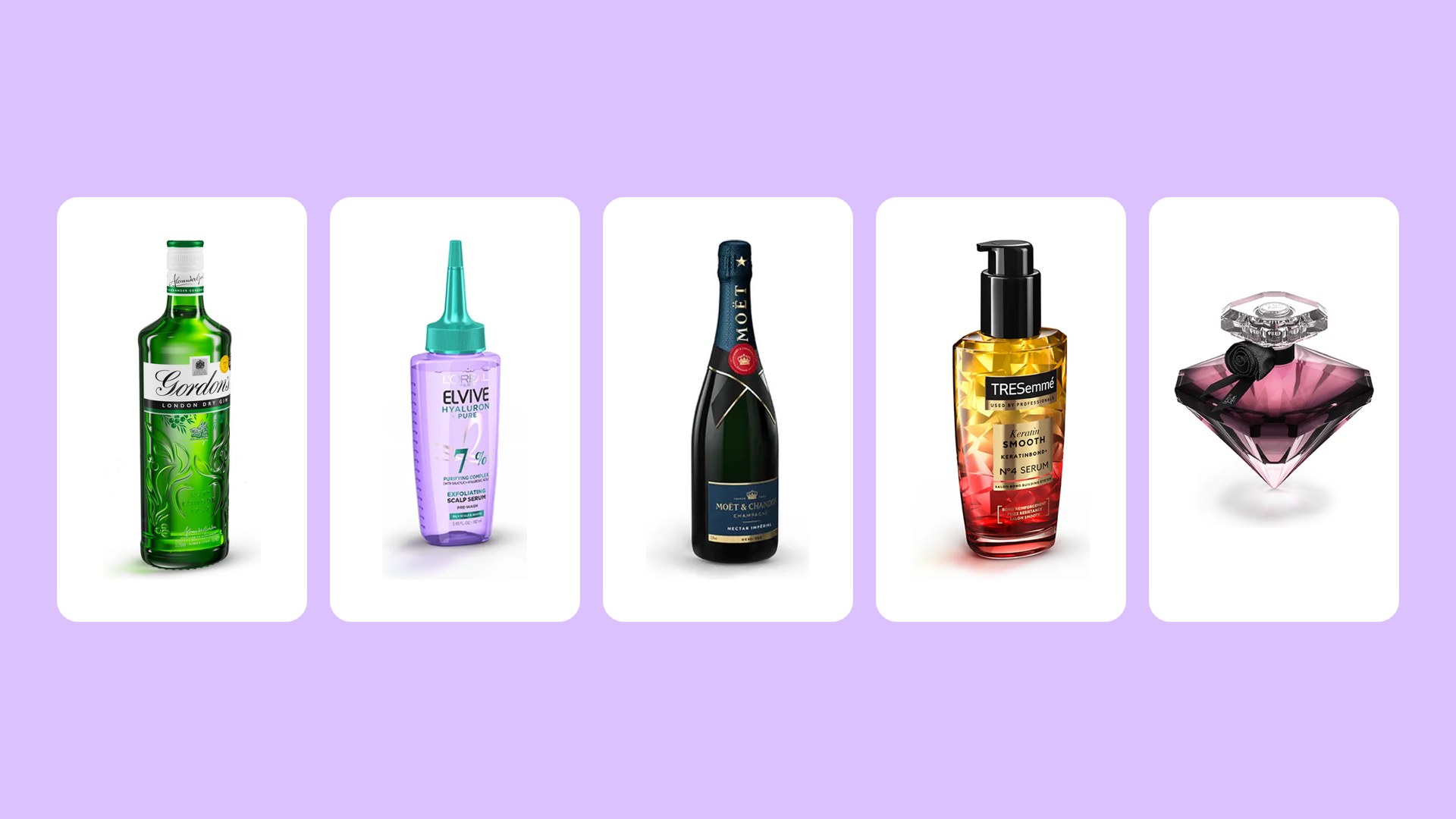
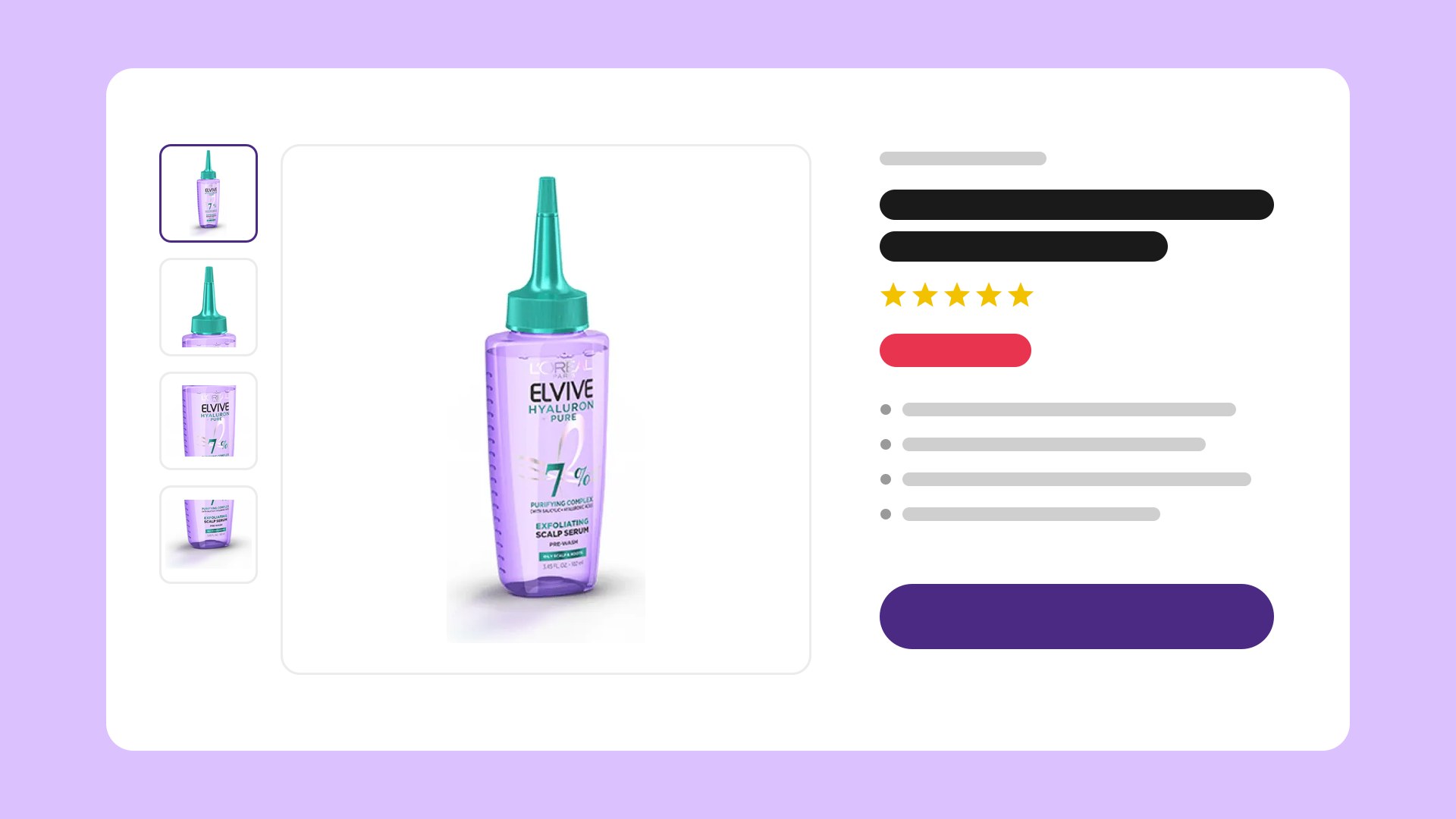
Ecommerce product images that convert


Ecommerce product images are the photos, computer-generated images, videos and 3D models that show a product on its product page, in search results, in marketplace listings and in shopping feeds. They are usually the first thing a shopper looks at. In Baymard Institute’s usability testing, 56% of users began their exploration of a product page with the images.
An image set that converts works like a sequence of answers. Before buying, shoppers want to know what the product is, how big it is, what is in it, what comes in the box, how it is used and whether it will suit them. Each image type answers one or two of those questions, and the questions differ by category. This guide covers the image types and the questions they answer, what the research says, 3D models for ecommerce, the technical specifications for product images on a website, the 2026 trends, and how to produce image sets across thousands of SKUs.
The questions an image set has to answer
| Shopper question | Image type | Typical examples |
|---|---|---|
| What is it? | Main image | Front packshot on white; a mobile ready hero image for small screens |
| How big is it? | Scale and dimensions | The product in a hand or next to a familiar object; a dimensions graphic |
| What does it look like up close? | Detail, texture and zoom | Fabric, finish, closure, label close-up |
| What is in it or on it? | Back of pack and information | Ingredients, nutrition panel, usage instructions, certification marks |
| What is included? | Contents | Accessories, refills, multipack contents |
| How is it used? | In use | Application, preparation, the product in action |
| Will it suit me or my space? | Lifestyle, on model, 3D and AR | The product in a setting, worn by a model, placed in the room |
| Is it as shown? | Reviewer photos and video | Customer images, short demonstrations |
GS1’s Product Image Standard uses a similar list for secondary images, including texture, detail, application or in-use, ambience or lifestyle, size comparison, nutrition label, ingredients, certification seals and preparation instructions. For the main image and packshot types, see packshots at scale.
What the research says about product images
Many product pages still leave some of these questions unanswered. In Baymard Institute’s benchmark of more than 155 e-commerce sites, last updated in March 2026, 37% of sites lacked images that show the product in scale, 23% lacked images of wearable products on a human model, and 63% did not let users browse the images that reviewers had uploaded. In earlier Baymard studies, 25% of sites fell short on image resolution or zoom, and 31% lacked an image of the accessories included with the product.
Academic studies add three points.
- Image quality affects demand. In a study of 7,423 Airbnb properties over 16 months, published in Management Science in 2022, Shunyuan Zhang and colleagues found that listings with photos taken by Airbnb’s professional photographers had about 8.98% higher occupancy. A study of eBay listings, presented at WSDM in 2014, found that images remain important against other selling factors, especially in categories where appearance matters.
- The first image carries the most weight. In a 2023 Management Science study of Airbnb listings, Li, Simchi-Levi, Wu and Zhu found that the cover image had a much larger effect than the other photos, and estimated that a listing switching to the best layout on its own would gain about 11% more bookings.
- More is not always better. In a field study of 3,658 property ads, Fabrice Larceneux and colleagues found that more photos lowered clicks and slowed sales for lower-range properties and made no difference for higher-range ones. In a 2021 Journal of Marketing study of a cosmetics retailer’s app, Yong-Chin Tan and colleagues found that augmented reality raised sales most where shoppers were least certain, such as for less popular brands, pricier items and customers new to the category.
Most of this evidence comes from listings and apps rather than consumer goods product pages, so read it as direction rather than a benchmark. Across the studies, the first image and the images that answer a shopper’s specific doubts matter most.
Plan image sets per category, not per SKU
Because the questions differ by category, the image set should be planned once per category and then applied to every SKU in it:
- Food and drink. Front pack, back of pack with nutrition and ingredients, the product prepared or served, the pack size against a hand or a glass, and multipack contents.
- Beauty and personal care. Front pack, texture swatch, application, before-and-after where claims allow, ingredients, and the product in a bathroom or handbag for scale.
- Household. Front pack, dosage or usage instructions, the product in use, refills and what is included.
- Spirits and wine. Front and back labels, the bottle at an angle to show the glass, the serve, and the gift pack where relevant.
- Apparel and accessories. On-model images, flat or detail shots of fabric and fastenings, and views from the back and side.
A category template sets the image types, their order, the angles, the light and the props, so every SKU in the category gets the same set. Baymard’s advice for teams that can’t cover every product is to start with key categories and best-sellers.
3D models for ecommerce
3D models let shoppers rotate and zoom a product and, on supported devices, place it in their own space with augmented reality. The formats are settling:
- glTF and GLB. glTF 2.0 is maintained by the Khronos Group and published as ISO/IEC 12113:2022. GLB is its single-file version and the format most web viewers use.
- USDZ. A packaged format defined in Pixar’s Universal Scene Description, used by Apple’s AR Quick Look and covered by the Alliance for OpenUSD’s Core Specification 1.0.
The platforms support them unevenly. Google Merchant Center accepts one glTF or GLB model per product, up to 15 MB, for eligible categories and countries. Google also generates spins from five or more product images for some US merchants and labels them as generated by Google. Amazon offers View in 3D and View in Your Room for eligible products. Shopify accepts GLB and USDZ files and converts between the two. Google’s open-source <model-viewer> web component shows 3D models on a brand’s own site and opens them in AR on phones.
Treat the headline uplift figures with care. Shopify said in 2022 that merchants adding 3D content saw a 94% conversion lift on average, but gave no sample, baseline or method, and its current 3D guide no longer cites the figure. The academic evidence on augmented reality points to real but uneven effects, largest where shoppers are uncertain.
A 3D model built for ecommerce is also a source of still images. GS1’s standard describes 3D models as digital twins from which product still shots can be extracted, so the same model can supply the packshots, the alternate angles and the AR view.
Technical requirements for product images on your website
On a brand’s own site, product images affect speed and search visibility as well as conversion:
- Formats. WebP and AVIF give smaller files than JPEG at similar quality and are supported by about 97% and 96% of browsers in use. The 2025 Web Almanac found that most of the largest images on pages are still JPEGs, about 57%.
- Page speed. The largest element on a page is an image on 76% of mobile pages, according to the same report, and about 17% of mobile pages lazy-load that image, which delays it. Google’s guidance is to reference the main image directly in the HTML, give it high fetch priority and not lazy-load it.
- Image search. Google indexes images in
<img>elements, not CSS backgrounds, and treats alt text as the most important image metadata, while descriptive file names give it light clues as well. - Structured data. Google’s merchant listing markup requires an image and recommends several, in 16:9, 4:3 and 1:1 ratios, of at least 50,000 pixels each.
- Shopping feeds. Google Merchant Center takes a main image, up to ten additional images and up to five lifestyle images per product, and recommends main images of 1,500 by 1,500 pixels.
Marketplaces and retailers set their own requirements on top. For one retailer’s rules in detail, see Amazon product image requirements.
Ecommerce product photography trends for 2026
- Visual search. Google said in October 2025 that Lens handles more than 25 billion visual searches a month, one in five of them commercial. Amazon’s Lens Live matches what a phone camera sees against its catalogue. Product images now need to be recognizable to software as well as to people.
- AI shopping assistants. Google’s Shopping Graph holds more than 60 billion product listings, and AI shopping features draw on their images and data. OpenAI’s product feed for ChatGPT requires an image for every product.
- Video on product pages. Amazon reported that product pages adding a first shoppable video saw 24% more sales on average in the first half of 2026. That is Amazon’s own figure, based on internal data.
- AI-generated lifestyle scenes. Generated settings around accurate product images are becoming common, with metadata and disclosure rules attached. AI product photography covers what is safe to generate and what isn’t.
- CGI and digital twins. In a 2024 study by Coresight Research with Nfinite, 68% of 190 brands and retailers in the US and Europe planned to invest in computer-generated imagery within a year.
Producing product image sets at SKU scale
The arithmetic of image sets is a common reason to automate. As an illustration, a range of 1,000 SKUs with a seven-image template needs 7,000 images, and every pack change, promotion or new market adds more. Many stores fall well short. A 2026 analysis by Nightjar, which sells AI product photography, of nearly 600,000 products in 1,000 Shopify stores found that the typical store shows four photos per product, and that in the average store 21% of products have only one.
Photographing each SKU for every image type repeats the same work for every product and every pack change. Generating the set from a digital twin of each product, with a category template that fixes the angles, light and props, repeats the template instead. The front pack, the back-of-pack, the detail shot, the scale image and the lifestyle scene then all come from one accurate source, so they agree with each other and with the current pack.
What it looks like in practice
The Coca-Cola Company has replaced traditional photography with digital twins across its digital shelf and e-commerce imagery, as it described with Grip at NVIDIA GTC in 2025. Beauty brands use Grip’s digital twins to show premium packaging accurately from every angle, and to change labels, textures and finishes without a reshoot.
Grip is the enterprise automation platform for publishable marketing content at scale, built by INDG. For ecommerce product images, it builds a digital twin of each SKU with OpenUSD and NVIDIA Omniverse, capturing its materials, dimensions and lighting. Digital Shelf generates hero shots, alternate views, rich media and promo variants from the twin, with art direction and retailer standards encoded in its Brand Center and applied by default, so every image in a category template looks as if it was shot together. Grip also combines photos, CGI, twins and stock into finished visuals, so existing shoots can sit alongside generated images. Every asset is validated against GS1, Amazon, Walmart and Carrefour requirements and delivered into the DAM, PIM and syndication workflows the brand already uses.
Where to start
Pick your best-selling category and write down the questions its shoppers ask before buying, using reviews, search terms and customer service logs. Map each question to an image type, set the order with the most important answer first, and compare the template with the images your top 20 SKUs have today. The gaps show which images to produce first. For how images fit into the rest of the page, read product detail page content, or talk to the Grip team.
Frequently asked questions
How many product images should an ecommerce product have?
Enough to answer the questions shoppers in that category ask before buying. Amazon recommends at least six images and a video, Walmart recommends at least four, and Google Merchant Center accepts a main image, up to ten additional images, up to five lifestyle images and a 3D model.
What types of product images do ecommerce sites need?
Most product pages need a main image on white, alternate angles, a scale or dimensions image, detail or texture shots, back-of-pack, ingredients or nutrition where relevant, an image of what is included, and lifestyle or in-use images. Wearables also need images on a model, and many categories benefit from video, 360 views or a 3D model.
What are 3D models for ecommerce?
3D models for ecommerce are digital models of a product that shoppers can rotate, zoom and, on supported devices, place in their own space with augmented reality. The common formats are glTF or GLB, maintained by Khronos, and USDZ, based on Pixar’s Universal Scene Description and used by Apple’s AR Quick Look. Google, Amazon and Shopify all support 3D models on product pages in some form.
What image format is best for ecommerce product images?
For web pages, WebP and AVIF give smaller files than JPEG at similar quality and are supported by most browsers. Retailers and marketplaces usually ask for JPEG or PNG uploads. Keep high-resolution masters, typically as TIFF, and generate the web and retailer formats from them.
What are the ecommerce product photography trends for 2026?
The main trends are visual search, with Google Lens handling more than 25 billion visual searches a month; AI shopping assistants that read product images and data; more video on product pages; AI-generated lifestyle scenes around accurate product images; and computer-generated imagery and 3D models built from digital twins.
References
- Baymard Institute, “All Products Need at Least One ‘In Scale’ Image (28% Get It Wrong),” 30 May 2017.
- Baymard Institute, “Product Page UX 2026: 10 Pitfalls and Best Practices,” updated 18 March 2026.
- Baymard Institute, “25% of E-Commerce Sites Don’t Have Product Images with Sufficient Resolution or Level of Zoom,” 2 April 2020.
- Baymard Institute, “PDP UX: Provide an ‘Included Accessories’ Image and Clarify That Optional Accessories Are Extra,” 19 February 2019.
- GS1, Product Image Standard.
- Shunyuan Zhang, Dokyun Lee, Param Vir Singh and Kannan Srinivasan, “What Makes a Good Image? Airbnb Demand Analytics Leveraging Interpretable Image Features,” Management Science 68(8), 2022.
- Wei Di, Neel Sundaresan, Robinson Piramuthu and Anurag Bhardwaj, “Is a picture really worth a thousand words? On the role of images in e-commerce,” WSDM 2014.
- Hanwei Li, David Simchi-Levi, Michelle Xiao Wu and Weiming Zhu, “Estimating and Exploiting the Impact of Photo Layout: A Structural Approach,” Management Science 69(9), 2023.
- Fabrice Larceneux, Marjolaine Bezançon and Thomas Lefebvre, study of photos in property ads, 2018.
- Yong-Chin Tan, Sandeep R. Chandukala and Srinivas K. Reddy, “Augmented Reality in Retail and Its Impact on Sales,” Journal of Marketing 86(1), 2022.
- Khronos Group, glTF.
- OpenUSD, USDZ file format specification.
- Alliance for OpenUSD, Core Specification 1.0.
- Apple Developer, AR Quick Look.
- Google Merchant Center Help, 3D model attribute (virtual_model_link).
- Google Merchant Center Help, AI-generated spins.
- Amazon, 3D and AR tools for sellers.
- Shopify Help Center, product media types.
- Google, model-viewer.
- Shopify changelog, on 3D and AR previews, 11 May 2022.
- Can I use, WebP.
- Can I use, AVIF.
- HTTP Archive, Web Almanac 2025, Performance chapter.
- web.dev, “Optimize Largest Contentful Paint.”
- Google Search Central, Google Images best practices.
- Google Search Central, merchant listing structured data.
- Google Merchant Center Help, additional image link.
- Google Merchant Center Help, image link.
- Google Merchant Center Help, lifestyle image link.
- Amazon Seller Central Europe forums, “Listings Lounge: Product Image Requirements,” Amazon staff post.
- Walmart Marketplace, “Product detail page: Image guidelines & requirements,” updated 12 May 2026.
- Google, on Google Lens and visual search, 23 October 2025.
- Amazon, “Amazon Lens Live.”
- Google, on agentic checkout and the Shopping Graph, 19 May 2026.
- OpenAI, product feed specification.
- Amazon, on product videos.
- Retail Dive, Nfinite and Coresight Research on enhanced product imagery, 18 January 2024.
- Nightjar, analysis of product images in 1,000 Shopify stores, 15 October 2026.
About Grip
As INDG’s software branch, Grip is a visual content configuration engine powered by NVIDIA Omniverse that makes it possible for large enterprises to use AI at scale. It breaks existing content down into configurable modules, allowing brands to swap out any element, including products, talent, accessories, and branding assets, with complete control and accuracy. Grip integrates with existing workflows to automate product swaps and generate endless, hero-quality content variation, without disrupting established content production processes.