Generative AI in marketing: brand-safe content at scale


Generative AI marketing is the use of AI models that create new content, such as text, images, video and audio, to produce marketing material. It covers drafting copy, generating and editing campaign and product imagery, producing video, localizing content for markets and creating personalized versions, and by late 2026 it is part of how most large marketing teams work.
The tools are widely shared. As Salesforce’s Bobby Jania put it when the company published its 2026 State of Marketing report, “Every marketer has access to the same AI models.” That makes a brand’s advantage depend on what it brings to the models: its actual products, its distinctive assets and its rules. This guide covers how generative AI is used in marketing today, why default output drifts toward the typical, what brand-safe generative AI requires, and how enterprise brands generate content at scale.
What is generative AI in marketing?
Generative AI models learn patterns from large collections of text, images, video or sound and generate new material in response to an input, usually a prompt, a reference image or structured data. Marketing uses four main kinds:
- Text models draft and adapt copy, product descriptions, emails, scripts and translations.
- Image models generate scenes and backgrounds, edit and extend photos, and create campaign and product visuals.
- Video models generate short clips, animate stills and extend footage to new formats.
- Audio models generate voice-overs, music and sound in many languages.
Generative AI differs from the predictive AI that marketing has used for years. Predictive models score, rank and forecast: which audience to target, which ad to show, which customer might churn. Generative models make the content those decisions are about. The two increasingly work together, for example when an ad platform tests generated variants against each other.
How marketers use generative AI in 2026
Adoption is broad and still rising. In McKinsey’s State of AI survey of 1,993 respondents, published in November 2025, 88% said their organizations used AI regularly in at least one business function, and marketing and sales has long been one of the functions where AI is used most. The 2026 edition of The CMO Survey, fielded in January 2026 and based on 308 US marketing leaders, found that the use of AI in marketing had more than tripled since 2022, and companies expected AI to be used in more than half of their marketing activities within three years.
Content creation leads. In a 2024 World Federation of Advertisers survey of 48 multinationals, 63% used generative AI in marketing and content creation was the most common use. Of the brands that used AI-generated content in their assets, 68% used it to alter or enhance real places, images or products. Legal risk was the most cited barrier to wider adoption, and 80% had concerns about how their agencies used generative AI. In video advertising, IAB reported in July 2026 that about two-thirds of video buyers were using generative AI for creative and expected it in about a third of their ad assets this year.
The most common uses of generative AI in marketing are:
- Copy and content drafting, from headlines and product descriptions to scripts and social posts.
- Image generation and editing, including backgrounds, scenes, retouching and extending images to new formats.
- Localization, adapting copy and visuals for markets and languages.
- Personalization, producing versions for segments, contexts and channels.
- Video and audio, from short social clips to voice-overs in many languages.
- Research and insight, summarizing reviews, studies and competitor material.
For a closer look at advertising specifically, including which tasks are mature and which are risky, see AI in advertising.
Same models, similar output
A growing body of research finds that generative AI raises the quality of individual work while making work from different people more alike.
- In a study published in Science Advances in 2024, Anil Doshi and Oliver Hauser asked 293 writers to write short stories, some with ideas from GPT-4. Access to up to five AI ideas made the stories more novel and more useful, as judged by 600 evaluators, with the largest gains for less creative writers. The stories written with AI ideas were also more similar to each other.
- In PNAS Nexus in 2024, Eric Zhou and Dokyun Lee studied more than 4 million artworks from over 50,000 users of an art-sharing platform. Artists who adopted text-to-image AI became 25% more productive and received more favorites per view, while the average novelty of the content and the visuals of their work declined.
- A 2026 meta-analysis by Alwin de Rooij and Michael Mose Biskjaer, covering 19 studies, found a small but significant homogenization effect, strongest in constrained idea-generation tasks.
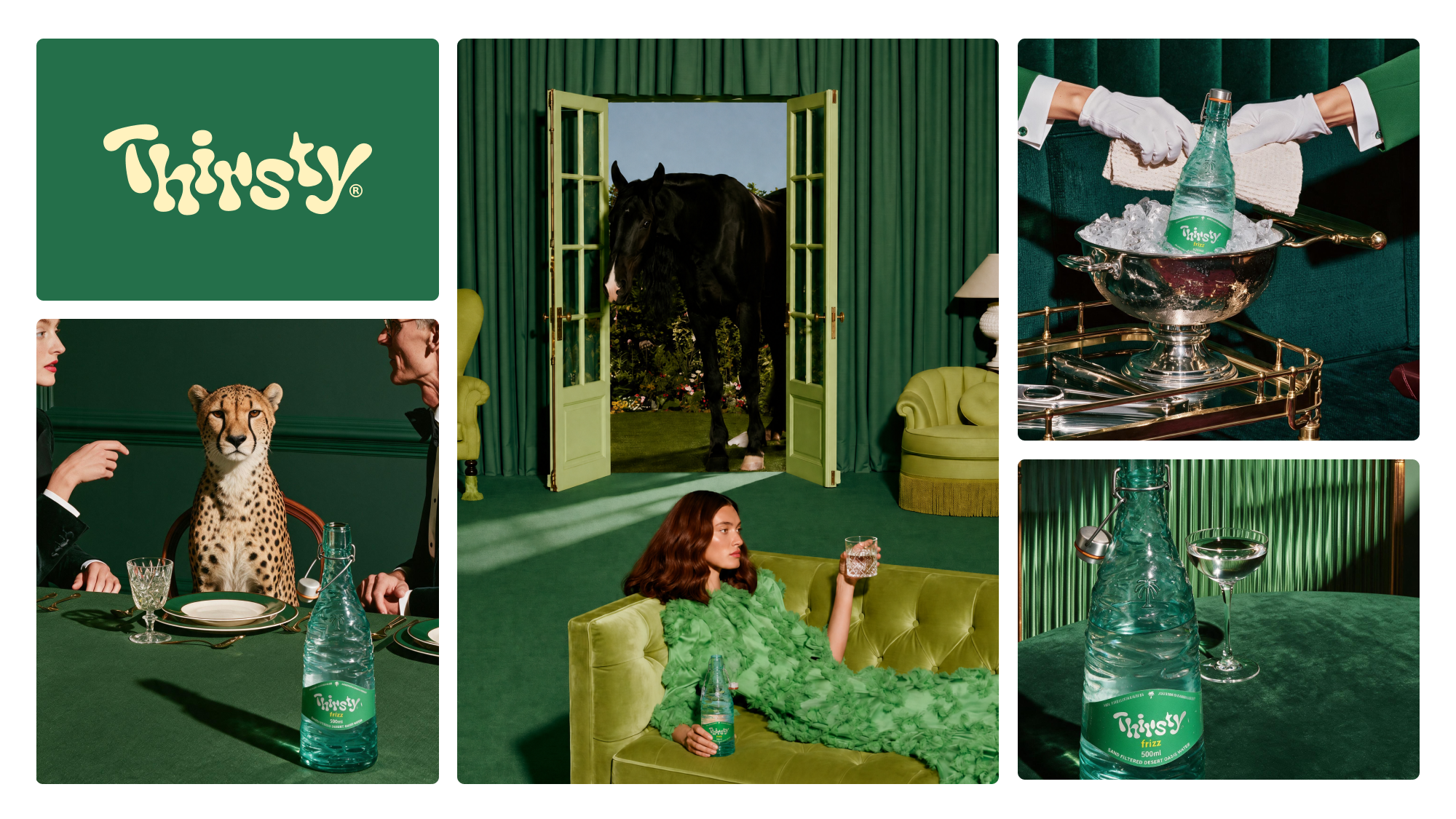
One explanation comes from how models are tuned. A 2025 preprint by researchers including Christopher Manning links the narrowing of model output to “typicality bias” in the human preference data used to fine-tune models, since people rating outputs tend to favor the familiar. Most of this research covers writing and art rather than advertising, so its application to brand content is an inference. It matches the pattern Grip describes for visual content in Everything goes grey, where soft light and stock compositions recur across brands that prompt the same models.
For brands, sameness is a cost. Jenni Romaniuk of the Ehrenberg-Bass Institute describes distinctive assets as sensory brand cues, visual or audio, such as shapes, colours, faces and words, that should contrast with their surroundings and are assessed on fame and uniqueness. In a study of 1,281 in-market brand elements across 13 consumer goods categories in 19 countries, Romaniuk and colleagues found that characters, logos and logotypes had the most potential for unique ownership, while colour was among the hardest to own because competitors share it. A model left to its defaults has no reason to reproduce any of these, so the brand has to supply them, along with the product itself.
What brand-safe generative AI means
Brand-safe generative AI is generative AI that produces publishable content without putting the brand’s product, identity, rights or reputation at risk. In practice that comes down to five properties.
| Property | What it protects against | How it is achieved |
|---|---|---|
| Product truth | A product that looks plausible but is wrong | Generating from digital twins or approved master assets |
| Brand rules | Off-brand, off-strategy or non-compliant content | Rules encoded once and applied at generation time |
| Rights | Copyright and trade mark claims | Models trained on licensed data, indemnities, the brand’s own assets |
| Disclosure and provenance | Breaches of AI transparency rules and platform policies | Required labels plus IPTC and C2PA metadata |
| Accountability | Errors no one owns | Named owners for rules and approvals, with the brand accountable for what is published |
Product truth
A model prompted for a product generates its idea of that product. For mood boards that is fine. For anything a shopper relies on, the product has to come from the brand’s own data, either a 3D digital twin or an approved photo, with AI generating the scene around it. The European Commission’s July 2026 guidelines on the AI Act give an AI-generated product image that could mislead about the product’s actual appearance as an example of a deepfake. AI product photography covers the methods in detail.
Brand rules applied at generation time
Brand guidelines written for people don’t translate well into prompts. They tend to be long and contextual, and much of what they ask for depends on judgment. Brand-safe generative AI encodes them as rules, covering art direction, composition, colour, claims, legal copy and market restrictions, and applies them while the content is generated. Rules applied during generation shape every asset from the start, whereas an AI check on finished output can only catch problems after the content exists.
Rights
In November 2025 the High Court in London dismissed Getty Images’ main remaining copyright claim against Stability AI. It ruled that a model which does not store or reproduce the training images is not an infringing copy, while finding limited, historic trade mark infringement where older model versions generated iStock and Getty Images watermarks. Getty was granted permission to appeal the copyright point on 16 December 2025, and the appeal is pending. In the US, the Copyright Office’s January 2025 report found that prompts alone do not give enough human control for the output to be protected, while human-authored material that remains perceptible in the output can be. Brand content built around the brand’s own assets is likely to be on firmer ground than content generated from prompts alone.
Model providers including Google, Microsoft and OpenAI offer IP indemnities for some enterprise products, and some image models are trained only on licensed data. These address copyright claims, and none of them covers a misleading depiction of the product.
Disclosure and provenance
In the EU, the AI Act’s transparency obligations under Article 50 have applied since 2 August 2026. Deepfakes must be disclosed, and generative AI systems already on the market before that date must mark their output as AI-generated in a machine-readable format by 2 December 2026. Platforms read provenance data in different ways. LinkedIn shows a C2PA icon on images and videos signed with Content Credentials, and TikTok says it has labelled more than 3 billion videos as AI-generated, using Content Credentials, creator labelling tools and its own invisible watermarking. Meta said in 2024 that it uses Content Credentials to inform its AI labels, but a test reported by IPTC in March 2026 found that Instagram appeared to read IPTC metadata but not C2PA, while LinkedIn read C2PA but not IPTC. Embedding both keeps the label consistent.
Accountability
The UK Advertising Standards Authority said in June 2026 that its existing rules apply however an ad is made and that using automated tools does not shift accountability. In March 2026 it upheld complaints against a WiggyDog ad for a robotic puppy toy, finding that scenes of what appeared to be real and/or AI-generated puppies exaggerated the product’s performance and characteristics. When the product comes from a digital twin and approved elements are locked in templates, a system can produce content that is correct by construction within its domain. The brand still keeps accountability, which means named owners for the rules, the templates and the approvals.
Generative AI content creation at enterprise scale
Prompting works for one asset at a time. Enterprise brands need thousands, for every product, market, channel and format, and the rules that make each asset correct differ between them. A prompt can’t carry all of that, and a person assembling the right context for each asset doesn’t scale. AI content generation at enterprise scale therefore depends on a system around the models, where product data, brand rules and market requirements are stored once and supplied to each generation step.
That system also has to outlast any single model. On the Arena text-to-image leaderboard in late October 2026, the top ten models came from six organizations, and new model versions keep entering at or near the top. Brands that keep their product data and rules in their own layer can use whichever model suits each task, and switch when a better one arrives, without rebuilding their workflows. Grip’s case for this approach is in There is no best AI model. But there’s something better.
Examples of generative AI in marketing
Published results show both the efficiency and the brand risk:
- Klarna said in May 2024 that it had produced more than 1,000 images with generative AI in the first quarter of that year and cut the time to develop images from six weeks to seven days (company figures).
- Disney agreed a $1 billion investment in OpenAI in December 2025 that included a three-year licence for more than 200 characters in OpenAI’s image and video tools, excluding talent likenesses and voices. It shows rights owners setting terms for generative use of their assets.
- Valentino’s AI-generated Instagram ads were labelled as AI and were still criticized in December 2025 as cheap and below luxury standards.
- Guess drew a backlash in August 2025 for an ad in Vogue that used AI-generated models.
Labelling did not protect Valentino, because the criticism was about quality and fit with the brand, which disclosure doesn’t address.
How to choose generative AI tools for marketing
The tools on the market range from general chat and image apps to enterprise platforms. For brand content at scale, ask:
- Where does the product come from? A digital twin or approved master asset, or the model’s interpretation of a prompt?
- Where do the brand rules live? Encoded in a system with a named owner and applied at generation time, or written into prompts?
- Which models can it use? Is it tied to one model, or can it use the best model for each task?
- What are the rights terms? Licensed training data, indemnities and their exclusions.
- Is provenance built in? Disclosure where required, with IPTC and C2PA metadata that survives export.
- Does it scale across the matrix? Products, markets, channels and formats in one run, with versions tracked.
- Does it connect? Integration with the DAM, PIM, artwork management and approval systems already in place.
What it looks like in practice
LVMH maisons Château Galoupet and Hublot are piloting Grip Originals, generating hero visuals and social variants grounded in the product and brand system, so the output is on-brand by design. LVMH’s head of AI, Olivier Marchand, described the aim as extending the life of an original campaign, for example so that a rosé campaign shot in summer can keep working through the year without losing the integrity of the original. Grip also integrates image models from Bria, which are trained on licensed data, for brands that need to know where a model’s training data came from.
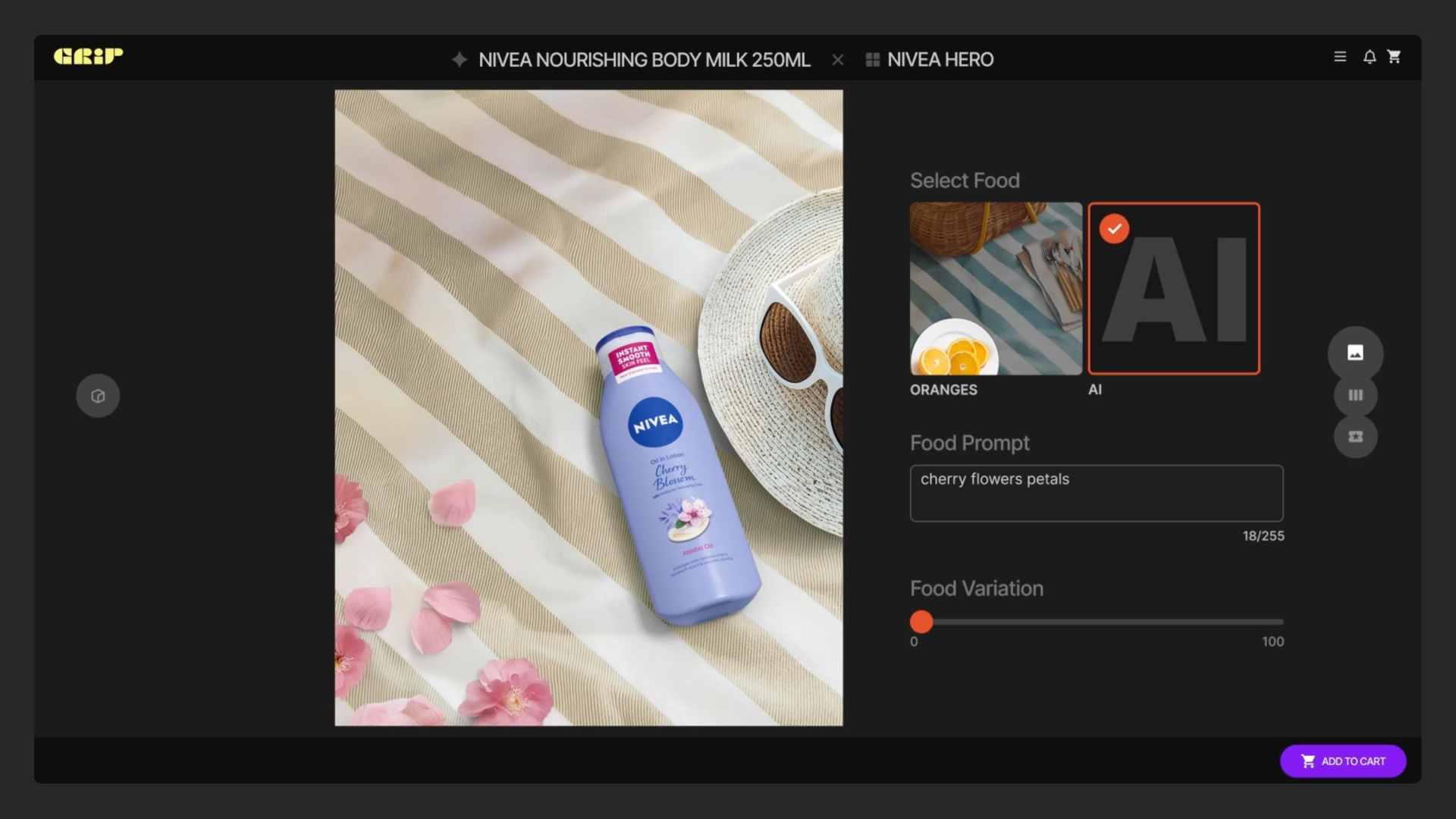
Grip is the enterprise automation platform for publishable marketing content at scale, built by INDG. It applies generative AI inside the brand’s own system. Art direction, brand and compliance rules are encoded in its Brand Center, and the Precision-AI control layer applies them at generation time across the models Grip uses, so brands are not tied to a single model. Originals creates new on-brand content from a brief without a physical shoot. Adaptations turns a master asset, from Originals, a new campaign or an existing shoot, into compliant variations across markets and formats. Digital Shelf generates product imagery from digital twins of the actual product, so the product in every image is the real one. The twins and rules belong to the brand, and each one added makes the next campaign faster to set up.
Where to start
List the content your team produced last quarter and mark where generative AI was used and what it was given: a prompt, reference images, or the brand’s product data and rules. For each type of content, write down which of the five brand-safe properties it met. The gaps show where to start, usually with the product data and the rules that are currently held in people’s heads. For how the wider production model changes, read content production at scale, or talk to the Grip team.
Frequently asked questions
How is generative AI used in marketing?
Marketers use generative AI to draft and adapt copy, generate and edit images and video, localize content, personalize campaigns, summarize research and answer customers. In a 2024 WFA survey of multinationals, content creation was the most common use, and most brands that used AI-generated content in their assets used it to alter or enhance real places, images or products.
What does brand-safe generative AI mean?
Brand-safe generative AI produces content that is grounded in the brand’s real product data, follows the brand’s rules, uses models and inputs the brand has the rights to, carries the required disclosure and provenance information, and leaves the brand accountable for what is published. Where the product itself has to be exact, it comes from a digital twin or an approved master rather than from generation.
Does generative AI make brands look the same?
It can. Several studies have found that AI-assisted work becomes more similar from person to person, even when individual quality improves. When brands prompt the same models without their own product data and brand rules, their content tends to drift toward the same visual and verbal defaults.
Can you copyright AI-generated marketing content?
In the US, the Copyright Office’s January 2025 report found that prompts alone do not give enough human control for the output to be protected, while human-authored material that remains perceptible in the output, or a creative selection and arrangement, can be. Rules differ by country. This is general information, not legal advice.
Do AI-generated marketing images need to be labeled?
It depends on the market, the content and the platform. In the EU, the AI Act requires deepfakes to be disclosed and generative AI systems to mark their output in a machine-readable format. Platforms such as Meta, LinkedIn and TikTok use Content Credentials or IPTC metadata to label AI content. This is general information, not legal advice.
References
- Salesforce, “State of Marketing,” 10th edition, news release, 19 February 2026.
- McKinsey & Company, “The state of AI in 2025: Agents, innovation, and transformation,” November 2025.
- The CMO Survey, “Marketing contracts under economic pressure despite growing value and AI gains,” 31 March 2026.
- World Federation of Advertisers, “Eighty percent of brands have concerns about agency use of GenAI,” 17 September 2024.
- IAB, 2026 Digital Video Ad Spend & Strategy report, news release, 14 July 2026.
- Anil R. Doshi and Oliver P. Hauser, “Generative AI enhances individual creativity but reduces the collective diversity of novel content,” Science Advances 10(28), 2024.
- Eric Zhou and Dokyun Lee, “Generative artificial intelligence, human creativity, and art,” PNAS Nexus 3(3), 2024.
- Alwin de Rooij and Michael Mose Biskjaer, “Generative AI makes creative output more homogeneous,” ECCE 2026.
- Alwin de Rooij and Michael Mose Biskjaer, “Does generative AI make us think alike? A systematic review and meta-analysis,” Behaviour & Information Technology, 2026.
- Jiayi Zhang et al., preprint on typicality bias and mode collapse in aligned language models, 2025.
- Jenni Romaniuk, “Brands need distinctive assets,” Ehrenberg-Bass Institute.
- Ella Ward, Song Yang, Jenni Romaniuk and Virginia Beal, “Building a unique brand identity: measuring the relative ownership potential of brand identity element types,” Journal of Brand Management 27(4), 2020.
- European Commission, guidelines on the transparency obligations for providers and deployers of AI systems, July 2026.
- Getty Images v Stability AI [2025] EWHC 2863 (Ch), 4 November 2025.
- Getty Images v Stability AI [2025] EWHC 3343 (Ch), permission to appeal, 16 December 2025.
- Simmons & Simmons, “AI and copyright in the UK: where are we now and what is to come,” 14 January 2026.
- US Copyright Office, “Copyright and Artificial Intelligence, Part 2: Copyrightability,” 29 January 2025.
- Google Cloud, “Protecting customers with generative AI indemnification,” 13 October 2023.
- Microsoft, “Microsoft announces new Copilot Copyright Commitment for customers,” 7 September 2023.
- Pillsbury, on OpenAI’s Copyright Shield indemnity, November 2023.
- European Commission, “Quick facts: transparency rules for AI systems.”
- LinkedIn Help, Content Credentials on LinkedIn.
- TikTok, “Helping people spot and understand AI-generated content on TikTok,” 10 July 2026.
- C2PA, “C2PA welcomes TikTok to Steering Committee,” 27 July 2026.
- Linux Foundation, “Meta joins the C2PA Steering Committee,” 5 September 2024.
- IPTC, “AI disclosure on social media: a work in progress,” 18 March 2026.
- Lewis Silkin, on the ASA’s guidance on AI-generated content and deepfakes, 18 June 2026.
- Advertising Standards Authority, ruling on UAB Commercecore (WiggyDog), 25 March 2026.
- Arena, text-to-image leaderboard.
- Marketing Dive, on Klarna’s use of generative AI to cut marketing costs, 29 May 2024.
- CNN via KVIA, “Disney is investing $1 billion in OpenAI and licensing its characters for Sora,” 11 December 2025.
- City AM, on Valentino’s AI-generated ads, 2 December 2025.
- ABC7 News, on Guess’s AI-generated models in Vogue, 1 August 2025.
About Grip
As INDG’s software branch, Grip is a visual content configuration engine powered by NVIDIA Omniverse that makes it possible for large enterprises to use AI at scale. It breaks existing content down into configurable modules, allowing brands to swap out any element, including products, talent, accessories, and branding assets, with complete control and accuracy. Grip integrates with existing workflows to automate product swaps and generate endless, hero-quality content variation, without disrupting established content production processes.